

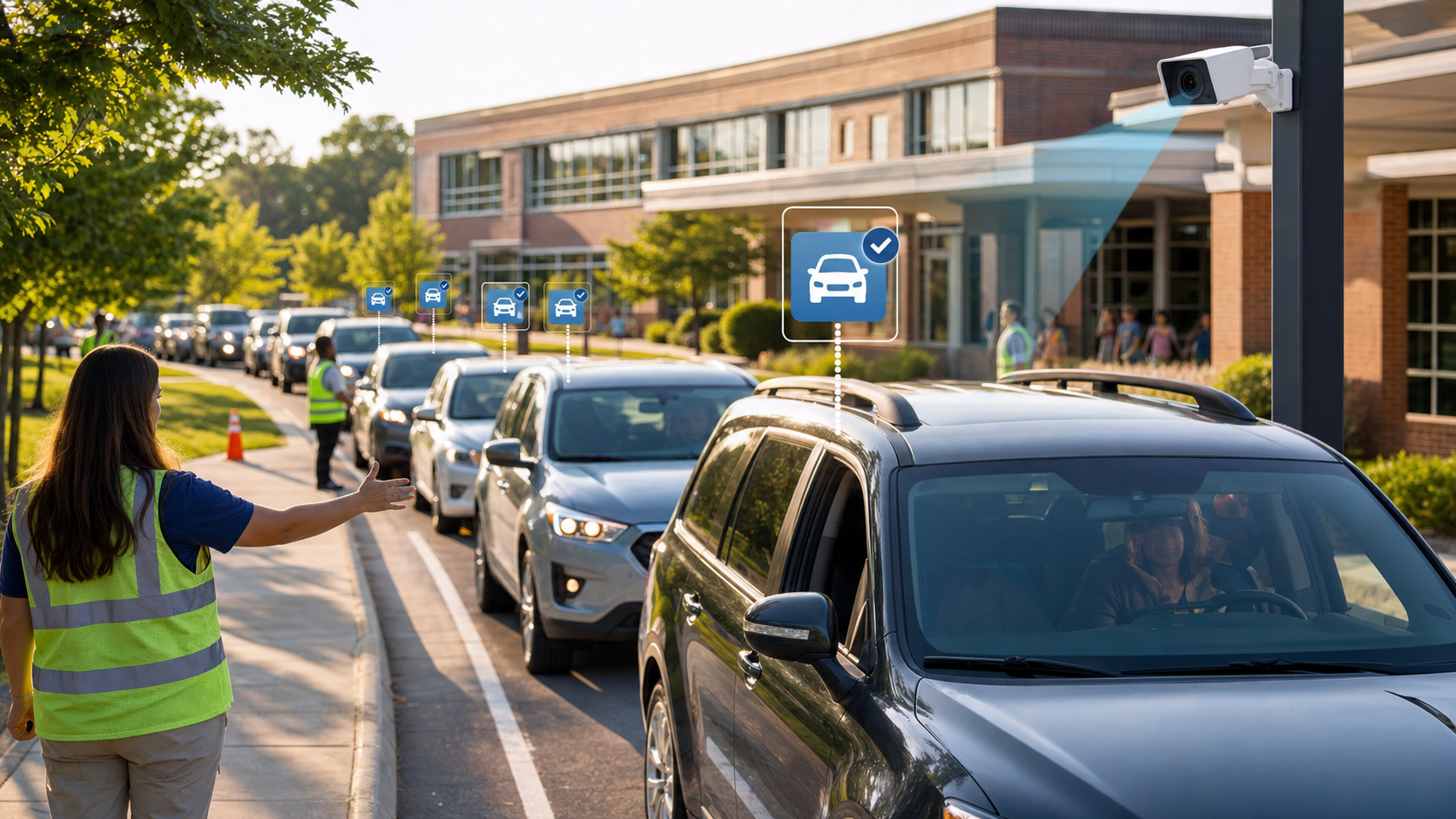
school carline takes too long
If your school carline takes 45 minutes, the problem isn’t the number of cars. It’s the bottleneck at the front — where a staff member is identifying cars, calling names on a radio, and waiting for students to arrive before the next car can pull up. This guide explains exactly why it happens and what actually fixes it.
Why Your Carline Takes So Long
Most school carlines operate on a simple but deeply inefficient sequence:
- Car pulls to the front
- Staff reads a placard or identifies the car
- Staff radios or calls the student’s name
- Student walks from building to car (1–3 minutes)
- Next car pulls up
The bottleneck is step 4. Every car idles at the front while the student walks out. With 300 students and an average 90-second loading time per car, that’s 450 minutes — 7.5 hours of sequential processing. Schools compress this by staggering grades and pulling multiple students simultaneously, but the fundamental problem remains: students aren’t ready before the car arrives.
The 7 Most Common Carline Killers
1. Students called after the car arrives
The single biggest delay. When staff identify the car at the curb and then call the student, the student is still in the classroom. The car waits 2–4 minutes while other cars queue behind it.
2. Last-minute dismissal changes
10% of students have plan changes on any given day (SchoolPass, 2024). Each change requires a note, a phone call, or a teacher update — any of which can stall the line when the car arrives and staff aren’t sure where the student is going.
3. Unrecognized vehicles
Grandparent uses a different car, parent borrowed a friend’s vehicle, rideshare pickup — staff can’t identify the vehicle and must verify the driver’s identity before releasing the student. This can take 3–5 minutes per incident.
4. Multiple students per family in different grades
Parents with children in different grades wait until both students are released. Staff must coordinate across grade monitors, adding time to every multi-sibling pickup.
5. Insufficient staging space
Short carlines that can’t accommodate peak volume cause overflow onto adjacent streets, creating traffic hazards and pressure that forces staff to rush — increasing errors.
6. Weather and visibility
Rain makes placard reading harder. Glare makes windshields difficult to see through. Any reduction in staff identification speed adds seconds per car that compound across hundreds of pickups.
7. No pre-queuing of students
Without advance notice that a specific car is entering the queue, students aren’t staged near the door. They’re in classrooms, libraries, or after-school programs — requiring retrieval time that holds up the entire line.
Solutions That Actually Work
Short-term fixes (immediate, no technology)
- Stagger dismissal by grade: Release grades 30 minutes apart to spread peak volume
- Assign dedicated car puller: One staff member’s only job is pulling cars forward — prevents the line from stalling when the front spot is occupied
- Pre-stage students near the exit: Move students to a staging area 10 minutes before their expected pickup window
- Double-lane loading: Two parallel loading spots instead of one cuts throughput time in half
Medium-term: App-based dismissal management
Apps like PikMyKid, PickUp Patrol, and DashPass digitize the change-management problem — parents submit changes via app, staff are notified on devices, and the dismissal list updates in real time. These reduce error from last-minute changes but don’t solve the core delay: students still aren’t pre-queued until the car is spotted at the curb.
Long-term: License Plate Recognition
LPR-based systems like PLACA.AI LineCam read approaching plates before cars reach the front of the line — typically 3–15 car-lengths back. The system matches the plate to the student roster and queues the student while the car is still waiting in line. By the time the car reaches the front, the student is already at the door.
| Method | Addresses Last-Minute Changes | Pre-Queues Students | Staff Required | Dismissal Time |
|---|---|---|---|---|
| Manual (clipboard) | No | No | 2–3 | 25–45 min |
| App only (PikMyKid) | Yes | No | 2 | 15–25 min |
| PLACA.AI LineCam | Yes | Yes | 1 | 10–15 min |
How to Implement LPR in Your School Carline
-
Audit your current bottleneck
Time your dismissal for 3 days. Note where delays occur: Is it student retrieval time? Change management? Car identification? The fix depends on the bottleneck.
-
Select and deploy your camera
PLACA.AI’s LineCam is solar-powered and 4G LTE connected — mount it at the carline entrance on a pole or wall. Installation takes under 2 hours. No wiring, no electrician.
-
Upload your student roster and authorized vehicles
Import your student list and link each student to their authorized pickup vehicles. The PLACA.AI dashboard accepts CSV imports from most SIS systems.
-
Train staff on the dashboard
Staff training takes 30–60 minutes. The interface shows which students are queued, which cars are in line, and any unrecognized vehicles — all in real time on a tablet or laptop.
-
Run a grade-level pilot
Start with one grade for the first week. Measure dismissal time, staff feedback, and parent experience. Expand to the full school once the workflow is proven.
Frequently Asked Questions
How much faster does LPR make carline dismissal?
Schools using PLACA.AI LineCam typically reduce dismissal from 25–45 minutes to 10–15 minutes. The key improvement is pre-queuing: students are walking to the pickup zone while their car is still 5–10 spots back in line, eliminating the 2–4 minute wait at the curb per vehicle.
What if a parent uses a different car than registered?
The system flags the unrecognized vehicle and alerts the staff member managing dismissal. Staff follow your school’s standard unauthorized vehicle protocol — typically ID verification before releasing the student. The student is never released automatically without staff confirmation.
Do parents need to do anything differently?
Parents register their vehicle plates in a simple portal during school enrollment or onboarding. After that, dismissal is invisible to them — they drive in, the system recognizes their plate, and their child is waiting when they reach the front. No app to open, no placard to display.
What is the cost to implement LPR at a school?
PLACA.AI’s school plans start at $5,800/year for schools with up to 250 students (1 LineCam included). This covers hardware, installation, 4G data, software, and support. Year 2+ renews at 60% of Year 1. Most schools recover the full cost in labor savings within the first semester.
Cut Your Carline Time in Half
30-day free pilot available. See LineCam working in your pickup line before committing to a full year.
Related Resources
Talk to PLACA.AI
Need help choosing the right LPR workflow?
Send your property, parking, or access-control question through the PLACA.AI contact form. Dr. Suhayb and the team can help map the right camera, software, and enforcement setup.
Internal Resources
- Vehicle-Based School Dismissal Workflows: A Guide for Transportation & Operations Teams
- How Elementary School Leaders Can Shorten Pickup Line Delays With Better Vehicle-Based Workflows
Related Resources
Data reference: National Center for Education Statistics – School Enrollment Data