

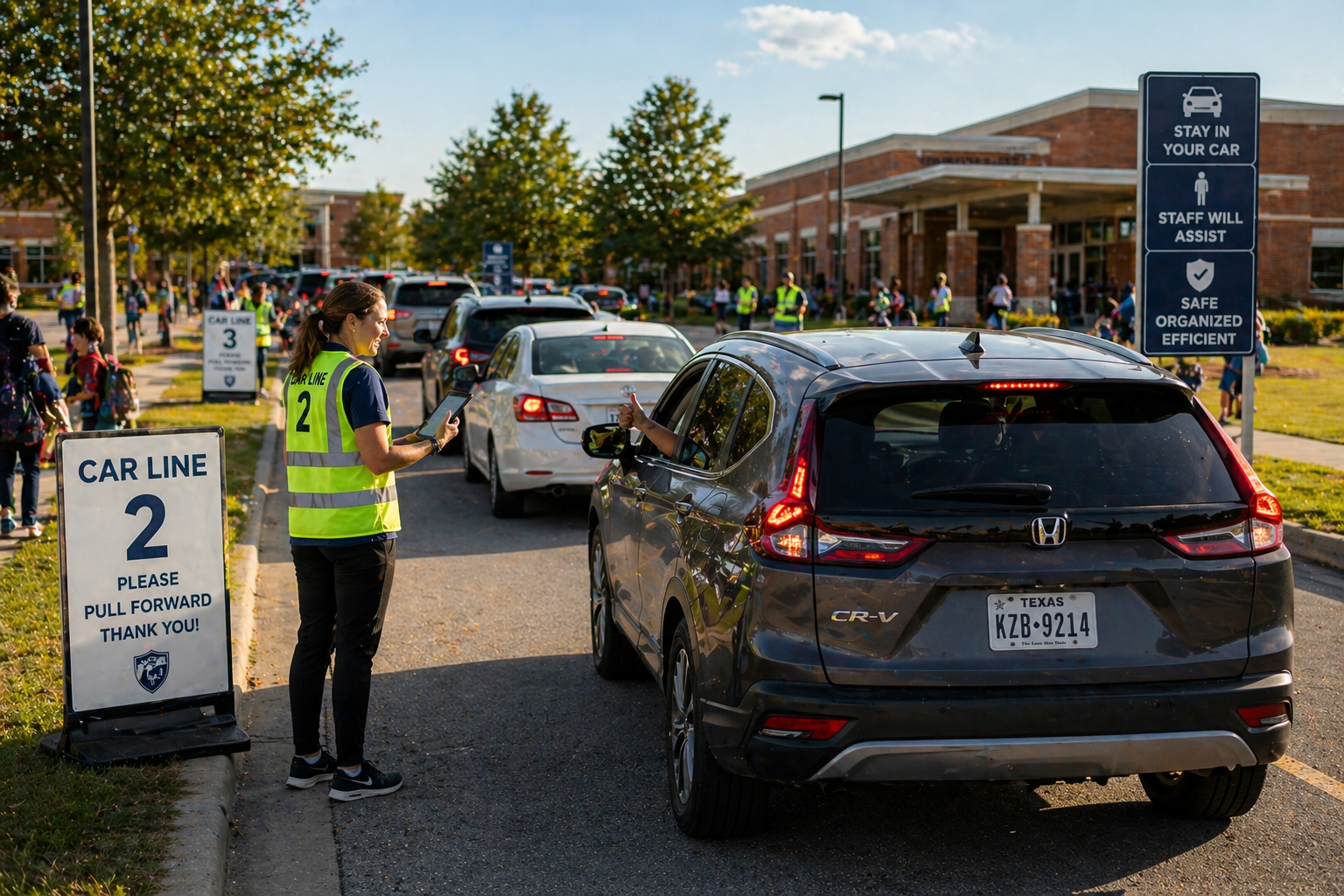
fix school pickup line traffic
Fixing a broken pickup line isn’t primarily a technology problem – it’s a process problem. Technology accelerates the fix, but only once you understand what the process should be. Here are five steps schools can implement in sequence. Each improves outcomes independently. Together, they transform pickup from a daily crisis into a predictable, safe, staff-light operation.
Step 1: Map Your Current Traffic Flow (Honestly)
Stand at your pickup zone with a stopwatch for three consecutive sessions. Record when the first car arrives, when the last clears, average time per student release, where vehicles queue when the line backs up, and how many staff are required. Most schools doing this for the first time are surprised – the 20-minute window is often 45. You cannot optimize what you haven’t measured.
Step 2: Remove Every Manual Step You Can
Manual steps are failure points. Audit your process for touchpoints that can be removed:
- Name card checking: removable with LPR or QR registration
- Staff radio communication: reduceable with digital notifications
- Paper sign-in logs: replaceable with digital records
- Parent queuing by arrival: restructurable with sequenced dispatch
For each manual step, ask: What would need to be true for this to happen automatically?
Step 3: Implement Vehicle Identification at the Perimeter
The single highest-leverage intervention is knowing which vehicles are approaching before they reach the pickup point.
- Basic: Parents pre-register plates; staff check against a list manually
- Intermediate: QR code check-in via parent app on arrival
- Advanced: LPR cameras detect and match plates automatically – no parent action required
A 90-second warning is the difference between a student ready at the curb and a student being called from the classroom when the car arrives. PLACA.AI operates at the advanced level: fully automatic, real-time.
Step 4: Notify Staff and Stage Students Before the Car Arrives
The core of any efficient pickup system is this sequence: Vehicle identified – Student staged – Car arrives – Release – Car departs.
Most schools run the reverse: car arrives, staff identify student, student is located, student walks to car, then release. The car waits through the entire process. Flipping the sequence eliminates most wait time. PLACA.AI sends a notification the moment a registered vehicle enters the detection zone – typically 60-120 seconds before it reaches the pickup point.
Step 5: Optimize Queue Sequencing Continuously
A system that logs every vehicle arrival time, release time, and position creates a dataset revealing peak arrival windows, bottleneck positions, and staff coverage gaps. Use this data monthly to adjust process. Pickup optimization isn’t a one-time installation – it’s an ongoing improvement loop that compounds each semester.
What Full Implementation Looks Like
A school running all five steps with PLACA.AI handling steps 3 and 4 automatically typically sees:
- Pickup time reduced from 40-50 minutes to 15-20 minutes
- Staff reduced from 3-4 dedicated personnel to 1-2
- Zero manual check-in required from parents
- Full digital audit trail for every dismissal
Want to see what Step 3 looks like in your specific lot?
Request a PLACA.AI site assessment
Related Reading: Why Pickup Lines Are Chaotic | Manual vs Automated Systems | What Is LPR for Schools?
Talk to PLACA.AI
Need help choosing the right LPR workflow?
Send your property, parking, or access-control question through the PLACA.AI contact form. Dr. Suhayb and the team can help map the right camera, software, and enforcement setup.
Data reference: National Center for Education Statistics
Elementary Pickup Traffic Practices
If traffic is the main concern, these best practices for elementary school pickup lines help translate carline fixes into an elementary-school routine.