


AI license plate recognition is software that uses computer vision to detect a vehicle license plate and optical character recognition (OCR) to read the plate number. Modern AI LPR systems can verify vehicles against an access list, open gates, log entry events, send alerts, and support parking enforcement workflows in real time.
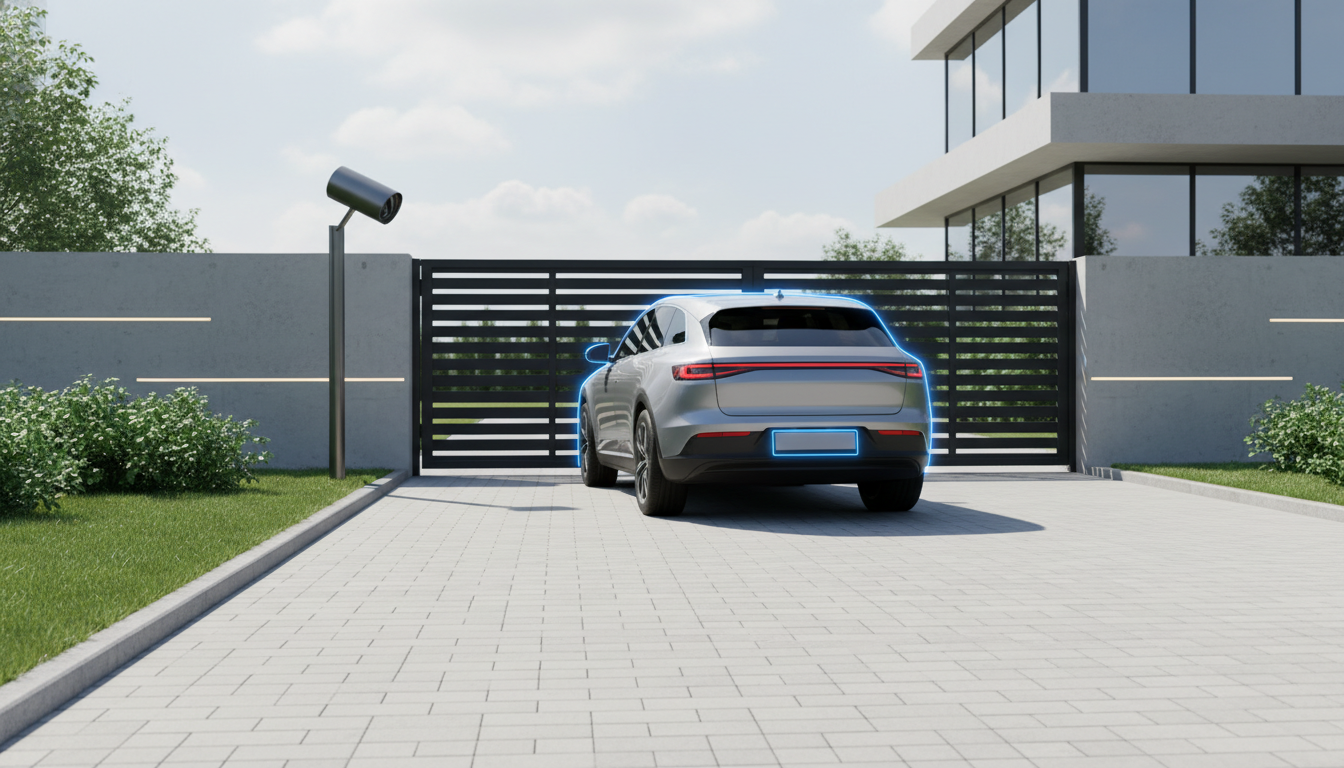
License plate recognition (LPR) technology has moved from police cruisers to parking lots, school pickup lines, HOA gates, and apartment complexes. This guide explains exactly how LPR works, where it delivers the most value, what to look for when buying a system, and how much it costs — with real data from industry sources.
Table of Contents
- What is License Plate Recognition (LPR)?
- How LPR Technology Works
- LPR Use Cases by Industry
- How to Choose an LPR System
- LPR Accuracy: What to Expect
- Privacy & Legal Considerations
- LPR Cost & ROI
- Frequently Asked Questions
1. What is License Plate Recognition (LPR)?
License plate recognition (LPR) — also called automatic number plate recognition (ANPR) or automated license plate reader (ALPR) — is an AI-powered imaging technology that reads vehicle license plates from camera footage, matches them against databases in real time, and triggers automated actions such as alerts, gate openings, or enforcement flags.
Modern LPR systems capture not just the plate number but also vehicle make, model, color, and direction of travel — creating a complete vehicle fingerprint in milliseconds.
2. How LPR Technology Works
Every LPR system — regardless of brand — follows the same core process:
Trigger
A vehicle enters the camera’s field of view. Modern systems use radar, infrared, or AI motion detection to trigger capture only when a vehicle is present, reducing false reads.
Image capture
The camera captures a high-resolution image of the rear (and sometimes front) of the vehicle. Infrared illumination ensures readability at night and in adverse weather.
OCR processing
Optical character recognition (OCR) software isolates the plate region, corrects for angle and distortion, and extracts the plate number. AI models trained on millions of plates handle non-standard fonts, dirt, and partial obstruction.
Database lookup
The extracted plate is checked against one or more databases — permit lists, watchlists, stolen vehicle registries, or violation records — in real time, typically within 500ms.
Action
Based on the match result, the system triggers an action: open a gate, send an alert, log a violation, or flag for enforcement. All events are stored in the cloud with timestamps and photo evidence.
3. LPR Use Cases by Industry
HOA & Residential Communities
With 373,000 community associations in the US (CAI Foundation, 2025), parking enforcement is the single most common source of resident complaints — the #1 issue raised at HOA annual meetings according to the Community Associations Institute. LPR automates guest tracking, unauthorized vehicle alerts, and incident investigation without requiring permanent staff at the entrance.
School Student Pickup & Dismissal
With 54.1 million K-12 students in the US (US Census Bureau, 2024), school dismissal is one of the most logistically complex daily operations in public infrastructure. LPR cameras like PLACA.AI’s LineCam automate the entire process — scanning approaching plates, matching them to the student roster, and queuing dismissal automatically — reducing staff requirements and eliminating unauthorized pickup risk.
Apartment & Gate Access Control
LPR replaces keycards, fobs, and stickers with automatic plate-based entry. Residents simply drive up and the gate opens. Guest and vendor access is managed via pre-registration in a mobile app. Unauthorized vehicles trigger instant alerts to property management.
Parking Enforcement
US cities collectively collect over $1.4 billion in parking ticket revenue annually from 16 major metros alone (Motor1 / Municipal Data, 2019). Private property managers use LPR to enforce permit programs, detect time-limit violations, and document incidents — capturing violations that manual drive-throughs routinely miss. Active LPR enforcement reduces parking violations by 60–80% within 30 days of deployment (HOA Management Research, 2024).
Towing & Private Property Enforcement
Approximately 20 million vehicles are towed annually in the US (Towing Industry Statistics, 2025). LPR gives towing operators documented, timestamped evidence for every tow — reducing disputes and liability. On private property, continuous scanning catches violations that periodic patrols miss, recovering 5–10% of annual revenue that leaks through undetected fraud and unauthorized parking (HONK, 2024).
Storage Facilities & Commercial Lots
LPR logs every vehicle entering and exiting storage facilities and commercial parking lots, enabling automated billing, access control, and security investigation without on-site staff.
| Industry | Primary Use | Key Benefit |
|---|---|---|
| HOA / Residential | Guest tracking, unauthorized vehicle alerts | Eliminates parking disputes |
| Schools (K-12) | Automated student dismissal | Reduces staff, improves safety |
| Apartments / Gates | Resident access, visitor management | Replaces keycards and fobs |
| Parking enforcement | Permit validation, violation detection | 60–80% fewer violations |
| Towing / private property | Violation documentation, patrol automation | Dispute-proof evidence |
| Storage / commercial lots | Access control, billing automation | Reduced staffing costs |
4. How to Choose an LPR System
Not all LPR systems are equal. Here are the five criteria that matter most:
Camera power and connectivity
Traditional LPR cameras require power cabling and ethernet or Wi-Fi — adding $500–$2,000 per camera in installation costs. Solar-powered, 4G LTE cameras like PLACA.AI’s GuardCam, GateCam, and LineCam install wire-free anywhere in under an hour, with no IT infrastructure required.
Camera ownership vs. subscription lock-in
Some vendors use a camera lease, while software-only products require you to supply compatible cameras and site infrastructure. With PLACA.AI, you buy the camera once and own it outright; the solar panel and battery are included, and the camera has a 2-year hardware warranty. Ongoing service is $99/month for software plus $45/month for unlimited cellular data per camera.
Per-camera vs. flat subscription pricing
Rekor Scout is a software-only option whose headline subscription does not include compatible cameras, site power, networking, local compute, installation, storage, or support. PLACA.AI pricing separates the customer-owned $1,399 solar camera from $99/month software and $45/month unlimited cellular data, with no per-scan fees.
Works with existing cameras
PLACA.AI works with any RTSP or ONVIF-compatible IP camera at 720p or higher. This means you can connect your existing security cameras immediately, without buying new hardware.
Cloud storage and data retention
Choose a plan based on how far back you need to investigate incidents. 7 days is sufficient for routine enforcement; 30 days is recommended for communities that need to document recurring violators or support legal proceedings.
| Criterion | PLACA.AI | Flock Safety | Rekor Scout |
|---|---|---|---|
| Hardware ownership | You own it | Lease only | Bring your own |
| Solar + 4G wireless | Yes — built in | Yes — built in | Depends on supplied hardware |
| Pricing model | Owned hardware + software + unlimited data | Per-camera annual lease | Software only; infrastructure separate |
| Works with existing cameras | Yes — any RTSP/ONVIF | No — proprietary only | Yes |
| Contract required | No — month-to-month | Yes — annual | No |
5. LPR Accuracy: What to Expect
Modern commercial LPR systems achieve 95–98% accuracy in controlled benchmarks (OpenALPR, 2024). Real-world accuracy depends on:
- Camera placement: Cameras should be mounted at a shallow angle (15–30 degrees) to the plate, not head-on
- Lighting: Infrared illumination is essential for reliable night reads
- Plate condition: Dirty, obscured, or custom-font plates reduce accuracy
- Vehicle speed: Radar-triggered systems capture plates more reliably than motion-only triggers at speeds above 15 mph
- AI model training: Systems trained on the specific plate formats for your state or country perform significantly better
6. Privacy & Legal Considerations
LPR collects vehicle movement data, which is subject to varying regulations by state and use case. Key considerations:
- Data retention limits: Some states restrict how long plate data can be stored. Most private property deployments retain 7–90 days of data.
- Notice requirements: Many jurisdictions require visible signage notifying drivers that LPR is in use on the property.
- Immigration enforcement: PLACA.AI explicitly prohibits use of its platform for immigration enforcement, in line with civil rights best practices.
- GDPR / CCPA: If your community includes California residents or EU nationals, consult legal counsel on applicable data privacy obligations.
7. LPR Cost & ROI
LPR deployments typically pay for themselves within 3–12 months through a combination of direct savings and recovered revenue:
| Value Driver | Typical Impact |
|---|---|
| Staff reduction (enforcement / dismissal) | 1–3 fewer FTE staff required at peak hours |
| Recovered parking revenue (fraud, unauthorized) | 5–10% of annual parking revenue (HONK, 2024) |
| Violation reduction | 60–80% fewer incidents within 30 days (HOA Management Research, 2024) |
| Legal dispute cost avoidance | $15,000–$25,000 per avoided dispute (HOA Management, 2024) |
| School dismissal efficiency | Reduces 2–3 staff to 1 during peak pickup window |
PLACA.AI for 2 cameras: $2,798 one-time hardware + $198/month software + $90/month unlimited cellular data = $6,254 Year 1 cost.
One avoided legal dispute: $15,000+ saved. One year of recovered parking revenue at 5% leakage on $50,000 annual permits: $2,500.
Break-even: within the first month of active enforcement.
8. Frequently Asked Questions
What is the difference between LPR, ALPR, and ANPR?
All three terms refer to the same technology. LPR (License Plate Recognition) is most common in North America for commercial applications. ALPR (Automated License Plate Reader) is typically used in law enforcement contexts. ANPR (Automatic Number Plate Recognition) is the standard term in the UK and Europe. The underlying technology is identical.
Does LPR work at night and in bad weather?
Yes, provided the camera includes infrared (IR) illumination. PLACA.AI cameras use built-in IR LEDs and wide dynamic range (WDR) sensors that maintain read accuracy in complete darkness, rain, fog, and direct sunlight.
Can LPR cameras read plates from multiple US states?
Yes. PLACA.AI is trained on license plate formats from all 50 US states and multiple countries, handling variations in fonts, colors, and specialty plates including military, handicapped, and vanity plates.
How many cameras do I need?
A general rule: one camera per access point plus one per 50 units or parking spaces for monitoring. A 100-unit HOA with one entrance and one exit typically needs 2–4 cameras. PLACA uses simple per-camera software pricing with no per-scan fees. Each active camera uses a $99/month software license.
Does PLACA.AI require specialized LPR cameras?
No. PLACA.AI works with any RTSP or ONVIF-compatible IP camera at 720p or higher resolution. You can connect existing security cameras immediately. PLACA.AI also offers its own purpose-built GuardCam, GateCam, and LineCam cameras which are solar-powered, 4G LTE, and wire-free for maximum flexibility.
What happens to my data if I cancel PLACA.AI?
Your account data is retained for 30 days after cancellation, during which you can export all records. After that period, data is permanently deleted. PLACA.AI does not sell or share your vehicle data with third parties.
Ready to Deploy LPR Technology?
PLACA.AI offers a free trial with 1 camera, unlimited plate scans, and no credit card required.
Start Free Trial View PricingAI License Plate Recognition vs Traditional LPR
Traditional LPR systems often focused on a narrow task: capture a plate image and convert the characters into text. AI license plate recognition adds stronger computer vision, confidence scoring, vehicle-event context, cloud workflows, and integrations that can trigger access, enforcement, alerts, and reporting.
| Capability | Traditional LPR | AI LPR Platform |
|---|---|---|
| Plate detection | Rule-based or camera-specific | Computer vision model locates vehicle and plate |
| OCR | Reads characters from a plate image | Reads characters, compares frames, and scores confidence |
| Workflow | Often stores a plate read | Can open gates, send alerts, validate permits, or trigger review |
| Deployment | Often hardware-specific | Can support cloud, edge, hybrid, and existing-camera deployments |
AI License Plate Reader, Software, and Platform Definitions
An AI license plate reader is the camera, device, or software component that reads the plate. AI license plate software turns camera images into structured vehicle events. An AI LPR platform connects those reads to dashboards, access lists, alerts, reports, and property-specific workflows.
AI LPR Use Cases by Property Type
- HOA license plate recognition for resident vehicles, visitor parking, and community security.
- Apartment license plate recognition for visitor parking, resident registration, and parking compliance.
- Parking enforcement software for towing companies using mobile LPR and violation documentation.
- School pickup line license plate recognition for authorized pickup workflows.
- Self-storage LPR access control for gate events, delinquent tenant controls, and audit logs.
- Vehicle access control software for gates, lots, campuses, and private properties.
Talk to PLACA.AI
Need help choosing the right LPR workflow?
Send your property, parking, or access-control question through the PLACA.AI contact form. Dr. Suhayb and the team can help map the right camera, software, and enforcement setup.
Open contact formData reference: EFF: Automated License Plate Readers