

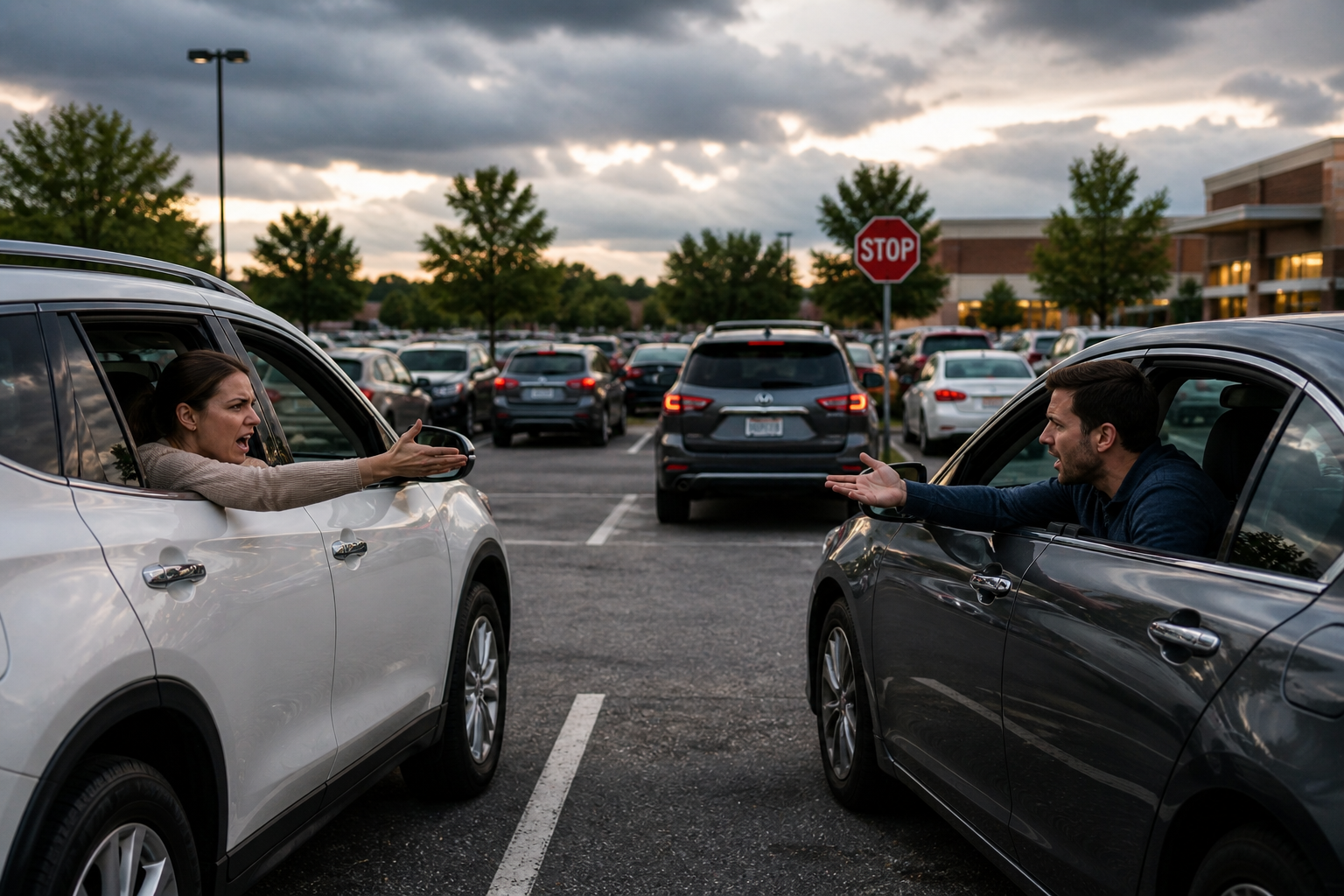
why people fight over parking
A 2023 survey found nearly 1 in 3 drivers have experienced a verbal altercation over parking. One in six report witnessing physical confrontation – over a parking spot. This seems absurd until you understand the psychology underneath it. Parking conflicts aren’t about parking. They’re about scarcity, territory, and fairness: three of the most deeply wired human triggers.
The Scarcity Mindset Activates Instantly
When resources feel limited, the brain shifts into competitive mode – fast. A parking lot with visibly limited spaces triggers the same cognitive switch as any zero-sum competition: if someone else gets it, you don’t.
The critical insight: the scarcity doesn’t have to be real to feel real. A lot at 70% capacity can feel full if drivers can’t see available spaces. Perceived scarcity creates the same stress response as actual scarcity – and the same conflict-prone behavior.
Territorial Claiming Happens Faster Than You Think
Psychologists call it the Endowment Effect: once we perceive something as “ours,” we value it more and fight to keep it. In parking, this is the blinker-signal claim, the pedestrian-blocking-the-space maneuver, and the extended bag-packing to hold a spot. None are legally defensible – but they feel like rights. When someone violates them, it registers as they took something that was mine.
Loss Aversion Turns Frustration Into Rage
Research shows losses feel approximately twice as painful as equivalent gains feel good. Missing a parking spot doesn’t feel neutral – it feels like losing something you never had. The person isn’t angry about asphalt. They’re experiencing the outsized emotional weight of loss, looking for someone to attribute it to.
Time Pressure Removes the Rational Override
Most parking conflicts happen under time pressure: picking up a child, running late, an expired meter. When cognitive load is high and time is short, slower deliberate reasoning gives way to faster reactive processing. Road rage logic takes over – not because people are irrational, but because the conditions strip away the margin for rational deliberation.
The Mimetic Escalation
Conflict is contagious. When one driver behaves aggressively, it signals that aggressive behavior is the norm. Others escalate to match. A single bad actor can shift the entire behavioral baseline of a parking lot within minutes.
The Solution Isn’t Civility. It’s System Design.
You cannot shame drivers into better behavior. The psychological triggers are too deep and too fast. What you can do is redesign the system so triggers don’t activate:
- Remove competition – eliminate the scarcity response
- Add visibility – eliminate perceived-scarcity triggers
- Automate flow – eliminate the time-pressure catalyst
AI-powered systems do all three. The goal isn’t to make parking more pleasant. It’s to make conflict structurally impossible.
What This Means for School Zones
In school pickup, the stakes are higher. Time pressure is acute. Perceived territory is intense. Students witness adult conflict. Structured, automated pickup systems remove the competitive conditions that turn reasonable adults into people arguing over asphalt. That’s not just a technology benefit – that’s a community benefit.
See how PLACA.AI removes pickup competition
Related Reading: Why Parking Is Broken | Hidden Safety Risks in Parking Lots | Top 10 Parking Problems
Talk to PLACA.AI
Need help choosing the right LPR workflow?
Send your property, parking, or access-control question through the PLACA.AI contact form. Dr. Suhayb and the team can help map the right camera, software, and enforcement setup.
Open contact formRelated Resources
Data reference: U.S. Department of Transportation