
Towing Industry LPR Report 2026
Towing company owners, private-property enforcement teams, patrol managers, and parking enforcement operators.
What This Report Covers
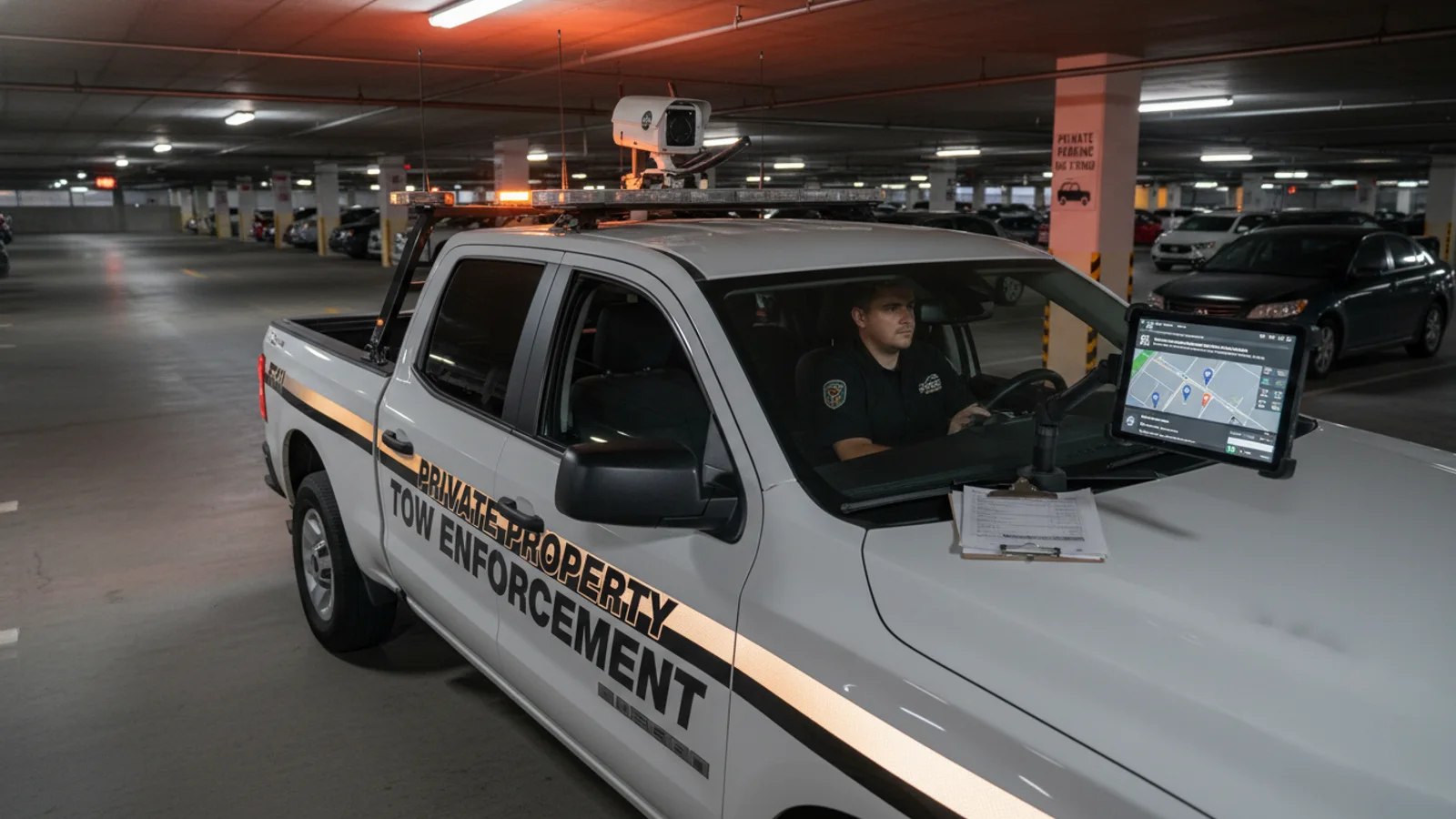
For towing companies, mobile LPR is not just a faster way to scan plates. It changes how patrols are documented, how property rules are checked, and how operators support property-manager review after an enforcement action.
This report focuses on private-property tow patrols, apartment and HOA enforcement, cloud LPR, mobile workflows, and the operational difference between alerts, documentation, and the final tow decision.
Short answer: Mobile LPR for towing helps patrol vehicles scan plates, check authorization, document rule context, and support property-manager review while keeping the final enforcement decision in the operator workflow.
Key Findings
Documentation is the value
Faster scanning matters, but searchable evidence is what strengthens property relationships.
Cloud workflows reduce hardware burden
Cloud LPR can reduce dependence on in-truck DVR management and manual lookup.
Alerts are not decisions
The best systems support driver review instead of pretending plate reads make final tow decisions automatically.
Property context matters
The same plate can be authorized at one property and unauthorized at another.
Data Snapshot
These report cards use operational counts and decision points rather than unverified market claims. External statistics should be added only after source verification.
Patrol evidence fields: plate, time, location, image, and property rule context.
Core stakeholders: driver, dispatcher/manager, and property manager.
Tow decision should remain governed by company and property policy.
Problem / Solution
The Old Workflow
Manual tow patrols rely on visual checks, handwritten notes, screenshots, property lists, and driver memory. That slows patrols and weakens documentation when a property manager or vehicle owner asks for details.
The Modern Workflow
Mobile LPR creates a faster patrol workflow with plate scans, authorization checks, alerts, images, timestamps, and property-specific context for later review.
Comparison Table
| Workflow Area | Manual Patrol | Risk | Mobile LPR Workflow |
|---|---|---|---|
| Plate lookup | Driver checks lists manually | Slow and inconsistent | Camera scans plates while patrolling |
| Permit check | Visual decal or paper list | Easy to miss edge cases | Plate matched to property authorization data |
| Evidence | Photos and notes | Hard to search later | Timestamped event records |
| Property reporting | Manual summaries | Limited proof | Searchable patrol and exception history |
Buyer Decision Framework
| Decision Area | What To Check | Why It Matters | Related Resource |
|---|---|---|---|
| Property rules | Are permit, visitor, and do-not-tow rules structured? | LPR needs clear property data. | Review the related PLACA.AI resource cards below. |
| Patrol route | Can cameras capture plates while drivers move normally? | Workflow fit affects adoption. | Review the related PLACA.AI resource cards below. |
| Driver review | How does the driver confirm an exception? | Alerts should support decisions, not replace judgment. | Review the related PLACA.AI resource cards below. |
| Reporting | Can property managers review event context? | Documentation strengthens retention. | Review the related PLACA.AI resource cards below. |
Implementation Roadmap
Map property rule data
Use this step to move from broad interest to a measurable, reviewable vehicle workflow.
Test camera placement on patrol routes
Use this step to move from broad interest to a measurable, reviewable vehicle workflow.
Define alert and review workflow
Use this step to move from broad interest to a measurable, reviewable vehicle workflow.
Pilot on selected apartment or HOA properties
Use this step to move from broad interest to a measurable, reviewable vehicle workflow.
Review dispute and property-manager feedback
Use this step to move from broad interest to a measurable, reviewable vehicle workflow.
State Relevance
For state and local relevance, PLACA.AI should expand existing state assets rather than create doorway pages. Existing regional resources include Florida LPR and gate access, Texas and DFW license plate recognition, and Phoenix/Arizona gate access control.
Related PLACA.AI Resources
Parking Enforcement Software for Towing Companies
Canonical towing software pillar.
Mobile LPR for Towing Companies
Mobile patrol support content.
Tow Truck License Plate Scanner
Tow truck scanner workflow page.
Towing Profitability Calculator
ROI and profitability support tool.
Parking Scanner for Apartments and HOAs
Apartment and HOA enforcement support content.
FAQ
What is mobile LPR for towing?
Mobile LPR for towing uses cameras on patrol vehicles to scan plates, check authorization, and document private-property parking enforcement workflows.
Does LPR automatically decide which vehicles get towed?
No. LPR can alert and document, but the final decision should follow company policy, property rules, and applicable law.
How does cloud LPR differ from an in-truck DVR?
Cloud LPR can centralize plate events, reporting, and property data rather than relying only on local in-truck storage.
How can towing companies document private-property patrols?
They can record plate reads, timestamps, property locations, images, and rule context for manager review.
What properties benefit most from tow patrol LPR?
Apartment communities, HOAs, commercial lots, and private properties with structured permit or authorization rules often benefit most.
Turn this report into a working vehicle access plan.
Share your current workflow and PLACA.AI can help map the cameras, rules, permissions, and review process that fit your property or operation.