

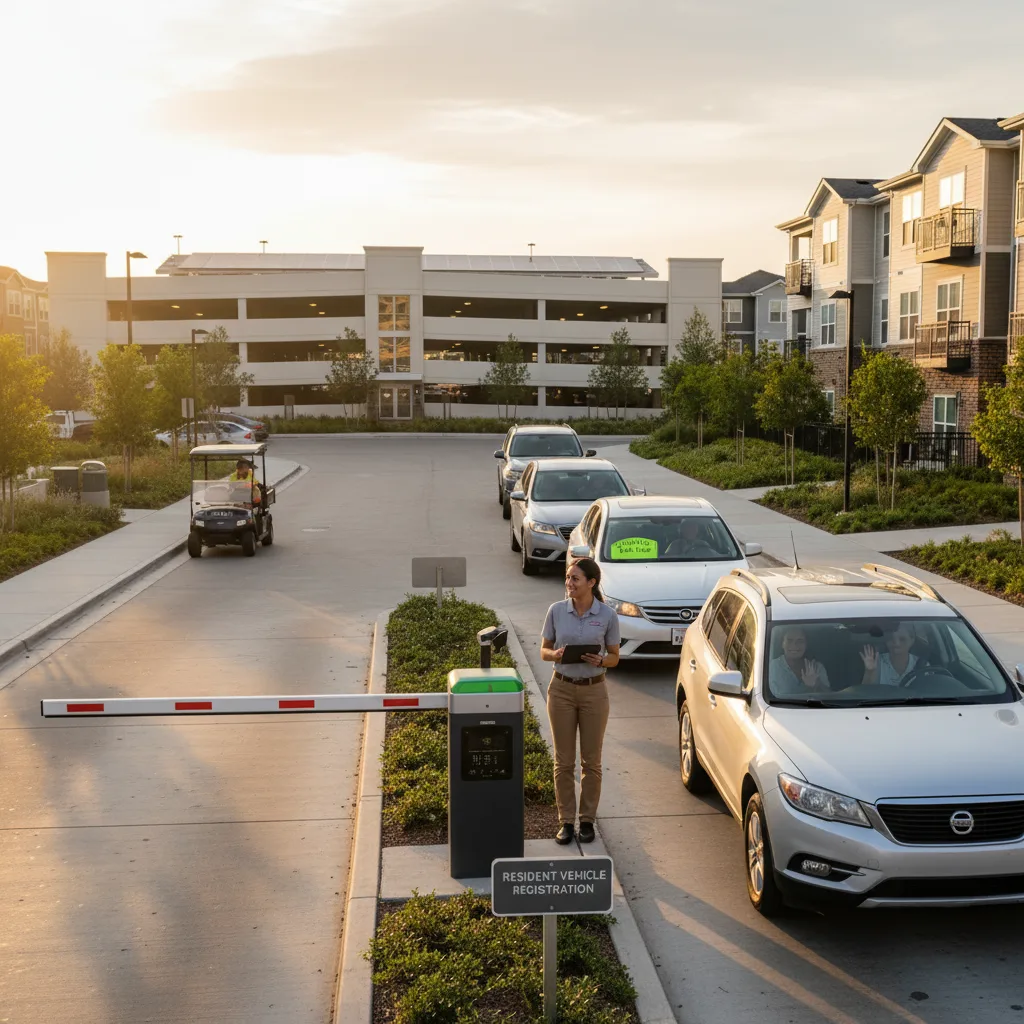
Direct answer: Vehicle registration disputes on a volunteer board usually trace back to one thing: the board never actually approved what data gets collected, who reviews it, or when a record expires — so whoever is handling registration day to day (a board member, a manager, or nobody in particular) is making those calls ad hoc. Fix it by having the board approve a short written policy once — eligibility, required proof, who reviews it, and when access ends — then get out of the day-to-day administration entirely.
This is for the board itself, not for whoever ends up doing the paperwork. Registration feels like an administrative task, which is exactly why boards tend to under-govern it — until a resident challenges why their guest’s car got towed despite being “registered,” or a departing board member turns out to be the only person who knew the current rules.
The gap between “we have a registration process” and “the board approved a registration process”
Most communities do collect some vehicle information — a spreadsheet, a form, a binder at the clubhouse. Very few boards have actually voted on and documented what that process requires: which residents and vehicles are eligible, what proof is acceptable, who’s authorized to approve or deny a registration, and what happens when a car is sold or a lease ends. Without that, the person doing the administrative work — often a single board member or an outside manager — is effectively setting policy by habit, and that habit changes every time the person changes.
What a board actually needs to approve
| Policy question | What happens without a board answer | What the board should vote on |
|---|---|---|
| Who’s eligible | Tenants, roommates, or adult children get registered or refused inconsistently | A written eligibility list covering owners, tenants, and household members |
| What proof is required | One resident is asked for a title and insurance card, another isn’t asked for anything | A minimum, consistent proof standard applied the same way to every registration |
| How long a record lasts | Sold or replaced vehicles stay “active” indefinitely because nobody’s job is to close them out | An expiry or renewal cycle, with a named person responsible for closing stale records |
| Who can see the data | Resident vehicle and address data circulates informally among board members or committee volunteers | A stated access rule — who can view registration records and for what purpose |
A policy a board can approve in one meeting
- Eligibility. Name who can register a vehicle — owners, tenants — and specify how household members and roommates are handled.
- Proof. Pick the minimum acceptable documentation and apply it the same way to every resident, not case by case.
- Lifecycle. Set a renewal or expiry period, and assign a specific person — not “the board” collectively — to close out records for sold, replaced, or moved-out vehicles.
- Access and correction. State who can see the registration list and how a resident corrects an error, so residents have somewhere to go besides a board member’s personal cell phone.
Once the policy exists, day-to-day administration should sit with a manager or a dedicated volunteer registrar — not the whole board. If guest vehicles are part of what’s driving registration disputes, our guide on stopping guest permit sharing covers the visitor side of the same problem, and the HOA safe-list opt-out checklist is a useful reference if your board is also being asked how resident data is stored and who can opt out of any camera-based system.
Why this matters more than it looks like it should
Registration data ends up being the evidence base for every parking enforcement decision your board makes later — if the registration record is inconsistent or stale, enforcement built on top of it will be too. A board that spends one meeting approving a short, written registration policy avoids months of ad hoc decisions and the awkward position of explaining, after the fact, why one resident’s car was “registered” and another’s wasn’t under rules nobody wrote down.
Questions to answer before your next board meeting
- Has the board actually voted on eligibility, proof requirements, and record lifecycle, or is someone administering this by habit?
- Is there a named person responsible for closing out stale or sold-vehicle records, or do they just accumulate?
- Do residents know who can see their registration data and how to correct an error?
- If a board member who currently handles registration left tomorrow, could someone else pick it up from written policy alone?
Related PLACA.AI planning resources
Plan a limited workflow review
Bring your current registration form, whatever policy exists in writing, and one recent case where a record was unclear or out of date. PLACA.AI can help evaluate whether an automated plate record would reduce the manual upkeep your registration list currently depends on.
Editorial refresh: September 18, 2026. Independently confirm current product capabilities, third-party features, pricing, contracts, governing requirements, and local rules before acting.
Data source: Community Associations Institute