

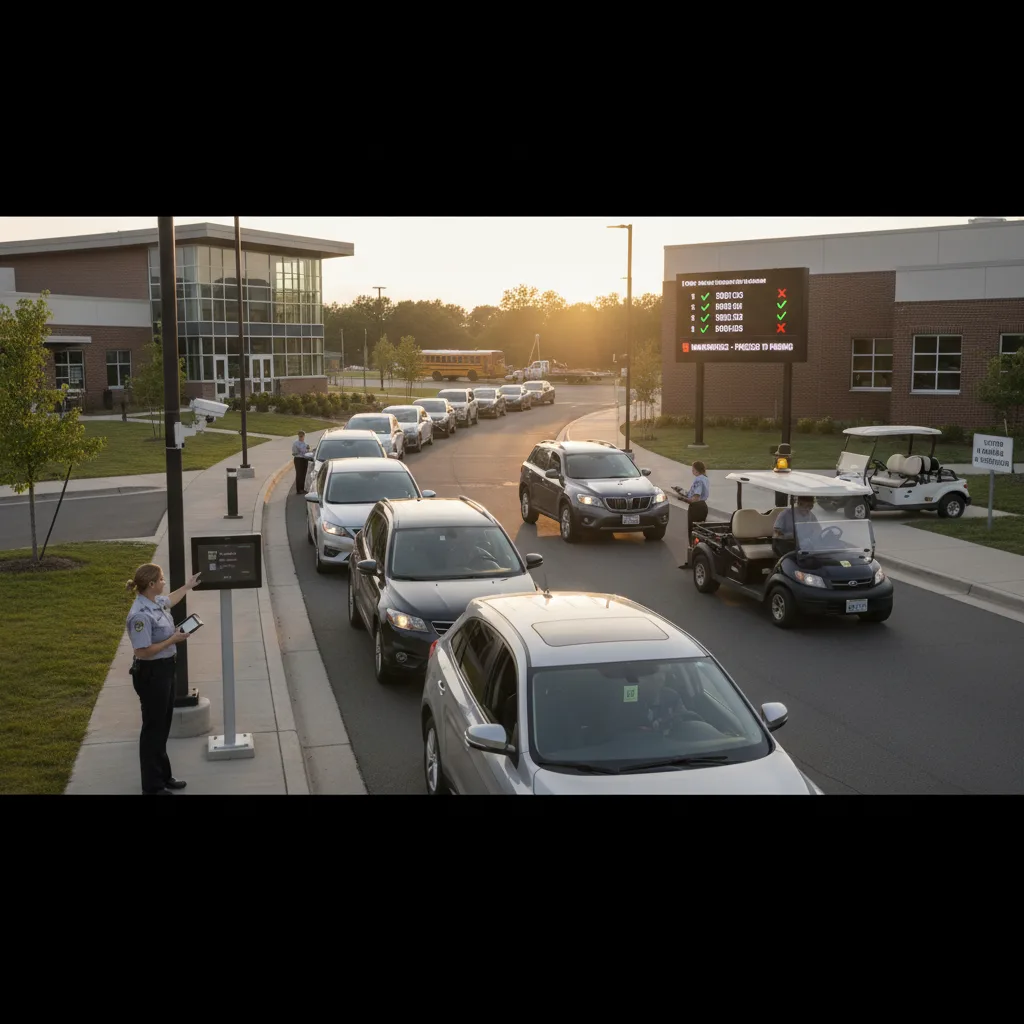
Direct answer: For a K-12 school, verifying authorized pickup vehicles has to work across very different needs at each grade band using one shared source of truth. Elementary students need a physical adult-to-child handoff with an ID or roster check every single time; middle and high school students may be authorized to walk to a car on their own once verified, which removes the escort step but not the authorization check. Build one authorized-pickup list – standing authorized adults, custody restrictions, and same-day temporary authorizations with an expiry – and make sure the front office, the curb or lot staff, and the bus loop are all reading from that same list rather than maintaining separate ones that can disagree with each other.
This guide is for school and building leaders setting pickup-verification policy across an entire K-12 site or a school that spans multiple grade bands, not staff running a single grade level’s daily dismissal.
Why one policy has to flex across grade bands
A five-year-old cannot confirm on their own whether the adult waiting for them is actually authorized, so elementary dismissal depends on staff physically matching a student to a roster before releasing them. A sixteen-year-old can. Schools that serve multiple grade bands – or districts standardizing across elementary, middle, and high campuses – often end up with informal, inconsistent rules about when a physical staff check is required and when self-release is acceptable. That inconsistency is where errors happen: a policy written for teenagers applied by habit to a younger sibling, or an elementary-level escort requirement nobody bothered to relax for verified upperclassmen.
Build one list, apply it differently by grade band
| Decision point | Elementary | Middle/high |
|---|---|---|
| Vehicle arrival | Treated only as a cue to prepare the student – never as proof of identity on its own | Same rule; a familiar car is not the same as a verified driver |
| Adult verification | Staff physically checks the adult against the roster before releasing the student | Required for pickup by a non-standard adult; not required for a verified self-release student |
| Custody restrictions | Flagged in the shared list, handled discreetly by trained staff only | Same flag, same handling – the restriction doesn’t relax with age |
| Same-day temporary authorization | Logged by the front office with a same-day expiry, communicated to curb staff before release | Same logging requirement; self-release doesn’t remove the need for a current, verified authorization |
Set the policy that holds across the building
- Build one authorized-pickup list covering standing authorized adults, active custody restrictions, and same-day temporary authorizations – not a separate spreadsheet per grade level or per staff member.
- Decide, in writing, which grade bands require a physical escort-and-match versus which can self-release once verified, and make sure that decision is documented somewhere new staff can find it.
- Require every temporary, one-day authorization to carry an expiry so a change made for a single afternoon doesn’t become a permanent, unreviewed addition to the list.
- Give the front office, curb staff, and any bus-loop supervisor access to the same current list, not three separately maintained versions that can silently disagree.
Where the vehicle-as-cue assumption breaks
A familiar or matched vehicle can be driven by someone other than the authorized adult, and that risk doesn’t go away with a student’s age – it just changes shape. At the elementary level it means a staff member has to actually see and check the adult, not just the car. At the middle and high school level it means a self-release policy still requires the student and vehicle to match a current, verified authorization – it isn’t a reason to skip verification altogether just because a staff member isn’t walking the student to the curb.
What to check during a pilot
- Whether elementary and secondary staff are applying the correct verification level for their grade band, not defaulting to whichever habit is easiest.
- How many same-day temporary authorizations were logged with an expiry versus added informally and left on the list indefinitely.
- Whether custody restrictions are being enforced consistently across grade bands, not relaxed as students get older.
- Whether front office, curb, and bus-loop staff are working from the same current list or from versions that have drifted apart.
Owner sign-off
- Confirm the grade-band verification policy is written down and available to substitutes and new hires.
- Audit the authorized-pickup list for stale temporary authorizations before expanding the policy schoolwide.
- Verify custody-restriction handling meets your district’s and legal counsel’s requirements independently – this is not a workflow detail to improvise.
- Confirm every point of contact – office, curb, bus loop – is reading from the same list before calling the pilot complete.
Related PLACA.AI planning resources
Questions for the team
Should the pickup-verification policy be the same for every grade?
The underlying list and rules should be the same; how they’re applied shouldn’t be. Elementary students need a physical adult match every time. Verified older students can often self-release, but the vehicle and authorization still have to be current.
What’s the most common failure point?
Treating a familiar or matched vehicle as proof of identity on its own, at any grade level, instead of checking the adult or confirming a current, verified authorization.
How should temporary, one-day authorizations be handled?
Logged by the front office with a same-day expiry and shared with every staff point of contact before release – never added informally and left active past the day it was meant to cover.
Plan a limited workflow review
Bring your current pickup-authorization list, your grade-band policy (if it’s written down anywhere), and any recent exception cases. PLACA.AI can help evaluate a bounded pilot without assuming another school’s grade-band mix matches yours.
Editorial refresh: September 18, 2026. Independently confirm current product capabilities, third-party features, pricing, contracts, governing requirements, and local rules before acting.
Data source: National Center for Education Statistics