

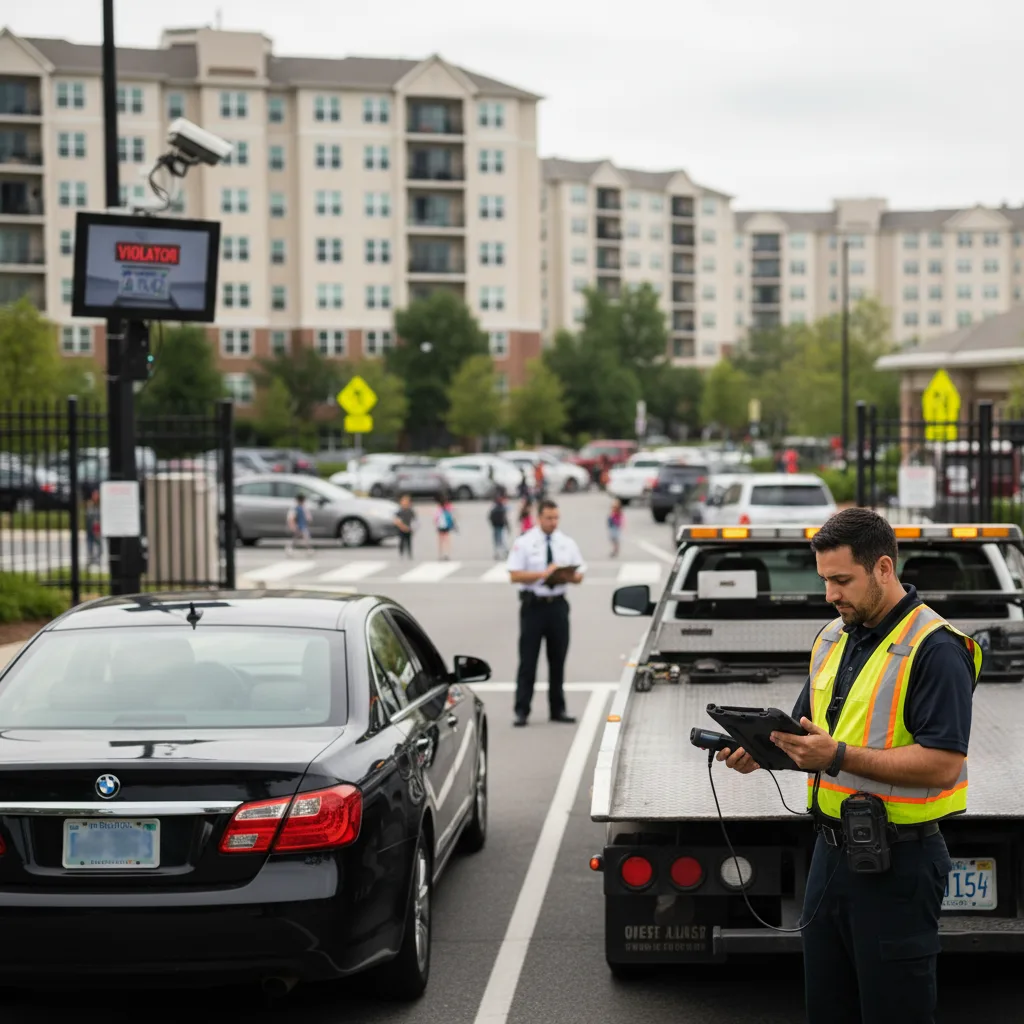
Direct answer: A private property towing company usually services dozens of lots under separate contracts, and repeat violators rarely stay on just one of them — the same plate shows up on a client’s lot this week and a different client’s lot next month. Spotting that pattern requires matching plate history across your whole portfolio, not just within one property’s log, and it’s the difference between towing a habitual scofflaw with full confidence and towing a driver who genuinely didn’t know the rules.
This is written for towing company owners, operations managers, and dispatch staff who patrol or respond across multiple contracted properties, not a single fixed site.
Why single-property tracking misses most repeat violators
If each property’s violation history lives in its own log or spreadsheet, a driver who gets towed from a retail lot in January and shows up unauthorized at an apartment complex you also service in March looks like a first-time offender at both locations. From the driver’s perspective, it’s a pattern. From your company’s records, it’s two unrelated one-offs — which means you lose the strongest justification for a tow (documented repeat behavior) and the client loses visibility into who’s actually causing recurring problems on their property.
Cross-property matching also protects you the other direction: a plate that looks suspicious because it’s shown up on two properties in one week might just be a delivery driver, a contractor working multiple sites, or a rideshare vehicle — not a violator at all. Portfolio-wide history helps you tell the difference before you act.
Building a usable repeat-violator record
1. Match on plate, not vehicle description
“Blue Honda Civic” isn’t a reliable identifier across properties or drivers. Plate number is the anchor; everything else (make, model, color) is a secondary check to catch a misread plate, not the primary match.
2. Keep property and rule context attached to each hit
A repeat match only means something if you know what happened each time — same violation type, same property, different property, previous tow versus previous warning. A plate that’s been towed twice for expired registration at the same lot is a very different case than one that’s been flagged once at three different properties for three different reasons.
3. Separate “repeat violator” from “repeat presence”
A vehicle that’s simply present often (a resident, an employee, a regular customer) isn’t a repeat violator unless it’s actually been in violation each time. Conflating frequency with violation history is one of the fastest ways to generate a wrongful-tow complaint and a client relationship problem.
4. Timestamp and retain the full chain
For any vehicle you tow based partly on repeat history, keep the dates, locations, and evidence for each prior instance available — not just a note that says “repeat offender.” If the tow gets disputed, you need to be able to show the actual pattern, not just assert it.
What this looks like operationally
In practice, this means your patrol or mobile LPR capture at any property should be checking against a shared violator list that spans your whole client roster, not just that site’s local record. When a plate hits, dispatch or the patroller in the field should see enough context to make a fast, correct call: how many prior instances, which properties, what violation type, and whether any of those were resolved as false positives or authorized exceptions.
This also changes how you talk to clients. A property manager who sees “this vehicle has three documented violations across your properties and two others we service” has a much easier case for supporting more assertive enforcement than one who only sees a single incident in isolation.
Where this can go wrong
- Stale entries. A vehicle sold or a plate reassigned means an old violator record can wrongly follow a new, innocent owner. Build in a way to flag and retire old entries rather than letting the list grow indefinitely.
- False confidence from a single misread. One bad plate capture that gets treated as confirmed history can snowball into repeated wrongful flags. Any entry added to a repeat-violator list should be based on a verified read, not an unconfirmed one.
- Cross-client data handling. Different clients may have different expectations — and different contract language — about whether their site’s violation data can be shared or matched against other properties you service. Confirm this is allowed before building a cross-property list, not after.
FAQ
How many prior instances should count as a “repeat violator”?
There’s no universal number — it depends on your contract terms and the property’s own policy. What matters more than a threshold is that every instance in the history is verified and documented, not just counted.
Can we tow faster on a confirmed repeat violator?
Often yes, since repeat, documented noncompliance is one of the stronger justifications for enforcement — but the underlying violation still has to be real and current. History supports the decision; it doesn’t replace the evidence for the tow in front of you.
Should clients see the cross-property history, or just their own site’s record?
That’s a contract and privacy question worth settling explicitly. Many clients appreciate the added context; some may prefer their data stay siloed. Set the expectation up front rather than assuming.
Related reading
- Parking enforcement software for towing companies
- Mobile LPR planning guide
- Parking enforcement LPR software overview
If your patrol teams are still checking violation history one property at a time, PLACA.AI can show you what a portfolio-wide mobile LPR workflow looks like — get in touch or book a demo.
Data source: U.S. Department of Transportation