

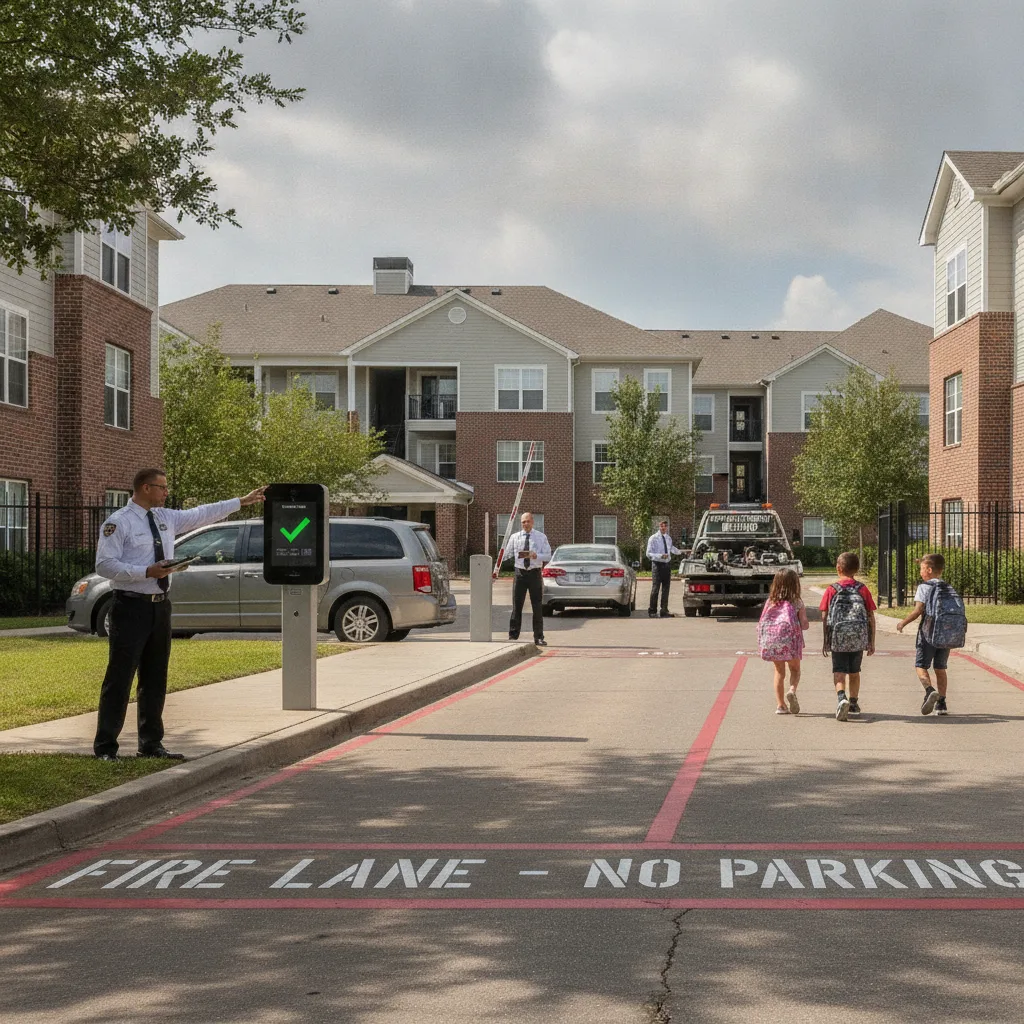
Direct answer: Handle fire-lane complaints through a safety-first escalation path: confirm the marked restriction, capture time-sensitive evidence, route urgent obstruction appropriately, document the action, and separate emergency response from later resident dispute resolution.
This guide is for HOA boards, community managers, safety committees, residents, and enforcement partners and focuses specifically on responding to HOA fire-lane parking complaints. Apply the framework only to the defined use case. Adjacent workflows may need different evidence, controls, and approval.
What creates avoidable disputes
Boards create risk and distrust when ordinary parking complaints and active emergency-access obstructions enter the same slow queue. The policy must distinguish immediate conditions from historical complaints.
Example: A delivery vehicle blocking marked emergency access during an active incident is not the same case as a photo submitted the next morning. The first follows the urgent path; the second follows evidence review.
Fire-lane complaint triage
| Decision point | Evidence or control | Required response |
|---|---|---|
| Active obstruction affecting access | Confirm location and follow the approved urgent-contact procedure | Immediate routing and incident log |
| Vehicle left but evidence exists | Review photo, time, marking, and applicable rule | Documented follow-up |
| Disputed marking or signage | Pause individual conclusion and inspect site conditions | Facilities or board review |
| Repeated complaint pattern | Analyze location, time, and prior response | Site or policy correction |
Decision path and ownership
- Step 1. Publish the channel for urgent and non-urgent reports.
- Step 2. Define the minimum evidence and who may act.
- Step 3. Record the disposition of every escalated complaint.
- Step 4. Review repeat locations for signage, curb visibility, loading conflicts, or policy gaps.
For responding to HOA fire-lane parking complaints, the named owner should document the approved rule, baseline, and result of each test. Ask the implementation owner to reproduce the result, including outage and correction paths, before accepting it.
When the normal path cannot be used
Emergency response, towing authority, notice, and enforcement obligations vary. The association should follow governing documents and qualified local advice; this page does not provide legal or emergency-response instructions.
Consistent closure protects both users and operators: correct the record, approve a bounded exception, deny under the rule, or escalate.
Measure before expanding
Choose a pilot small enough to inspect case by case and long enough to capture the recurring operating pattern.
- urgent complaints routed through the correct channel
- records with location and time evidence
- repeat complaints by location
- disputes caused by unclear markings
- closed cases with recorded disposition
State the measurement rule in plain language before collecting the first result.
What the owner must confirm
- Write the purpose and non-goals for responding to HOA fire-lane parking complaints and name the accountable owner.
- Verify the process with the actual HOA boards, community managers, safety committees, residents, and enforcement partners who will use, administer, or review it.
- Test a correction, an unavailable-system path, and the exception described on this page.
- Confirm current pricing, contract terms, support, integrations, and data handling directly with each provider.
- Use urgent complaints routed through the correct channel as one acceptance signal and record what evidence can stop the rollout.
Related PLACA.AI planning resources
Decision-specific FAQs
Should residents confront a driver in a fire lane?
The policy should direct residents to the approved reporting channel rather than encouraging confrontation.
What if curb markings are unclear?
Escalate the site condition for inspection instead of relying on inconsistent resident interpretations.
Can LPR decide whether a fire-lane violation occurred?
No. Plate recognition can help identify and document a vehicle, but an authorized human process must apply the rule and context.
Build a fire-lane complaint response map
Bring the rules, current process, known exceptions, and success criteria for responding to HOA fire-lane parking complaints. PLACA.AI can help evaluate a limited pilot without presuming that another property’s hardware or workflow is the right answer.
Editorial refresh: July 22, 2026. Before using this framework for responding to HOA fire-lane parking complaints, independently confirm current product capabilities, third-party features, pricing, contracts, governing requirements, and local rules.
Data source: Community Associations Institute