

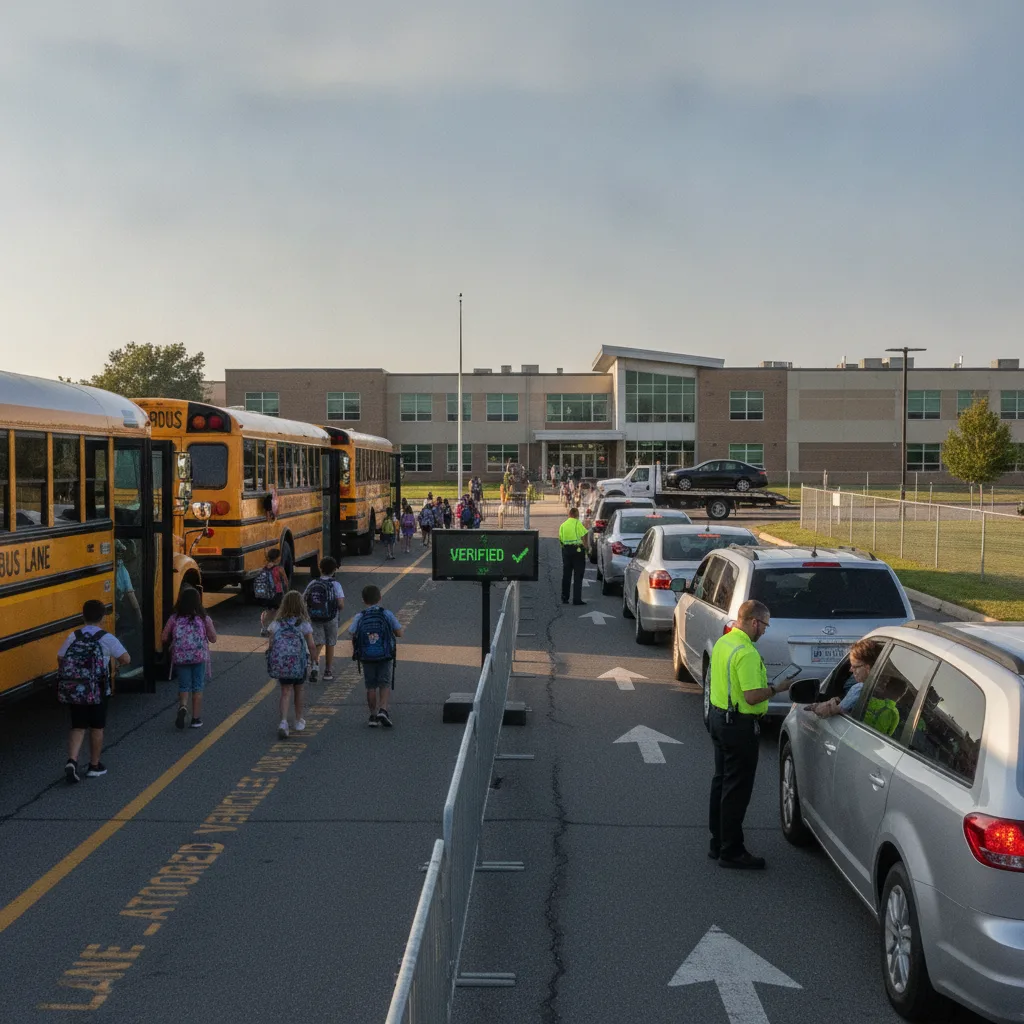
Direct answer: Separate bus and car traffic through distinct approach routes, staging areas, staff roles, release signals, crossing controls, and completion states. Resolve mixed-mode student changes before vehicles enter the loading zone. Record the accepted result and the reason for every correction before expanding the process.
This guide is for K-12 administrators, transportation teams, campus safety staff, teachers, bus drivers, and families and addresses separating bus and carline traffic at K-12 dismissal. The people affected by the rule should be able to understand how a correction or exception works.
Find the bottleneck
Shared entrances and late transportation changes can cause buses, cars, pedestrians, and released students to cross the same space unpredictably.
Example: A student switching from bus to parent pickup should be updated in one authoritative roster before either loading team receives a release signal.
Bus-carline separation plan
| Decision point | Evidence or control | Required response |
|---|---|---|
| Mode assignment | current bus, car, walker, or exception status | confirm before dismissal |
| Physical route | entrances, staging, crossings, barriers | separate movements |
| Release signal | mode-specific staff acknowledgment | avoid duplicate calls |
| Mode change and closure | office approval and completed handoff | resolve off-line |
Sequence daily work
- Step 1. For mode assignment, verify current bus, car, walker, or exception status and then confirm before dismissal.
- Step 2. For physical route, verify entrances, staging, crossings, barriers and then separate movements.
- Step 3. For release signal, verify mode-specific staff acknowledgment and then avoid duplicate calls.
- Step 4. For mode change and closure, verify office approval and completed handoff and then resolve off-line.
Expansion should stop when required evidence is missing.
Fallback route
Missing students, unauthorized changes, bus incidents, blocked routes, and unsafe crossings require transportation or office control.
Correct the record, approve a bounded exception, deny under the written rule, or escalate to the named authority; do not leave the case unresolved.
Bounded pilot
Run a limited test long enough to observe the recurring pattern and at least one correction or fallback.
- students with confirmed mode before dismissal
- late mode changes
- bus-car conflict points observed
- duplicate release messages
- unresolved students at close
Define who counts each measure, the observation window, and the result that blocks expansion.
Acceptance evidence
- State the purpose and non-goals for separating bus and carline traffic at K-12 dismissal.
- Assign owners for the normal path, correction, exception, and final approval.
- Test live conditions with the people who administer and experience the workflow.
- Confirm contracts, pricing, support, integrations, data handling, and governing requirements independently.
- Retain enough evidence to reproduce each approval, denial, correction, or escalation.
Related PLACA.AI planning resources
Practical questions
What must be approved first for separating bus and carline traffic at K-12 dismissal?
Approve the purpose, owner, evidence standard, decision rule, and exception path before scaling.
What should the pilot reproduce?
Test the normal process and the named exception while collecting students with confirmed mode before dismissal and the other listed measures.
When should rollout stop?
Stop when ownership is unclear, required evidence is missing, a serious exception lacks a safe route, or the result conflicts with the approved rule.
Plan a limited workflow review
Bring the current rule, process, exceptions, and success criteria for separating bus and carline traffic at K-12 dismissal. PLACA.AI can help evaluate a bounded pilot without assuming another property’s workflow is the right answer.
Editorial refresh: July 22, 2026. Independently confirm current product capabilities, third-party features, pricing, contracts, governing requirements, and local rules before acting.
Data source: National Center for Education Statistics