

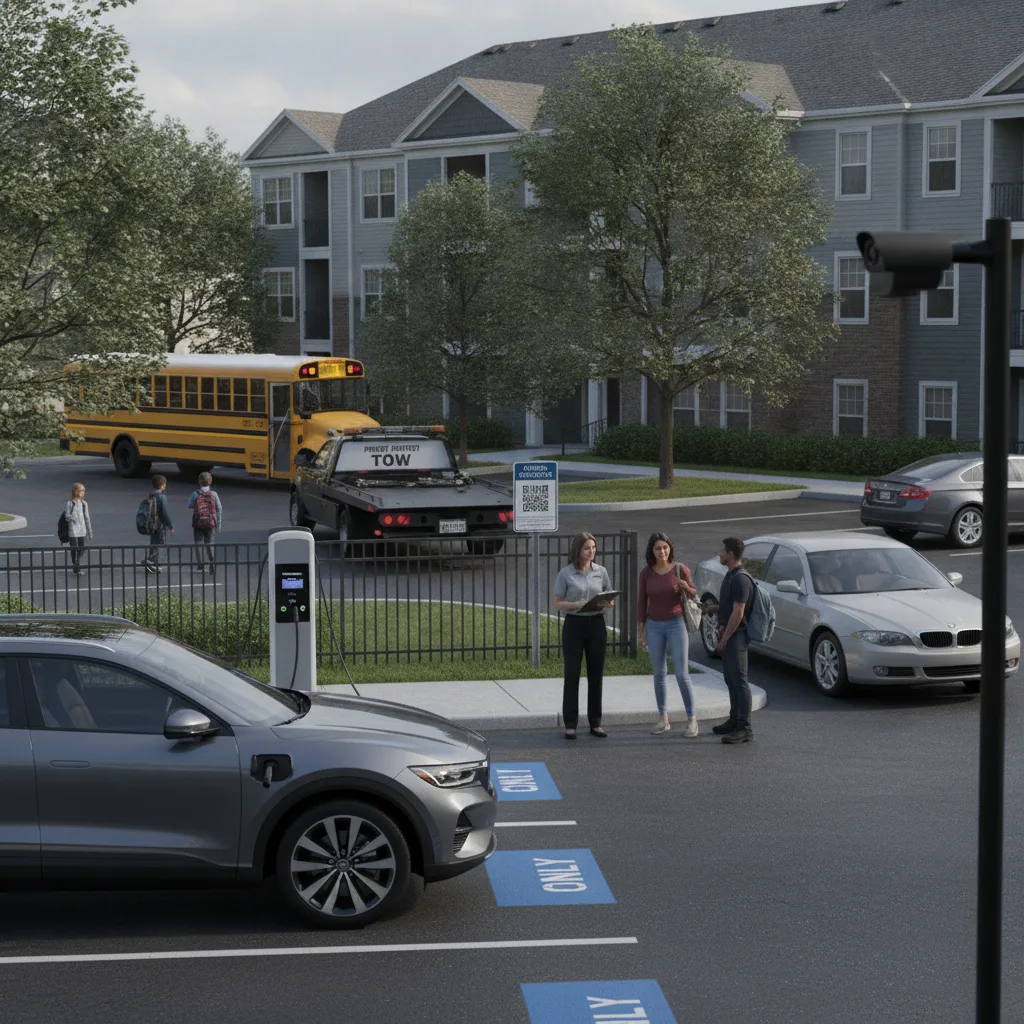
Direct answer: Define EV-space eligibility through charging status, session or time limits, resident or guest authorization, idle period, posted rule, charger availability, and a correction or accessibility process. Treat charging policy and parking enforcement as one workflow.
This guide is for HOA boards, community managers, EV drivers, parking committees, residents, and charging vendors and addresses handling misuse of HOA EV charging spaces. Detection does not replace an authorized decision or documented policy.
Separate signal from decision
A vehicle can be electric but not charging, fully charged but within an allowed grace period, unable to start a broken charger, or using an accessible charging space under a separate rule.
Example: If a charger fails after the vehicle parks, the driver needs a documented reporting path so enforcement can distinguish equipment failure from space misuse.
EV charging-space decision table
| Decision point | Evidence or control | Required response |
|---|---|---|
| Eligible vehicle and user | vehicle type, resident or guest status | confirm access category |
| Charging session | charger state, start, energy or fault record | verify active or failed session |
| Time and idle rule | posted limit, completion, grace period | apply measured window |
| Exception and enforcement | accessibility, outage, notice, evidence | correct or escalate |
Document each stage
- Step 1. For eligible vehicle and user, verify vehicle type, resident or guest status and then confirm access category.
- Step 2. For charging session, verify charger state, start, energy or fault record and then verify active or failed session.
- Step 3. For time and idle rule, verify posted limit, completion, grace period and then apply measured window.
- Step 4. For exception and enforcement, verify accessibility, outage, notice, evidence and then correct or escalate.
Choose the baseline before seeing pilot results.
Stop conditions
Charging equipment faults, accessibility needs, emergencies, and vendor outages require clear handling. Governing documents and applicable requirements need qualified review.
Correct the record, approve a bounded exception, deny under the written rule, or escalate to the named authority; do not leave the case unresolved.
Baseline and test
Run a limited test long enough to observe the recurring pattern and at least one correction or fallback.
- occupied spaces with a valid charging state
- charger faults reported before action
- idle-time cases measured consistently
- warnings caused by unclear signs
- appeals resolved from charger and parking evidence
Define who counts each measure, the observation window, and the result that blocks expansion.
What to verify
- State the purpose and non-goals for handling misuse of HOA EV charging spaces.
- Assign owners for the normal path, correction, exception, and final approval.
- Test live conditions with the people who administer and experience the workflow.
- Confirm contracts, pricing, support, integrations, data handling, and governing requirements independently.
- Retain enough evidence to reproduce each approval, denial, correction, or escalation.
Related PLACA.AI planning resources
Frequently asked questions
What must be approved first for handling misuse of HOA EV charging spaces?
Approve the purpose, owner, evidence standard, decision rule, and exception path before scaling.
What should the pilot reproduce?
Test the normal process and the named exception while collecting occupied spaces with a valid charging state and the other listed measures.
When should rollout stop?
Stop when ownership is unclear, required evidence is missing, a serious exception lacks a safe route, or the result conflicts with the approved rule.
Plan a limited workflow review
Bring the current rule, process, exceptions, and success criteria for handling misuse of HOA EV charging spaces. PLACA.AI can help evaluate a bounded pilot without assuming another property’s workflow is the right answer.
Editorial refresh: July 22, 2026. Independently confirm current product capabilities, third-party features, pricing, contracts, governing requirements, and local rules before acting.
Data source: Community Associations Institute