

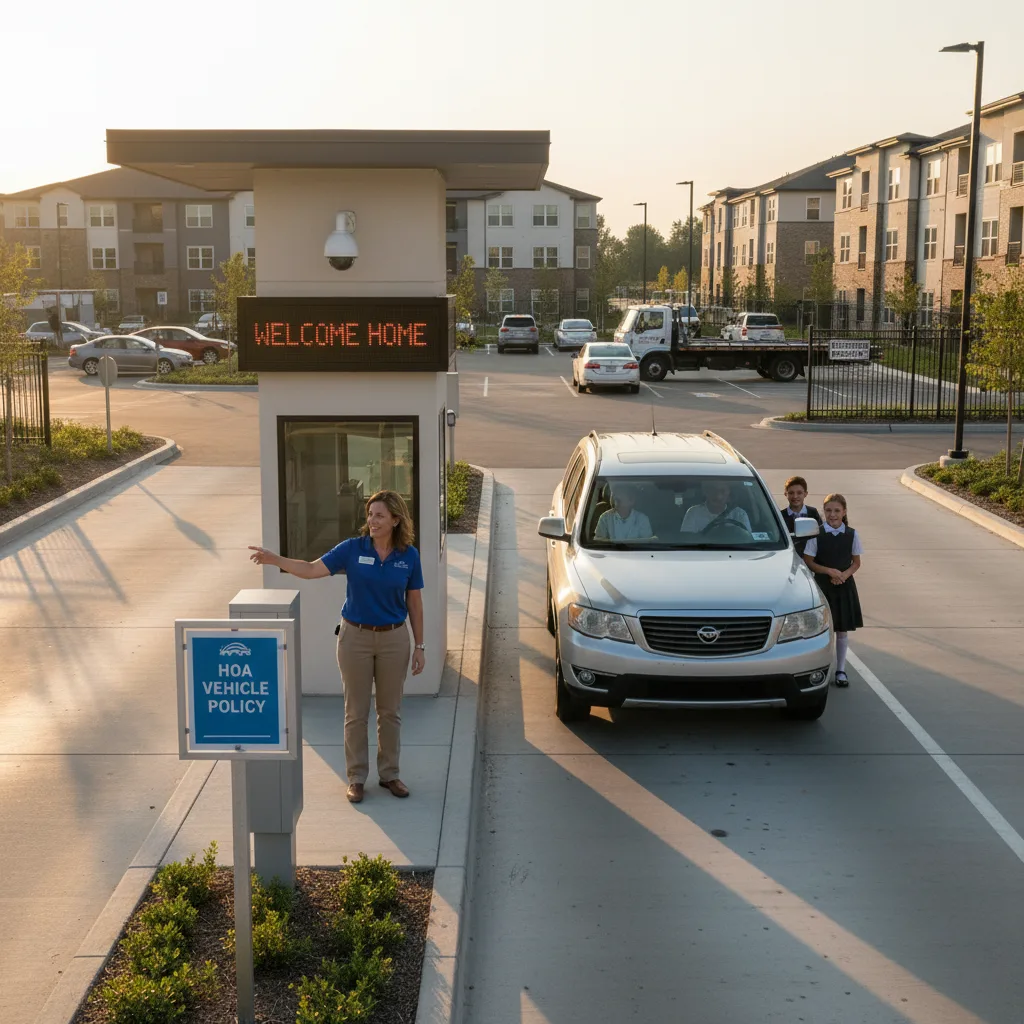
Direct answer: Board enforcement disputes turn personal because volunteer directors are enforcing rules against their own neighbors, usually based on whatever one director remembers or saw personally. The fix isn’t a stricter rule — it’s taking individual board members out of the fact-finding role entirely: let a manager or vendor collect the evidence, let the board vote on policy only, and give every resident a documented appeal that doesn’t depend on which director picks up the phone.
This is written for the people who actually sit on HOA boards: unpaid volunteers, usually three to seven of you, who ran for the board to fix the pool schedule or the landscaping contract and ended up fielding parking complaints at 9 p.m. instead. The dispute pattern below is the one that burns out board members and occasionally exposes them personally — not the theoretical governance-textbook version.
Why parking disputes are different from every other board decision
Most board votes — budget, vendor contracts, capital projects — are decided once and don’t come back. A parking violation notice is decided over and over, one car at a time, usually by whichever director happens to be walking the property or checking the community Facebook group that week. That’s the structural problem: the board approves a policy once, but individual directors end up making dozens of small, informal enforcement calls that were never actually voted on.
When a resident challenges a fine, they’re not really challenging the rule. They’re challenging whether Director Smith remembered the timestamp correctly, whether the tow happened before or after the grace period, and whether the same rule was enforced against the board president’s brother-in-law last month. Those are exactly the questions a volunteer board is worst equipped to answer from memory, and exactly the questions that end up in a demand letter or a small-claims filing with individual board members named.
Where volunteer boards get exposed
| Decision point | What goes wrong when it’s informal | What protects individual directors |
|---|---|---|
| Spotting the violation | A director notices a car and mentions it at the next meeting from memory | A dated, timestamped record — photo, log, or scan — created by staff or a system, not a director’s recollection |
| Deciding to fine | The same director who noticed also decides whether to escalate | A separate reviewer (manager or a rotating board member who wasn’t the one who flagged it) confirms the record before a fine issues |
| Handling the appeal | The resident calls a board member they know personally | A written appeal process with a stated deadline, reviewed against the record, not against who called whom |
| Conflicts of interest | A director votes on a case involving a friend, tenant, or family member without saying so | Standing recusal rule: any director with a personal connection to the case discloses it and steps out of the vote |
A division of labor a volunteer board can actually sustain
- The board votes on policy, not on cars. Approve the rule, the notice period, and the fine schedule at a meeting, in the minutes — then stop making individual calls at the curb.
- One party owns evidence collection. That’s your management company, a designated staff member, or a scan-based system that logs plate, location, and time automatically so no single director’s memory is the record.
- A second party reviews before a fine goes out. Doesn’t need to be a lawyer — needs to be someone other than whoever flagged the car, checking the record against the approved policy.
- Appeals go to a named process, not a named person. Put a deadline and a reviewer role in writing so residents aren’t guessing who to call, and so the outcome doesn’t depend on relationship.
If your board is also revisiting guest parking rules while you’re at it, our guide on stopping guest permit sharing covers the same evidence-first approach applied to visitor passes, and the piece on protecting limited guest spaces is worth reading before your next meeting if guest spots are part of what’s driving complaints.
The burnout pattern boards don’t plan for
In practice, enforcement work concentrates on one or two directors — often whoever lives closest to the problem area or answers email fastest. Those directors become the face of every denied appeal, get the angry texts, and are the ones most likely to quit mid-term or stop running for re-election. Spreading the workload across a documented process, rather than a person’s goodwill, is what keeps a board seated for more than one term. It also means that when a resident does escalate — to the management company, an attorney, or a state agency — the board can produce a record instead of relying on someone’s memory of what was said in the parking lot.
None of this requires new bylaws. It requires the board to stop being the evidence source and start being the policy-approval-and-appeal-review body it’s actually structured to be. A basic license-plate log — whether kept by a patrol vendor or an automated parking enforcement method your community already uses — does more to depersonalize a dispute than any amount of careful wording in the rules.
Questions to answer before your next board meeting
- If a resident disputes a fine today, can you produce a timestamped record without asking a specific director to remember what they saw?
- Is there a written recusal rule, and has it actually been used when a director had a personal connection to a case?
- Does your appeal process have a stated deadline and reviewer, or does it depend on who the resident happens to know on the board?
- Has the same violation been enforced consistently across the property, or only where a director happened to notice it?
Related PLACA.AI planning resources
Plan a limited workflow review
Bring your current enforcement process, one recent dispute, and the names of who currently handles evidence, review, and appeals. PLACA.AI can help evaluate whether automated plate logging would reduce the load on individual board members without assuming your community’s situation matches another one.
Editorial refresh: September 18, 2026. Independently confirm current product capabilities, third-party features, pricing, contracts, governing requirements, and local rules before acting.
Data source: Community Associations Institute