

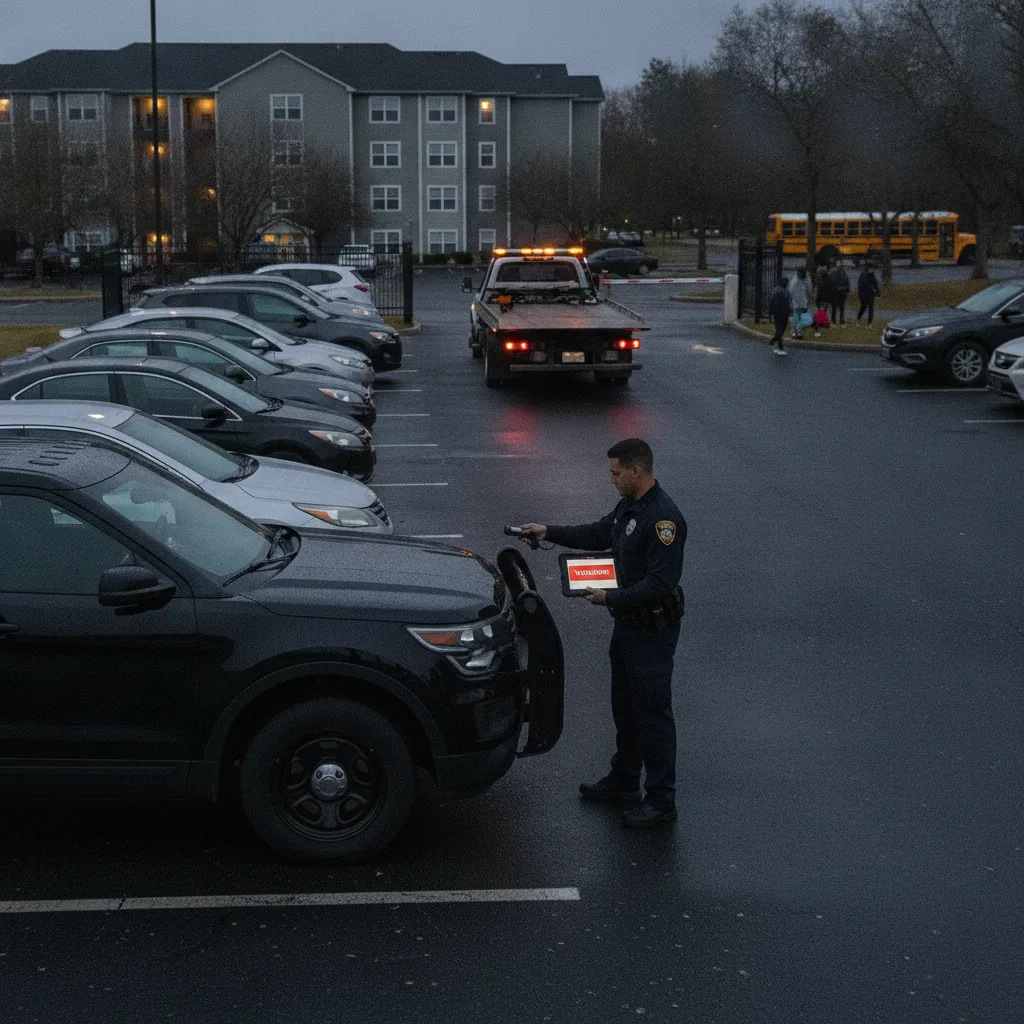
Direct answer: A parking violation documented at night needs to answer one extra question a daytime case doesn’t: can this evidence be trusted, given the lighting it was captured in? Beyond the plate and timestamp, a night violation record should include a wide shot that clearly shows the vehicle’s location relative to a sign or space line, confirmation the image isn’t compromised by glare or shadow, and a note of anything that affected visibility, because whoever reviews the case the next morning wasn’t there to see it firsthand.
This is written for officers working overnight patrol shifts, and for the supervisors and property contacts who review those cases the following morning.
Why night documentation carries more weight, not less
A daytime violation is usually easy to confirm — anyone can look at the photo and the space and agree on what happened. At night, the person reviewing the case wasn’t standing there, doesn’t have the benefit of daylight, and has to trust that what the camera captured actually represents the scene. That means the documentation standard for a night case should be at least as thorough as a daytime one, not looser because it was dark and hard to get a clean shot.
What a night violation record needs
A readable plate, confirmed — not assumed
Zoom in on the captured plate before moving on. A read that looks fine on a small phone screen in the dark can turn out blurry or partially obscured by glare when someone views it later on a full screen. If it’s not clearly legible, retake it or note that it needs manual confirmation rather than letting an uncertain read carry the case.
A location shot that stands on its own
The plate photo proves which vehicle. A separate wider shot proves where it was, showing the vehicle next to a sign, a numbered space, or another fixed reference point. Without this second image, a resident can reasonably argue the plate photo alone doesn’t prove where the car was actually parked.
A timestamp that matches the shift log
Confirm the app’s timestamp is accurate and, where the workflow allows it, cross-reference it against the route or check-in log for that stop. If a case is disputed weeks later, a timestamp that lines up with an independent route log is a much stronger record than the timestamp alone.
A note on visibility conditions
If the only light source was a distant streetlamp, if a vehicle’s own headlights created glare, or if the officer had to use a flashlight or phone light to get a usable shot, note it. This isn’t an admission of a weak case — it’s context that helps whoever reviews it later understand exactly what they’re looking at.
Handling the case when something isn’t clear
Not every night stop resolves cleanly. Build in a simple standard: if the plate is not clearly readable, if the vehicle’s position relative to the rule is ambiguous, or if the permit or authorization data might be out of date at that hour, flag the case for daytime confirmation rather than escalating to a tow on uncertain evidence. A vehicle isn’t going anywhere before morning in most of these situations, and a short delay to confirm is cheaper than towing a legitimately parked car.
Handing the case off at shift change
Night cases often need someone during business hours to finish them — confirming a permit with the leasing or HOA office, or getting property-manager sign-off before a tow. Make sure the overnight officer’s case includes enough for the day shift or office staff to pick it up without needing to reach the original officer by phone. A complete photo set, a clear note of what’s outstanding, and who needs to confirm what closes that gap.
Officer safety while documenting
Getting a clean shot shouldn’t come at the cost of standing in a blind spot or lingering near a vehicle whose owner might return. If a stop requires getting closer than feels safe to get a usable photo, that’s a sign to document what’s reasonably possible, note the limitation, and move on rather than pushing for a perfect shot from an unsafe position.
FAQ
Is a single plate photo ever enough to support a night violation?
No. A plate photo alone confirms the vehicle’s identity but not its location or the rule it violated. Pair it with a location shot and a timestamp every time.
Should we use flash or supplemental lighting?
If it produces a clearer, more accurate image without disturbing residents or creating a safety issue, yes. Note in the case that supplemental light was used, since it can slightly change how the scene appears compared to natural conditions.
What happens to a case where the plate just can’t be read clearly?
Flag it for a follow-up pass later in the shift or the next night rather than guessing at a partial read. A wrong plate on a violation record is worse than a delayed one.
Consistent, defensible documentation matters most when the light is worst. See how mobile LPR supports low-light capture for security patrol or review a complete parking enforcement workflow, then get in touch to talk through your night-shift documentation standard.
Data source: U.S. Department of Transportation