

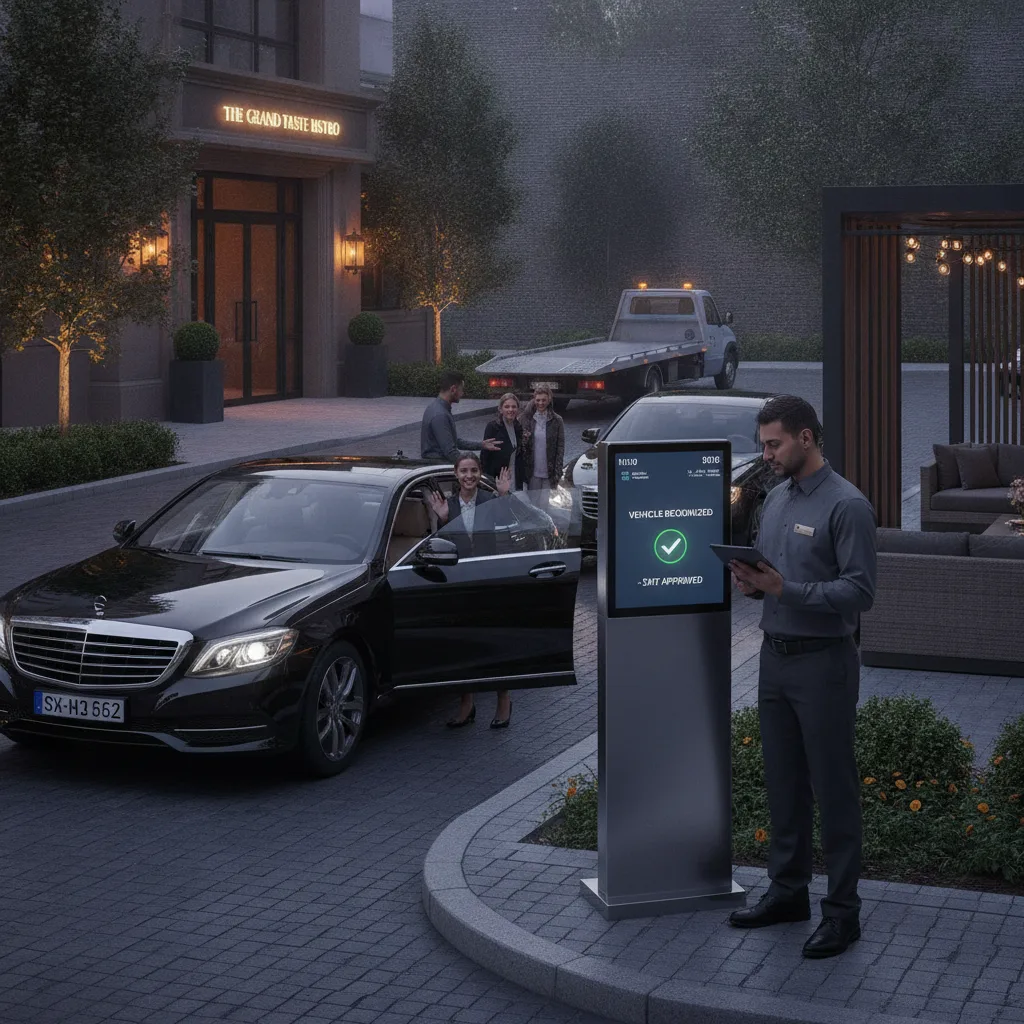
Short answer: Restaurant valet operators reduce lost valet ticket problems by never relying on the paper stub as the only proof of a claim — pairing it with a plate-based vehicle record captured at drop-off, so a lost ticket becomes a quick match against the guest’s description and the dining party rather than a hold-up at the door while a table is trying to turn over.
A lost ticket at a restaurant hits differently than at a hotel. Diners are already standing at the host stand, often with a car full of people waiting, sometimes mid-conversation about splitting the check, and the valet stand usually has one or two people working a curb that’s also trying to keep the next reservation’s parking spot clear. There’s no room for a ticket search to become a ten-minute production.
Why “what table were you at” isn’t enough
It’s tempting to use the dining context as the shortcut — “you were at table 12, here’s your car” — but that’s exactly where mistakes happen. The person picking up the car isn’t always the person who dropped it off. A couple might split up, with one person leaving early by rideshare while their car sits until later. A group of four might send one person to get the car while the rest close out the bill. If the valet stand hands over a vehicle based only on which table someone says they sat at, it’s one easy step away from handing the wrong car to the wrong person.
The reservation or table number is a useful starting point for a conversation — it’s not a substitute for actually matching the person to a specific vehicle.
A workable lost-ticket process for a restaurant curb
- Ask for what they remember. Make, color, and approximate parking time are usually enough to narrow the search immediately, especially on a slow night.
- Check the vehicle record. If arrivals are logged by plate at drop-off (rather than relying on the ticket stub alone), a runner can confirm the match in seconds instead of walking the lot.
- Confirm identity before handoff. A quick ID check or a second identifying detail (last four of a phone number tied to the reservation, description of an item left in the car) closes the loop without turning it into an interrogation.
- Log the exception. Note that this vehicle was released without the original ticket, who approved it, and how it was verified — a two-line note is enough, but it needs to exist.
This whole process should take under a couple of minutes for the vast majority of lost-ticket cases. The goal isn’t more paperwork — it’s making sure the two-minute conversation actually verifies the right person instead of just being polite and handing over keys.
Keep it fast enough to protect table turn
A restaurant’s valet stand isn’t just a courtesy service — it’s part of how the dining room keeps moving. A slow, awkward lost-ticket exchange at the door creates a visible bottleneck right as other parties are trying to leave and new reservations are trying to arrive. Train hosts and runners on a version of the process that’s fast by design: a short, consistent script (“no problem, can you tell me the make and color, and about when you arrived?”) gets to the same verification without making the guest feel accused of anything.
Handle the harder cases with a manager, not a runner
Some situations shouldn’t be resolved at the curb by whoever’s working that shift:
- Two people both claiming the same vehicle.
- The person requesting the car doesn’t match any detail on file and can’t provide a second form of verification.
- Visible intoxication, where releasing a vehicle raises a separate safety concern regardless of ownership.
- A dispute about vehicle condition that comes up at the same time as the lost-ticket claim.
Have a clear rule: any of these situations gets escalated to a manager on duty, and the runner’s job is to hold the situation calmly, not to make the final call alone.
A worked example
A four-top closes out and one guest heads to the valet stand alone while the others finish paying. She doesn’t have the stub — her husband, still at the table, has it in his jacket pocket. Instead of waiting for him or guessing, the runner asks what the car looks like and roughly when they arrived, checks it against the arrival record from drop-off, confirms a quick detail (the reservation was under her name), and brings the car around. The whole exchange takes under two minutes and nobody had to walk back inside.
FAQ
Should we just stop using paper tickets entirely?
You can keep a paper stub for the guest’s convenience, but don’t make it the only proof of claim — the vehicle record captured at drop-off should be the actual source of truth.
How do we train new or seasonal staff on this quickly?
Keep the verification steps to a short, memorable script and pair new runners with an experienced one for their first few lost-ticket cases rather than handing them a written policy alone.
What if the restaurant doesn’t have its own valet lot and uses a shared curb?
The same verification steps apply — if anything, a shared curb makes accurate vehicle records more important, since more than one business’s guests may be mixed in the same queue.
For more on building a verified, ticketless intake process, see PLACA’s valet parking software for restaurants, the ticketless vehicle recognition system overview, and the valet parking knowledge hub.
Want to see how a plate-based record can speed up lost-ticket handling on a busy dinner shift? Contact PLACA or book a demo.
Data source: U.S. Department of Transportation