

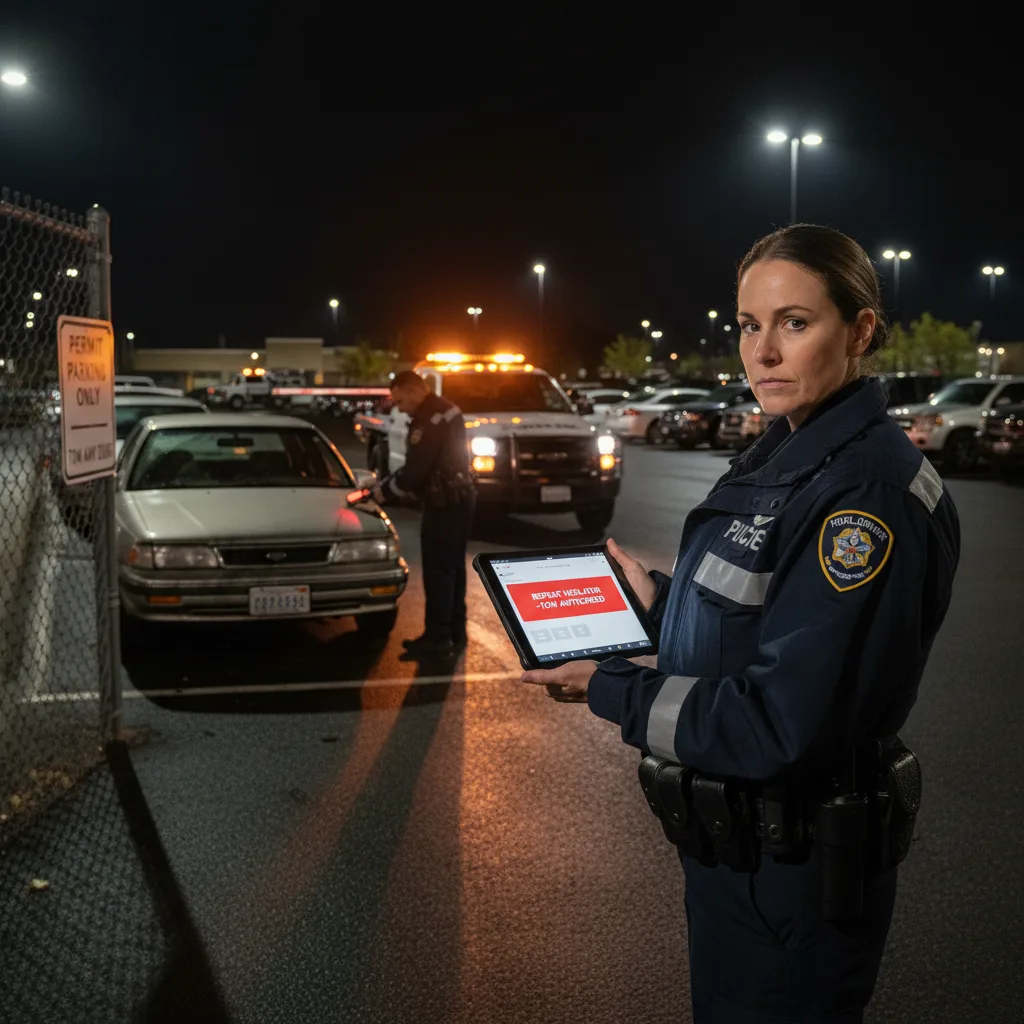
Direct answer: For night patrol teams, identifying a repeat violator depends on the plate read holding up in the dark as reliably as it does in daylight, and on the violation history actually carrying over between shifts and between the different patrollers who cover a route on different nights. A plate that comes back as a “first-time” violation because last week’s misread or a different patroller’s notes never made it into the shared record isn’t a repeat-violator problem — it’s a data-continuity problem that happens to show up most on overnight shifts, where staffing is thinnest and handoffs are least formal.
Why Nighttime Capture Conditions Matter for Repeat-Violator Tracking
Plate reads at night depend on illumination in a way daytime reads don’t. Standard plates in the U.S. use a retroreflective coating designed to bounce light back toward its source, which is why infrared illumination paired with the camera is the standard approach for reliable nighttime capture — without it, headlight glare, uneven lot lighting, and motion blur from a vehicle pulling into a space all raise the odds of a partial or failed read. For a night patrol team, that matters specifically for repeat-violator identification: a single bad read doesn’t just miss one event, it can break the chain that would otherwise link tonight’s vehicle to last week’s.
Where this shows up in practice: a vehicle parked in a dim corner of a lot, angled so headlight glare washes out part of the plate, gets logged with a low-confidence read. If that read doesn’t match cleanly against the same vehicle’s prior entries, the system — or a patroller working from a paper log — treats it as a new vehicle rather than a fourth occurrence, and a pattern that should have triggered escalation never does.
Night Patrol Teams: What Reliable Repeat-Violator Tracking Requires After Dark
| Condition | Why it matters at night | What closes the gap |
|---|---|---|
| Low-light plate capture | Glare and uneven lighting reduce read confidence more than in daylight | IR-paired capture and a defined low-confidence review step |
| Shift-to-shift handoff | Overnight coverage often rotates between different patrollers on different nights | A shared violation history, not a personal notebook |
| Sparse staffing | Many properties run a single overnight patroller across a route | A route that prioritizes known problem zones first |
| Pattern definition | What counts as a “repeat” needs a fixed rule, not a patroller’s memory | A written definition tied to plate, property, and time window |
The Staffing Problem Overnight Shifts Have That Day Shifts Don’t
Most properties run overnight patrol leaner than daytime coverage — often a single patroller covering a route that a daytime team might split between two or three people. That has a direct effect on repeat-violator identification: with less time per pass and no second person to double-check an ambiguous read, the temptation is to keep moving rather than stop and verify. A route that treats every stop the same wastes that limited time; a route that prioritizes zones with known repeat-violator activity from prior nights makes better use of it.
Overnight-specific violations compound this. Many properties enforce rules that only apply between set hours — no overnight parking without a permit, reserved spaces that revert to open parking during the day but not at night — which means the violation itself only exists during the patrol window, and the only record of it is whatever the overnight patrol captured. If that record doesn’t carry forward cleanly to the next night’s patroller, the property loses visibility into exactly the pattern that overnight enforcement exists to catch.
Building a History That Survives the Handoff
The fix isn’t a better patroller — it’s a record that doesn’t depend on the same person working the route every night. That means every flagged vehicle needs a timestamp, a location, a confidence level on the plate read, and a place the next night’s patroller can check before assuming a vehicle is new. When a read comes back low-confidence, the record should say so explicitly rather than silently treating it as a clean match or a non-match — a human reviewer can then decide whether it’s the same vehicle as a prior low-confidence entry.
Escalation Checklist for Night Patrol
- Define how many occurrences, in what window, constitute a repeat violation — and make that definition available to every patroller, not just the one who set it.
- Flag low-confidence nighttime reads separately from clean matches, and review them before they’re dropped from the pattern count.
- Prioritize patrol passes toward zones with recent repeat-violator activity when staffing only allows for one pass per shift.
- Confirm violation records are visible to whichever patroller works the next shift, regardless of who worked the last one.
- Review the overnight-only violation windows (permit hours, reserved-space rules) separately from all-day rules, since they only generate evidence during the patrol shift itself.
Measuring Whether the Pattern Is Actually Being Caught
Track how often a vehicle is later confirmed as a repeat violator after initially being logged as new, since that gap is the clearest sign of a broken handoff or a missed low-confidence match. Track low-confidence read rates by location, since that points to specific lighting gaps worth fixing rather than a general capture problem. And track how patrol time is actually spent across a shift — if the same single patroller is covering the same ground every night regardless of where repeat activity is concentrated, the route, not the camera, is the bottleneck.
Related PLACA.AI planning resources
Risk questions
Why does a repeat violator sometimes show up as a first-time violation?
Usually because a prior read came back low-confidence due to glare, poor lighting, or motion blur, and wasn’t matched to the vehicle’s history — or because the record from a prior night’s patroller never reached the next shift.
What’s different about tracking repeat violations overnight versus during the day?
Staffing is thinner, often a single patroller per route, and many of the rules being enforced — overnight-only permit requirements, reserved spaces that revert at night — only generate evidence during the patrol shift itself, so there’s no daytime record to fall back on.
How should low-confidence nighttime reads be handled?
They should be flagged and reviewed rather than silently dropped or silently counted as a clean match, since either extreme either hides a real pattern or creates a false one.
Plan a limited workflow review
Bring the current rule, process, exceptions, and success criteria for identifying repeat violations for night patrol teams. PLACA.AI can help evaluate a bounded pilot without assuming another property’s workflow is the right answer.
Editorial refresh: July 22, 2026. Independently confirm current product capabilities, third-party features, pricing, contracts, governing requirements, and local rules before acting.
Data source: U.S. Department of Transportation