

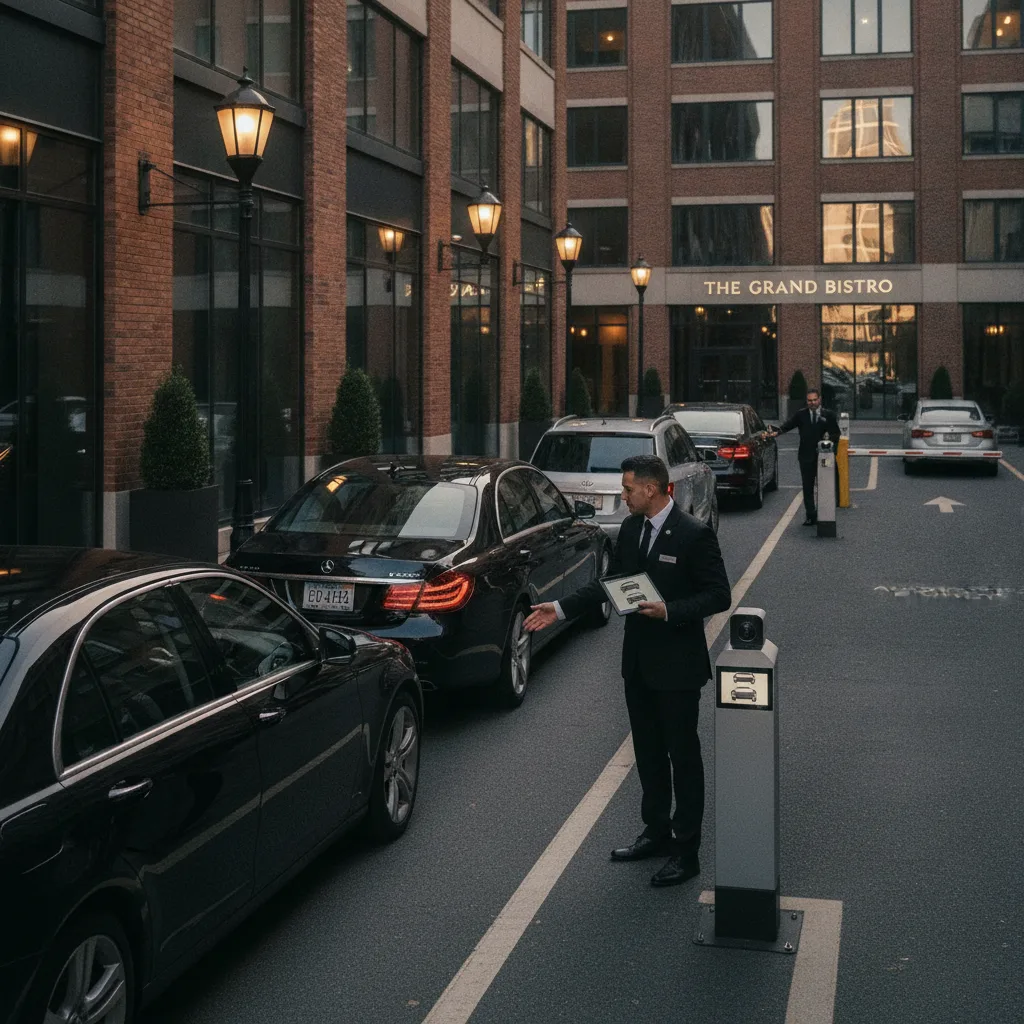
Direct answer: Restaurant valet operators manage peak arrival surges by staffing to the dinner reservation curve rather than a flat shift schedule, keeping the curb itself moving (not just the lot), and using ticketless vehicle recognition so retrieval at the end of the night — when many tables turn over and leave within the same 30-minute window — doesn’t create a backup that spills onto the street or sidewalk.
Restaurant valet surges are short and sharp compared to a hotel’s all-day trickle: most of the pressure concentrates into two windows, the 6:30–8:00 dinner rush and the corresponding retrieval wave 90 minutes to two hours later as tables turn. And unlike a hotel or venue with a large dedicated lot, restaurant valet often runs on a tight urban curb with limited stacking space, sometimes competing with delivery drivers, rideshare pickups, and street parking regulations. Managing the surge is as much about curb geometry as it is about staffing.
Map the surge to your actual reservation pattern, not a generic dinner-rush assumption
Every restaurant’s arrival curve is shaped by its reservation book, not just “Friday night is busy.” Pull your reservation and walk-in data for the last several comparable nights (same day of week, similar covers) and look at:
- The first seating wave: Reservations clustered around 6:00–6:30 create one arrival spike.
- The second seating wave: An 8:00–8:30 turn creates a second spike that often overlaps with the first wave’s departures — this overlap is where curb congestion is worst.
- Walk-in and bar traffic: Less predictable than reservations, but usually concentrated in the same windows, adding volume on top of the reservation curve rather than spreading it out.
Staff your heaviest curb coverage to the overlap points — where one wave’s arrivals meet the previous wave’s departures — rather than evenly across the whole dinner period.
The curb is usually the real bottleneck, not the lot
At most restaurants, valet capacity isn’t limited by how many cars the storage lot can hold — it’s limited by how many cars can physically queue and be processed at the curb without blocking the street or a neighboring business. A few practical levers:
- Keep the curb moving, not full. A car sitting at the curb waiting for a key-in or a runner is worse than a slightly longer walk to a staging area — an idle car at the curb blocks the next arrival.
- Pre-position runners before the wave hits, not after. If your reservation data shows a spike at 6:15, have runners staged and ready at 6:00, not scrambling once the queue has already formed.
- Have a documented overflow plan. If your primary lot fills during a surge, know in advance where the next car goes — a secondary lot, a garage arrangement, or a clearly defined walking distance — rather than improvising mid-rush.
Why the retrieval wave, not the arrival wave, causes the worst backups
Arrivals are spread out somewhat by reservation times, but departures cluster hard: a table that was sat at 7:00 and finishes dinner around 9:00 often leaves within minutes of several other tables from the same seating wave. That means your retrieval-side staffing needs to be, if anything, heavier than your arrival-side staffing during the second half of a dinner service.
This is where ticketless vehicle recognition earns its keep specifically for restaurants: when six parties want their cars back within the same ten minutes, a runner who can identify a car by plate instead of hunting for a matching ticket stub moves faster, and any runner — not just the one who happened to park that specific car — can retrieve it. That flexibility matters most exactly when you’re short-handed during the retrieval crunch because everyone’s also trying to help close out the dining room.
Coordinating valet timing with the host stand
The host stand controls table pacing, and valet controls curb pacing — but they’re rarely looking at the same information in real time. A simple radio or messaging handoff (a table requesting the check, or a large party finishing dessert) gives the valet team a few minutes’ lead time to have that party’s car ready, which smooths the retrieval spike rather than letting six requests land on the curb team simultaneously.
FAQ
How many valet staff do we need for a typical dinner rush?
There’s no fixed ratio — it depends on your curb’s physical capacity and your reservation volume. Use your own timestamped arrival and retrieval logs from recent comparable nights as the baseline, and adjust for known factors like a private event or holiday.
What’s the single biggest fix for a chronically backed-up curb?
Usually it’s staffing the retrieval side more heavily relative to the arrival side — most restaurants over-staff greeters for the arrival wave and under-staff runners for the compressed retrieval wave that follows.
Should we cap valet intake during the worst of the rush?
If your curb or lot genuinely reaches capacity, a brief, clearly communicated hold (with a documented overflow option) is better than accepting cars you can’t process quickly — a long visible backup does more damage to the guest experience than a short, well-managed pause.
For more on restaurant valet operations, see the valet operations knowledge hub, valet parking software for restaurants, and the ticketless valet system guide.
Smooth out your dinner-rush curb
Talk to PLACA.AI about setting up ticketless vehicle recognition so your retrieval team can keep pace with your busiest seating waves.
Data source: U.S. Department of Transportation