

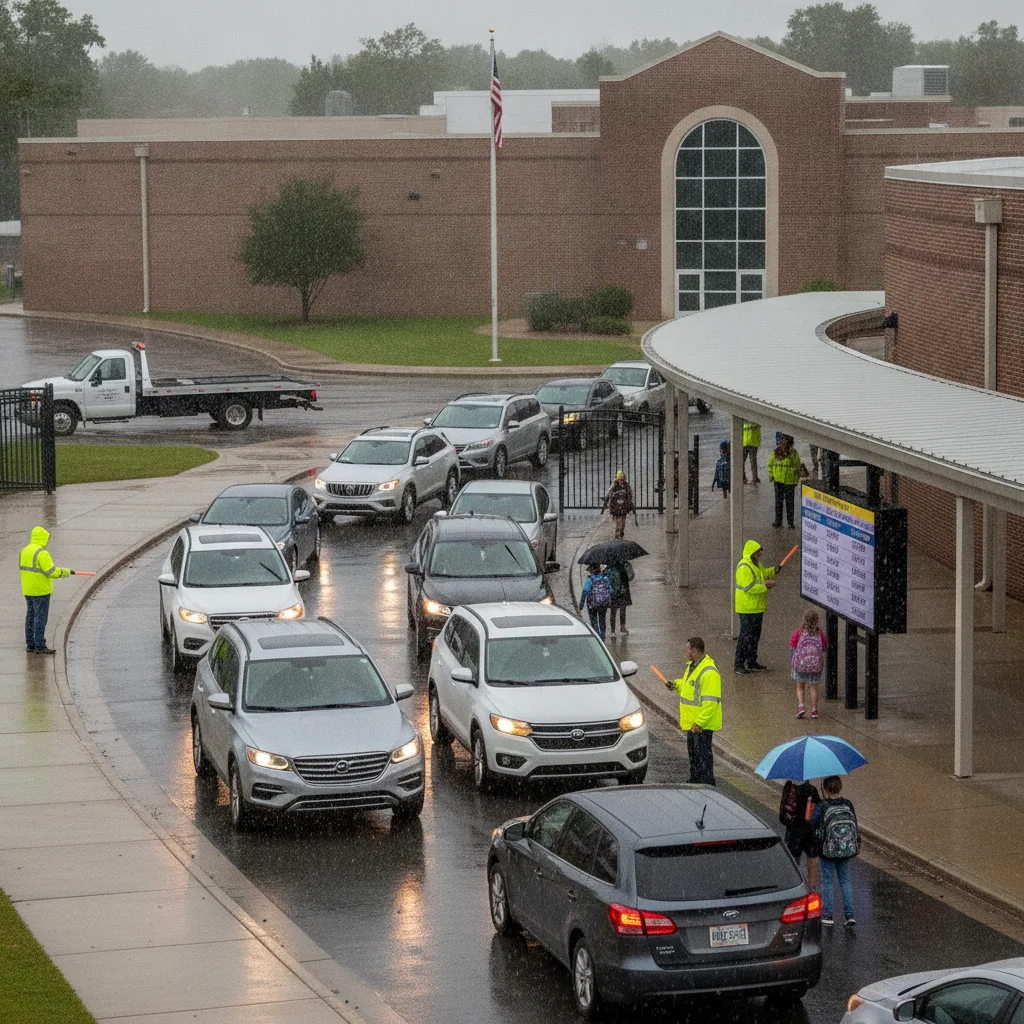
Direct answer: A rainy-day carline backup hits elementary campuses harder than any other grade band because five- to ten-year-olds move slower in the rain, need an adult’s hand to cross a wet lane safely, and cannot be expected to hustle to a car the way a middle schooler can. Cut the backup by shrinking the release batch size rather than trying to speed children up, keeping covered staging capacity matched to how many students actually fit under it at once, and giving the person who calls the rain plan the authority to activate it before the line backs up – not after parents are already circling the block.
This guide is for elementary principals, assistant principals, and the teachers, aides, and volunteers who staff dismissal, and it is scoped specifically to what changes about carline backups when the students being moved are young children rather than teenagers.
Rain doesn’t just slow traffic – it slows children
Most rainy-day dismissal plans are written like traffic plans: more lanes, faster loading, a bigger overflow lot. That misses where the actual time gets lost at an elementary campus. A kindergartner in a rain jacket, carrying a backpack, holding an umbrella they can barely manage, moving across a wet curb toward a car they have to be helped into, simply takes longer than the same walk on a dry day – and multiplying that by twenty or thirty students per release group is what actually backs up the line, not the number of lanes. A plan built only around vehicle throughput will still fail on a rainy Tuesday because it never accounted for the fact that the bottleneck is upstream of the cars, at the covered curb where children are staged.
Example: A first-grade class of twenty-two waits under a covered walkway built for maybe fifteen. On a dry day, the extra seven simply stand a few feet into the open and it doesn’t matter. In the rain, those seven either get wet standing exposed, or staff try to squeeze everyone under cover and lose the ability to see which child belongs to which car. Neither is acceptable, and it happens every time it rains until someone actually measures covered capacity against typical class size and adjusts the release groups accordingly.
What actually changes for young children in the rain
| Dry-day assumption | Why it fails in the rain | The rain-plan adjustment |
|---|---|---|
| Students walk themselves to the car | Wet pavement, umbrellas, and puddles slow a young child dramatically | An adult escorts each student the last few steps to the vehicle |
| Covered space fits “most” of a class | Exposed students get soaked or crowd forward unsafely | Release groups sized to actual covered capacity, not class roster size |
| Siblings find each other in the mix | Younger children can’t reliably locate a sibling in a crowded, rainy staging area | Sibling groups staged together before release, not left to self-sort |
| Staff can visually track every child | Hoods, umbrellas, and rain reduce visibility of faces and names | Smaller groups and a named staff member per zone, not one roving monitor |
Activation has to happen before the line exists, not after
By the time cars are visibly backed up onto the street, it is too late to activate a rain plan gracefully – staff are now trying to change the process in the middle of executing it, with students already staged and parents already arriving. Whoever owns the activation decision needs a trigger that fires on forecast or early radar, not on watching the line grow from the office window. A short daily check – is rain likely during the dismissal window, yes or no – costs almost nothing and avoids the far more expensive alternative of mid-dismissal improvisation. Elementary campuses that still coordinate this by radio and gut feeling should also look at the broader emergency dismissal drill workflow, since the discipline of a pre-planned trigger applies to weather delays just as much as it does to a true emergency.
Matching cars to children faster, without rushing anyone
The other lever elementary campuses have that older grades don’t is how the car itself gets matched to the waiting child. If staff are still cross-checking a paper roster or a laminated tag against every arriving vehicle in the rain, that manual lookup adds real seconds to every single release – seconds that compound across dozens of cars into the exact backup you’re trying to avoid. Matching the vehicle automatically as it approaches, so staff already know which child to bring forward before the car reaches the curb, removes that lookup delay without asking anyone to move faster than is safe for a young child on wet pavement. This is also where a dedicated kindergarten car-seat workflow pays off, since the youngest students already take the longest to load even in dry weather.
What to measure before expanding the process
- rain plan activated before the line visibly backed up
- students staged within actual covered capacity, not over it
- sibling groups released together on the first attempt
- time from vehicle arrival to student loaded, rain versus dry day
- students still waiting at the final bell on a rain day
Owner sign-off
- State the purpose and non-goals for managing rainy-day carline backups at this elementary campus.
- Name who owns the activation decision and how early it has to fire.
- Test with the actual aides and volunteers who staff the curb, not just administrators watching from inside.
- Confirm contracts, pricing, support, integrations, and data handling independently.
- Retain enough of a record to review what worked and what didn’t after the next real storm.
Related PLACA.AI planning resources
Decision questions
What must be approved first for managing rainy-day carline backups at an elementary campus?
Who triggers activation and how early, how covered space is matched to actual release group size, and how staff track sibling groups and student identity when visibility is reduced.
What should the pilot reproduce?
An actual rainy dismissal with normal staffing, at least one sibling-group release, and one moment where covered capacity is tested against a full class group.
When should rollout pause?
If activation still happens after the line has already backed up, if covered space is regularly over capacity, or if staff cannot reliably track which child belongs to which arriving vehicle.
Plan a limited workflow review
Bring the current rule, process, exceptions, and success criteria for managing rainy-day carline backups at this elementary campus. PLACA.AI can help evaluate a bounded pilot without assuming another campus’s workflow is the right answer.
Editorial refresh: September 18, 2026. Independently confirm current product capabilities, third-party features, pricing, contracts, governing requirements, and local rules before acting.
Data source: National Center for Education Statistics