

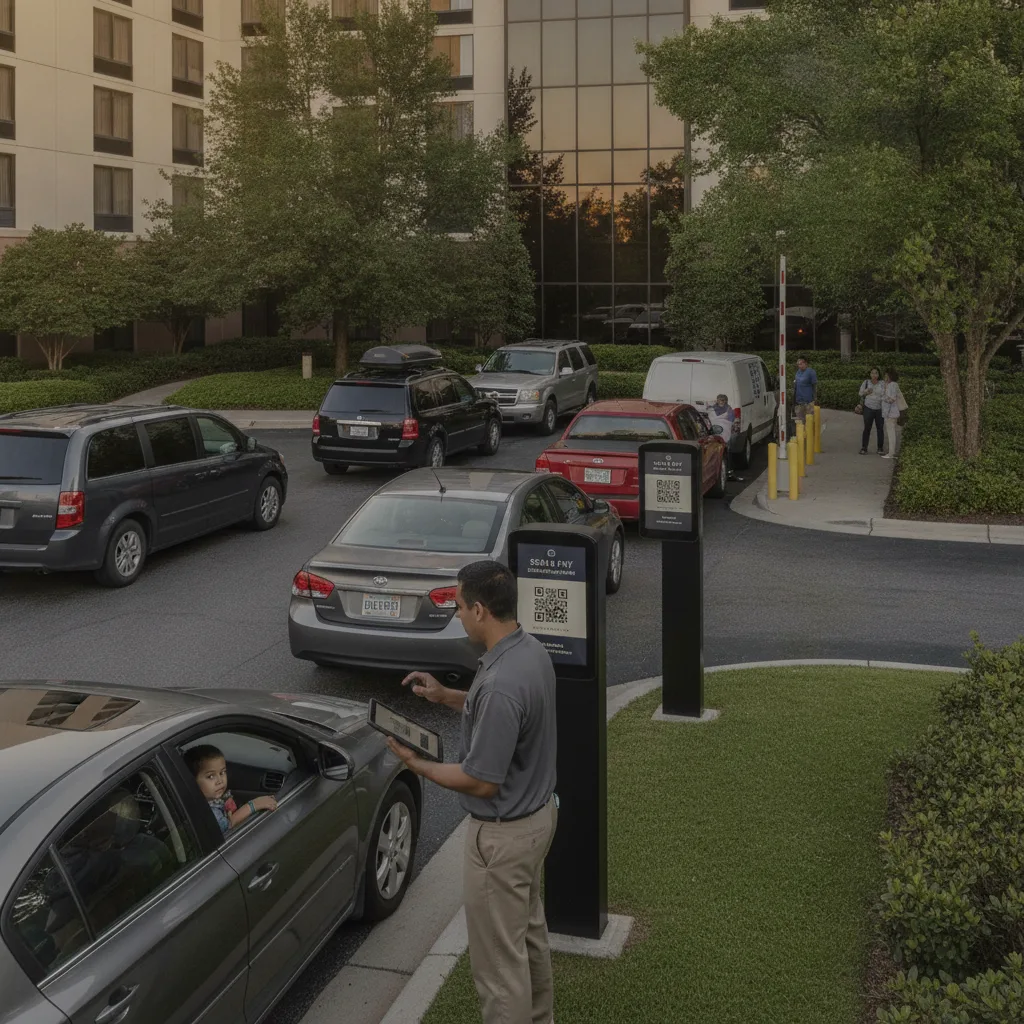
Direct answer: For hotel parking teams, “simplify guest parking payments” mostly means getting the parking charge onto the right folio the first time — matching a plate to a reservation, distinguishing overnight guests from restaurant or banquet visitors, and routing valet and self-park charges through the property management system (PMS) instead of a separate standalone payment step that guests have to manage themselves.
A hotel’s parking situation is structurally different from a standalone lot: the driver is already a guest of the property, already has a reservation or a reason for being there, and in most cases would rather see one line on checkout than a separate parking receipt. The simplification opportunity is folio integration and accurate guest-type matching, not just reducing steps at a kiosk.
Match the plate to the stay, not just the space
A guest’s parking charge should follow their length of stay and rate plan, not a flat per-day rate applied uniformly. An overnight guest on a package that includes parking, a guest paying nightly parking separately, a restaurant patron eligible for a short validated period, and a banquet or event attendee with a different comped or discounted rate all need to resolve to the correct charge automatically once the plate is captured at arrival. Getting this match wrong is what generates both guest complaints and front-desk rework at checkout.
Where valet and self-park handoffs create risk
| Handoff point | What can go wrong | Simplification without new hardware |
|---|---|---|
| Valet arrival | Valet ticket isn’t linked to the room reservation, so the charge lands on a separate receipt instead of the folio | Capture the plate at drop-off and match it against the reservation system already integrated with the PMS |
| Self-park entry | Guest parks without checking in first, so there’s no reservation record yet to match against | Allow a short grace window before the session needs to resolve to a folio, matched retroactively once check-in completes |
| Restaurant or event validation | Non-overnight guest gets charged the overnight rate, or a valid overnight guest gets double-billed via both folio and a separate parking charge | Route validation through the same point-of-sale system that already tracks restaurant or banquet transactions |
| Checkout | Parking charge appears as a surprise line item guests don’t recognize | Itemize parking clearly on the folio at the time it’s applied, not just as a lump sum at checkout |
Execute the workflow across guest types
- Capture the plate at the earliest point of contact — valet drop-off or self-park entry — and hold it against a short grace window if the reservation isn’t yet in the system.
- Match against the PMS reservation to apply the correct rate: included in the room rate, nightly add-on, or ineligible for a room charge at all (walk-in day parking, for example).
- Route restaurant and event validation separately from overnight guest billing, using the existing point-of-sale or event system rather than a manual comp code applied at the gate.
- Reconcile before checkout, so front desk staff see a resolved parking line rather than discovering an unmatched charge while a guest is standing at the counter.
When to pull a case off the automatic path
Stop automatic folio matching and route to a person when the plate doesn’t match any active reservation, when a guest disputes a charge at checkout, or when a comp or discount code doesn’t align with what the event or restaurant system shows. A named staff member — typically the same shift supervisor who handles other guest billing exceptions — should own these cases, since they usually require a quick judgment call rather than a policy lookup.
Measure the site pilot
- Share of plates matched to the correct folio automatically, without front-desk intervention
- Wrong-rate corrections needed at checkout, by guest type
- Validated (restaurant or event) sessions billed correctly on the first pass
- Guest disputes tied specifically to a parking line item
Review packet
- Confirm the rate logic for every guest type — included, add-on, validated, and walk-in — is documented and matches what’s actually configured in the PMS.
- Verify the grace window for unmatched plates doesn’t create a gap valet or self-park guests can exploit.
- Check that restaurant and event validation routes through the correct point-of-sale integration, not a manual override.
- Keep a record of every manual correction for revenue reconciliation.
Related PLACA.AI planning resources
Site questions
How is guest parking billing different from a standalone lot?
The charge needs to route through the property management system and match a specific guest’s rate plan — included, add-on, validated, or ineligible — rather than resolving to a flat rate at a kiosk.
What happens if a guest parks before checking in?
Hold the session against a short grace window and match it retroactively once check-in creates the reservation record, rather than charging a walk-in rate that has to be corrected later.
How do we avoid double-charging a guest for parking?
Route restaurant and event validation through the same point-of-sale or event system that already tracks those transactions, so a validated session doesn’t also generate a separate overnight charge.
Plan a limited workflow review
Bring your current rate logic by guest type and how parking currently connects (or doesn’t) to your PMS. PLACA.AI can help evaluate where plate capture and folio matching remove manual work at checkout.
Editorial refresh: September 18, 2026. Independently confirm current product capabilities, third-party features, pricing, contracts, governing requirements, and local rules before acting.
Data source: U.S. Department of Transportation