

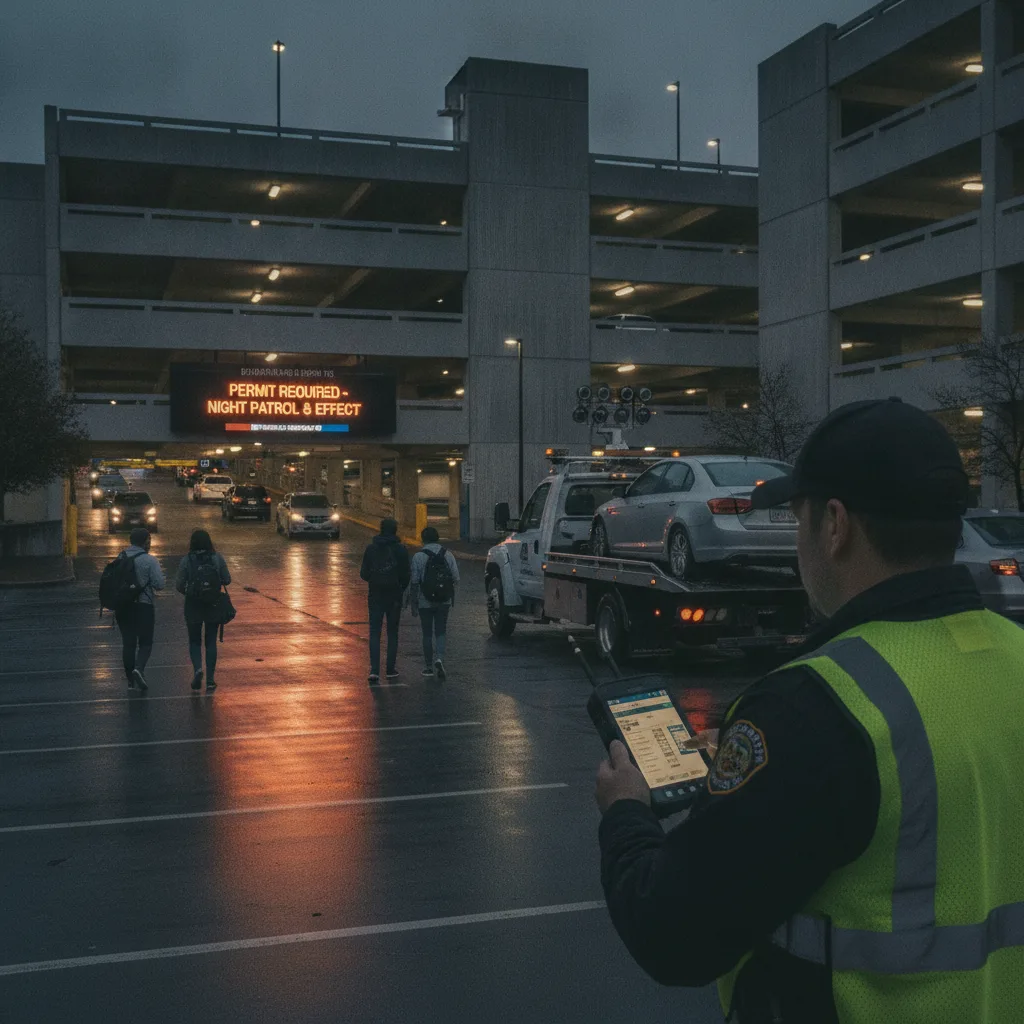
Direct answer: Managing an overnight patrol route is a different planning problem than a daytime route, mostly because of two constraints daytime routes don’t carry the same way: a single patroller is often covering ground that would be split between two or three people during the day, and lone-worker safety has to shape the route itself, not just be a policy on paper. A route built by copying the daytime sequence and running it at night usually skips the same difficult stops every time, because those are exactly the stops a solo overnight patroller has the least incentive to slow down for.
Why Overnight Routes Need Their Own Design, Not a Night Copy of the Day Route
Daytime patrol routes are usually built around traffic patterns, complaint volume, and staffing that allows a stop to be handled by whoever’s closest. Overnight routes run into different limits: fewer patrollers covering the same or a wider set of properties, lighting that varies a lot from one lot to the next, and enforcement windows tied to overnight-only rules — no-overnight-parking policies, reserved spaces that revert to restricted status after a set hour — that only apply during the exact hours the patrol is running. A route sequence that made sense during the day doesn’t automatically make sense once the constraints change.
Where this shows up in practice: a remote or poorly lit lot at the far end of a multi-property route keeps getting pushed to the end of the shift, or skipped when the patroller is running behind — not because it doesn’t need coverage, but because it’s the stop a solo overnight patroller is least comfortable lingering at alone. Over weeks, that lot quietly becomes the one with the least enforcement, and often the one where violations accumulate.
Night Patrol Teams: What an Overnight Route Has to Account For
| Factor | Overnight-specific issue | What a workable route does about it |
|---|---|---|
| Staffing ratio | One patroller often covers ground split between multiple people during the day | Sequences stops by priority instead of geographic convenience alone |
| Lone-worker safety | No second person to back up a patroller at a poorly lit or isolated stop | Sets a check-in cadence and a defined response if a check-in is missed |
| Enforcement time windows | Overnight-only rules only generate a violation during the exact hours patrolled | Times the route so those windows are actually covered, not assumed |
| Travel time between properties | A wider service area at night can eat the time meant for the stops themselves | Accounts for drive time explicitly rather than padding stop time to compensate |
The Safety Constraint That Actually Shapes the Route
Lone-worker safety on overnight patrol isn’t just a policy statement — it changes which stops get skipped and when. A patroller working alone has a real reason to move quickly through a poorly lit or isolated lot rather than linger to document a marginal case, and a route plan that doesn’t account for that will keep losing coverage at exactly those stops. A defined check-in schedule, with a specific response if a patroller misses one, gives a solo overnight worker a reason to take the time a difficult stop needs instead of treating speed as the only safety strategy.
Timing the Route to the Rules, Not Just the Shift
Overnight-only violations — no-overnight-parking without a permit, reserved spaces that convert to restricted after a set hour — only exist as enforceable violations during the specific hours those rules apply. A route that reaches a property before the restricted window starts, or well after it, records nothing useful for that rule even if the patroller physically passed through. Building the route around when each property’s overnight rules are actually in effect, rather than an even time split across every stop, is what keeps the patrol producing evidence instead of just mileage.
Route Design Checklist
- Sequence stops by known problem-zone priority first, not purely by geographic convenience, when one patroller is covering ground a daytime team would split.
- Set a check-in cadence for solo overnight patrollers, with a defined escalation if a check-in is missed.
- Confirm each property’s overnight-only enforcement window, and time the route so the patrol actually passes through during those hours.
- Account for drive time between properties explicitly, rather than compressing stop time to make the schedule work on paper.
- Review which stops are routinely shortened or skipped, and treat a recurring pattern there as a route design problem, not a performance issue with the patroller.
Measuring Whether the Route Is Actually Working
Track completion by stop, not just by shift, since an overall “route completed” figure can hide the same one or two difficult stops being shortened every night. Track how often a patrol pass falls outside a property’s actual overnight enforcement window, since that points to a timing fix rather than a staffing fix. And track missed check-ins separately as a safety metric, not folded into general route performance, since the two point to different corrections.
Related PLACA.AI planning resources
Questions before expansion
Why doesn’t a daytime route sequence work well when run overnight?
Overnight staffing is usually thinner, often one patroller covering ground split between several people during the day, and lighting and lone-worker safety constraints change which stops actually get full attention versus a quick pass-through.
What’s the most common way overnight routes lose coverage without anyone deciding to cut it?
A poorly lit or isolated stop keeps getting pushed to the end of the shift or shortened, not because it’s unimportant, but because it’s the stop a solo patroller has the least incentive to linger at. Over time that stop quietly gets the least enforcement.
How should overnight-only enforcement windows factor into route timing?
The route needs to actually pass through each property during the specific hours its overnight-only rules apply — arriving before or after that window produces no usable record for that rule, even if the stop was physically covered.
Plan a limited workflow review
Bring the current rule, process, exceptions, and success criteria for designing overnight patrol routes for night patrol teams. PLACA.AI can help evaluate a bounded pilot without assuming another property’s workflow is the right answer.
Editorial refresh: July 22, 2026. Independently confirm current product capabilities, third-party features, pricing, contracts, governing requirements, and local rules before acting.
Data source: U.S. Department of Transportation