

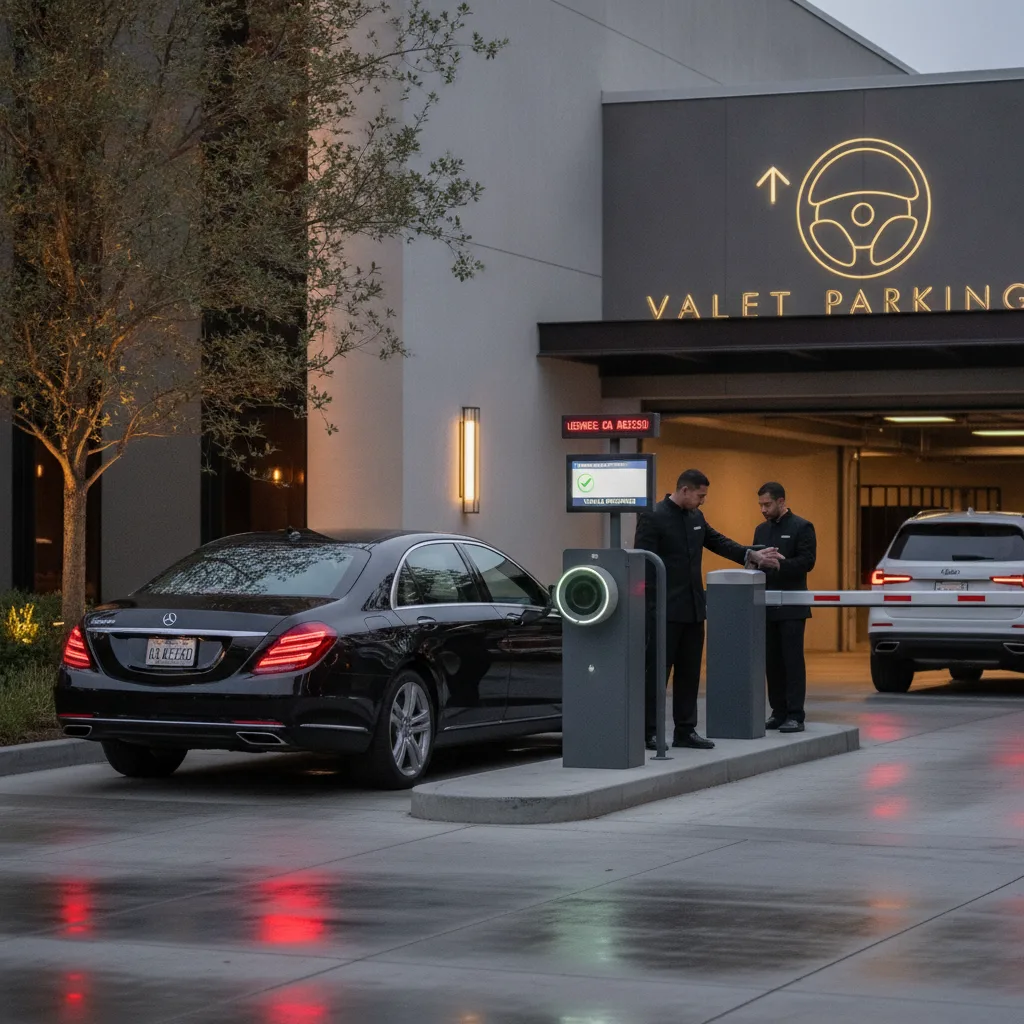
Short answer: Restaurant valet liability disputes usually surface within minutes of the car coming back, not days later — a scuff the guest swears wasn’t there, a claim their car was “parked somewhere it shouldn’t have been,” or confusion about who in the party is actually authorized to take the keys. Because restaurant valet runs on short custody windows and high turnover, the fix isn’t more paperwork at the podium — it’s a fast, accurate record tied to the plate that your manager can pull up before the guest even finishes explaining the problem.
Why restaurant valet liability plays out differently than hotel or event valet
A hotel valet holds a car for days. A restaurant valet holds it for the length of a meal — typically 60 to 150 minutes — but does it dozens of times a night, often with cars stacked nose-to-tail in a small lot, a loading zone, or a leased spot down the block. The liability exposure isn’t custody duration, it’s volume and turnover: more vehicles in and out per hour means more handoffs, more chances for a mismatched key, and less time per car for a careful condition check.
Add in the reality that many restaurant valets are run by a third-party valet company under a service agreement with the restaurant, not restaurant employees, and liability questions immediately become a two-party conversation: whose insurance responds, and does the restaurant’s lease or landlord agreement require the valet vendor to carry specific coverage limits.
Where restaurant valet claims come from
The stacked lot and the “someone moved my car” complaint
Small lots and curbside stands often require stacking or relocating cars mid-service to keep the flow moving during a rush. If a car gets moved and the guest wasn’t told, that’s a common source of complaints — even when nothing happened to the vehicle. A movement log tied to timestamps answers the “where was it” question before it becomes a bigger dispute.
Wrong-party pickup
A party of six leaves together, and whoever reaches the valet stand first says the table number. Without matching that person against who dropped the car off, you risk releasing a vehicle to the wrong guest — which is both a liability and a safety issue, especially if alcohol was involved in the meal.
Curb and loading zone incidents
Restaurant valet frequently operates on public curb space, fire lanes with special permits, or adjacent lots. Fender-benders during the shuffle in and out of tight curb spots are common, and because these happen on a public street, other drivers and pedestrians can be involved — raising the stakes beyond a simple guest-to-restaurant dispute.
Peak-rush handoff errors
Friday and Saturday dinner rush is when claims spike, simply because attendants are running multiple cars at once under time pressure. This is also when documentation habits break down first if the process depends on someone remembering to write a ticket note.
Building a record that fits how restaurants actually run valet
The process needs to work at the speed of a dinner rush, not slow it down.
- Arrival scan. Plate recognition logs the vehicle the moment it’s dropped, with a quick condition photo — no separate paper ticket to lose or hand off between attendants.
- Movement log. Any relocation during service (stacking, re-spotting for a departing car, moving off a loading zone) is timestamped and tied to the attendant who moved it.
- Identity match at retrieval. When a guest requests their car, the system matches against the original arrival record rather than relying solely on a table number or a name shouted across the stand.
- Same-night incident capture. If a guest raises a concern before leaving, staff can pull the arrival photo and movement history on the spot — often resolving it before the guest even gets to their car.
Handling the vendor-restaurant split
If valet is outsourced, your service agreement with the valet company should already spell out who’s responsible for what — but in practice, restaurant managers are the ones fielding the angry guest at 9pm on a Saturday, regardless of who technically employs the attendant. Two things help here: give restaurant management access to the same custody record the valet company keeps (so a manager isn’t stuck saying “let me call our valet vendor and get back to you”), and confirm your landlord or lease requires the valet operator to carry adequate garagekeepers and general liability coverage with the restaurant named as an additional insured. This is operational guidance, not legal advice — have your attorney or broker review the actual service agreement and certificates, not just the summary page.
Handling alcohol-adjacent situations
Restaurants carry an added wrinkle hotels and venues don’t face as often: a guest who appears intoxicated requesting their car back. Staff should have a clear, documented process for declining to release a vehicle in that situation (arranging a rideshare, calling a manager, offering to hold the car overnight) and logging that the refusal happened and why. This protects both the guest and the restaurant, and a documented record of the refusal is far more useful after the fact than staff recollection.
Practical steps to put in place
- Make plate-based arrival logging standard for every car, even during a slow Tuesday lunch — consistency is what makes the record useful later.
- Train attendants on a simple rule: never release a car without matching the requester to the arrival record, regardless of how confident they sound about the table number.
- Log every relocation, including quick re-spots during a rush, not just moves to a separate overflow area.
- Document intoxication-related refusals the same way you’d document a damage claim.
- Review your valet vendor’s certificate of insurance annually, and confirm it actually names your restaurant as an additional insured — not just a general liability policy that happens to exist.
Frequently asked questions
Who’s liable if a third-party valet company damages a guest’s car at our restaurant?
It depends on your service agreement and the specific coverage in place — this is a question for your broker or counsel, not a generic answer. What you can control operationally is having a clear custody record that shows when the damage most likely occurred, which helps whoever’s policy responds.
How fast do restaurant valet disputes typically need to be resolved?
Often same-night — the guest is standing right there. Having arrival photos and movement logs accessible in real time, not filed away in a back office, is what actually makes same-night resolution possible.
Should we log vehicle movements during a fast-paced rush, or just at drop-off and pickup?
Log every movement if the system allows it without slowing attendants down. Mid-service relocations are one of the most common sources of “someone moved my car” complaints, and they’re the easiest to resolve when there’s a timestamp.
PLACA.AI’s valet parking software for restaurants is built for exactly this kind of high-turnover, fast-paced environment, and the valet parking knowledge hub has more on setting up documentation that doesn’t slow down service. If you’d like to talk through how this fits your lot layout and peak-night volume, book a demo and we’ll walk through it.
Data source: U.S. Department of Transportation