

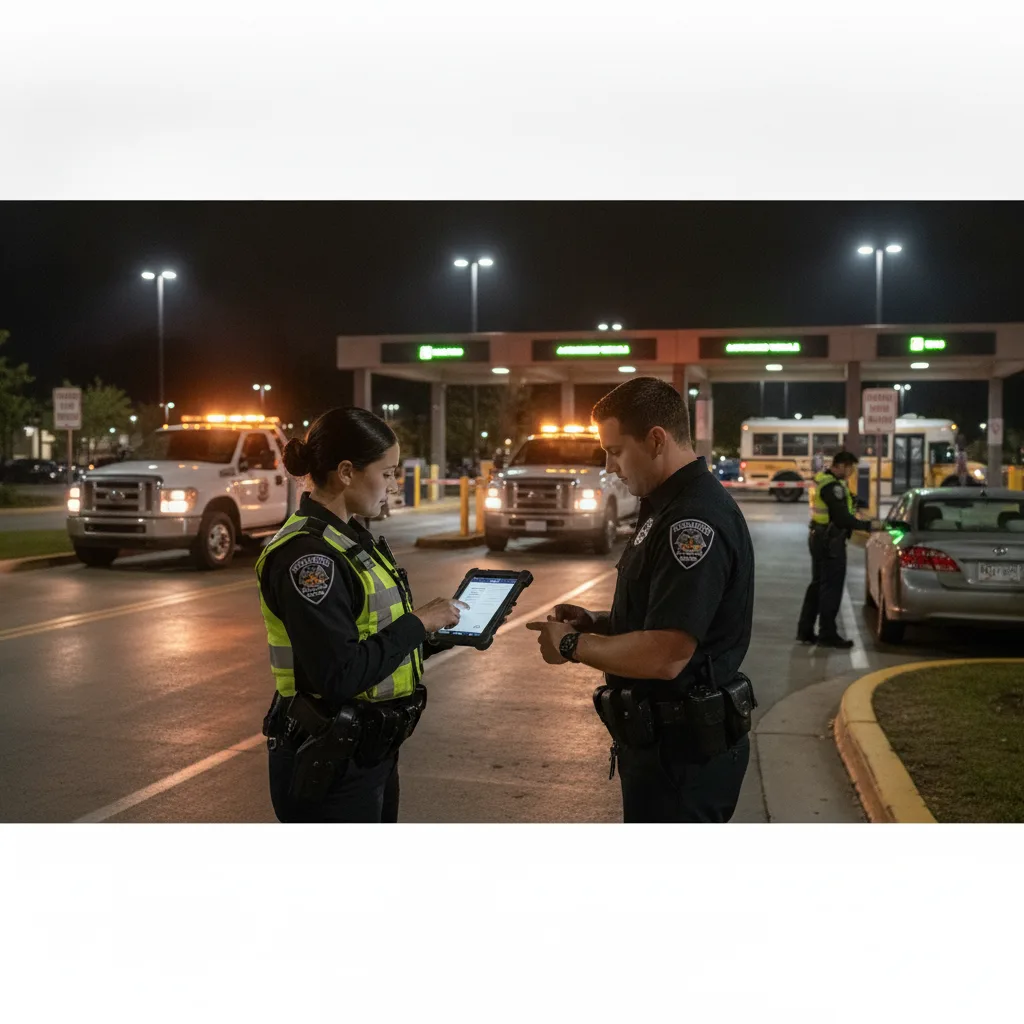
Direct answer: Training a night patrol driver on mobile LPR means layering two things on top of standard scanning skills: techniques for getting a clean plate read in bad lighting, and a safety-first decision process for working largely alone after the property office, on-site security desk, and most residents or employees have gone home. The technology doesn’t change at night — the conditions and the backup available to the driver do, and training has to account for both.
What actually changes after dark
A daytime patrol driver can usually get a second opinion — call the leasing office, flag down a coworker, or wait for a supervisor to swing by. A night patrol driver often can’t. That changes what “good training” means: it’s less about teaching the app and more about teaching judgment under reduced visibility and reduced backup.
Two practical realities drive the training priorities: plate capture is harder in low light and mixed lighting (sodium lot lights, headlights, shadowed rows), and a driver working a graveyard or late-evening shift alone needs a communication and safety routine that doesn’t depend on anyone noticing if something goes wrong.
Getting clean reads after dark
Camera technique for low light
- Angle matters more at night. Glare off a wet plate or a chrome frame under sodium lighting can wash out a read that would be trivial in daylight. Train drivers to shift angle slightly rather than move closer, since closing distance under a light pole often makes glare worse, not better.
- Know the device’s low-light limits. Every mobile LPR camera has a point where it stops reliably resolving characters — heavy shadow, unlit rows, fog. Teach drivers to recognize “the app is guessing” versus “the app has a clean read,” and to manually re-photograph a plate rather than accept a low-confidence match.
- Use the wide shot as your night insurance policy. A daylight violation is often provable from the plate alone plus a general position photo. At night, capture a wider context shot with visible lighting reference (a lit sign, a building number, anything that timestamps and locates the scene credibly) because a disputed night tow gets scrutinized harder — “how could you even see that at 2 a.m.” is a real question a driver needs to be able to answer with photo evidence, not just recollection.
What to do with a read you’re not confident in
The instinct for a new driver is to push forward and make a call anyway rather than admit the plate wasn’t clear. Train the opposite instinct directly: an unreadable or low-confidence plate is not a “probably fine, move on” situation — it’s a flag-and-return case. Have drivers note the space number or location and come back on the next pass rather than guessing at a character or forcing a partial match.
Working alone: safety and communication routine
This is the part of night patrol training that has nothing to do with the scanner and everything to do with keeping the driver safe, and it deserves as much structured attention as the app workflow does.
- Check-in cadence. Set a specific, non-negotiable check-in interval with dispatch or a supervisor — for example, a text or app ping at set points in the route, not just “call if something happens.” A missed check-in should trigger someone actually following up, not sit unnoticed until the next shift.
- Reading the scene before approaching a vehicle. Occupied vehicles, people nearby, or activity that doesn’t look like a resident coming home are reasons to hold off, not push through the scan for the sake of finishing the route. Train drivers on a simple rule: if a stop feels wrong, it’s fine to skip that vehicle and continue, then note it for daylight follow-up.
- De-escalation over documentation. A driver who gets confronted at night while scanning should prioritize disengaging safely over finishing the evidence capture. The tow or the citation can wait; a confrontation at 1 a.m. in an empty lot is not the moment to hold ground for a better photo.
- Know who to call, and when. Make sure new drivers have a clear, memorized (not just written-down) escalation path — property security line, local non-emergency police line, and their own dispatcher — and know which situations call for which.
The morning handoff: what night patrol should leave behind
Night shifts typically don’t have a supervisor reviewing decisions in real time, so the quality control has to happen the next morning instead. Build this into training from day one so new drivers understand their logged work gets reviewed, not just recorded.
- Flag, don’t guess, on stale data. Permit systems sync on their own schedule, and a night driver has less ability to call the office to verify an edge case. Teach drivers to log a flagged vehicle for morning review rather than towing on an ambiguous read when no one is available to confirm it.
- Leave a clean handoff note. Anything unresolved from the shift — an unreadable plate on a repeat offender, a vehicle that looked abandoned versus one just parked overnight, a scene the driver chose not to approach — should be logged specifically enough that the day team can pick it up without re-driving the whole route.
- Morning supervisor review. New night drivers should have their full shift’s dispositions reviewed against photo evidence each morning for the first couple of weeks, the same way a daytime new hire would get reviewed in real time. This is where drift gets caught early — a driver being too aggressive to finish the route faster, or too cautious and letting real violations slide.
Distinguishing abandoned, overnight, and violating vehicles
A common night patrol judgment call: a vehicle that hasn’t moved in several scans could be a resident’s second car, a legitimately parked overnight guest, or an actually abandoned vehicle. Train drivers to use the scan history (first-seen date, repeat flags) rather than a single night’s observation to make this call, and to treat “looks abandoned” as a multi-visit pattern to confirm, not a single-shift judgment.
Site questions
Do night patrol drivers need different equipment than day drivers?
Not necessarily different hardware, but they need to understand its low-light limits and default to re-capturing a plate rather than accepting a low-confidence read, since there’s usually no one nearby to double-check a call in person.
How should new night drivers be onboarded?
Start them on a daytime or early-evening shift first so the app workflow is second nature before layering in low-light capture and lone-worker safety protocols. Pair a first night shift with a supervisor or experienced driver rather than sending someone out solo on night one.
What’s the biggest risk with night patrol training done poorly?
Driver safety, ahead of enforcement accuracy. A driver who wasn’t trained to disengage from a confrontation, or who doesn’t have a real check-in routine, is a bigger operational risk than a missed or delayed tow.
Related PLACA.AI resources
- Parking enforcement software for towing companies
- Mobile LPR planning guide
- Parking enforcement LPR workflow guide
Want to see how PLACA.AI’s mobile LPR handles low-light capture and shift handoffs for night patrol teams? Get in touch or book a demo.
Data source: U.S. Department of Transportation