

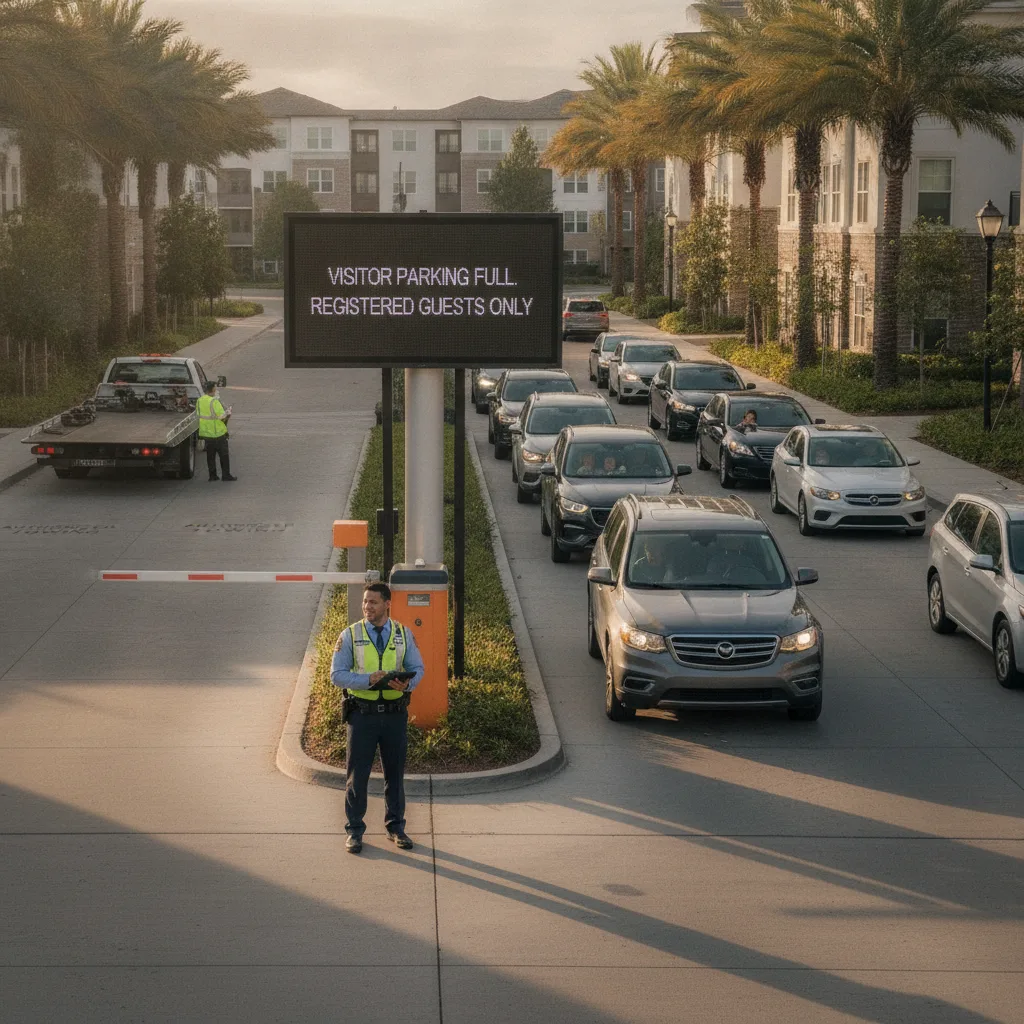
Direct answer: In a gated community, visitor parking abuse usually isn’t a stranger sneaking in — it’s a legitimately gate-authorized visitor who overstays the parking rules because entry permission got confused with parking permission. Join the gate log (who authorized entry, when, for how long) to the parking record (which space, for how long) so guards and patrol aren’t guessing which one governs.
This guide is for gated-community boards, guard staff, and patrol teams. The advantage gated communities have over open developments is a real access record; the risk is treating that access record as if it also answers the parking question.
Entry permission is not parking permission
A guest admitted at the gate on a call-ahead list, a delivery driver buzzed through, or a contractor with a standing pass all have permission to be inside the community. None of that tells you whether they’re allowed to leave a vehicle overnight in a specific space, use a spot reserved for a different unit, or block a fire lane. The most common visitor-abuse pattern in gated communities is a guest who was legitimately let in once and then keeps re-entering, or never leaves, without anyone re-checking whether the original authorization covered an extended stay.
Example: A weekend guest admitted Friday evening under a 48-hour call-ahead authorization is still parked in a visitor space the following Thursday. The gate log shows one valid entry; it doesn’t show that the visitor never left, because most gate systems only log entries and exits at the gate itself, not vehicle location once inside.
Where guard staff and parking enforcement need to talk to each other
| Decision point | Evidence or control | Required response |
|---|---|---|
| Invitation | sponsor, guest name, authorized dates, vehicle | set the parking window, not just gate access |
| Gate event | arrival timestamp, guard or system authorization | record access, flag if it exceeds the sponsor’s window |
| Parking check | space, zone limits, how long the vehicle has actually been present | confirm parking is still within the authorized window |
| Closure | departure, extension request, or violation notice | end the record or open a documented exception |
Building the workflow
- Set the parking window at the gate, not after. When a resident sponsors a guest, capture how long the vehicle is authorized to park, not just that entry was approved.
- Check parking status independently of gate status. A vehicle can still be inside the gate on a valid old entry while being well past its authorized parking window — patrol needs to check the vehicle, not just the log.
- Route extensions through the sponsor, not the guest. If a visit needs to run longer, the resident who sponsored it should confirm the extension, since they’re accountable for guests they invite.
- Reconcile shift handoffs. A vehicle authorized on one guard shift needs its status confirmed by the next shift, not re-flagged as unknown.
Handling the recurring-visitor case
Home-health aides, contractors on a standing job, and similar recurring visitors need a different authorization than a one-time guest — a bounded, renewable pass tied to the sponsoring resident, reviewed periodically rather than re-approved at every gate entry. Treating every recurring plate as a fresh guest event creates unnecessary friction for legitimate service providers and burns guard time that should go toward catching actual overstays. Our guide on stopping guest permit sharing in gated communities covers the related problem of one authorization being used for multiple different vehicles.
Fallback and escalation
Gate access never overrides posted safety restrictions — a fire lane or accessible space violation gets addressed regardless of gate authorization status. For everything else, stop before escalating when the sponsor can’t be reached, the gate log and parking observation don’t match up, or the vehicle belongs to a documented emergency or accessibility case. Those go to a named reviewer, not to whichever guard is on shift. LPR cameras positioned at both the gate and the parking areas can automate the timestamp comparison that makes this workflow practical instead of a manual log-check burden; see our gate access control guide for hardware placement options.
Running a bounded pilot
Test the joined gate-and-parking process for a defined window, tracking how many gate visits get correctly joined to a parking record, how many visits exceed their authorized window before anyone catches it, and how many same-day extension requests actually reach patrol instead of getting lost in a guard shift change. If extensions or overstays keep slipping through, that’s a sign the gate and parking systems need to be connected directly rather than reconciled manually at shift changes.
Related PLACA.AI planning resources
Practical questions
If a guest was let through the gate, are they automatically authorized to park?
No. Gate entry confirms the visitor was allowed inside the community; it doesn’t confirm they’re within their authorized parking window. The two need to be checked separately.
How should recurring visitors like caregivers be handled?
With a bounded, renewable authorization tied to the sponsoring resident, reviewed periodically — not treated as a fresh unknown guest at every gate entry.
Who should approve an extended stay?
The sponsoring resident, since they’re accountable for guests they invite. The guest themselves shouldn’t be able to self-extend an authorization at the gate.
Plan a limited workflow review
Bring the current rule, process, exceptions, and success criteria for reducing visitor parking abuse in gated communities. PLACA.AI can help evaluate a bounded pilot without assuming another property’s workflow is the right answer.
Editorial refresh: September 18, 2026. Independently confirm current product capabilities, third-party features, pricing, contracts, governing requirements, and local rules before acting.
Data source: Community Associations Institute