

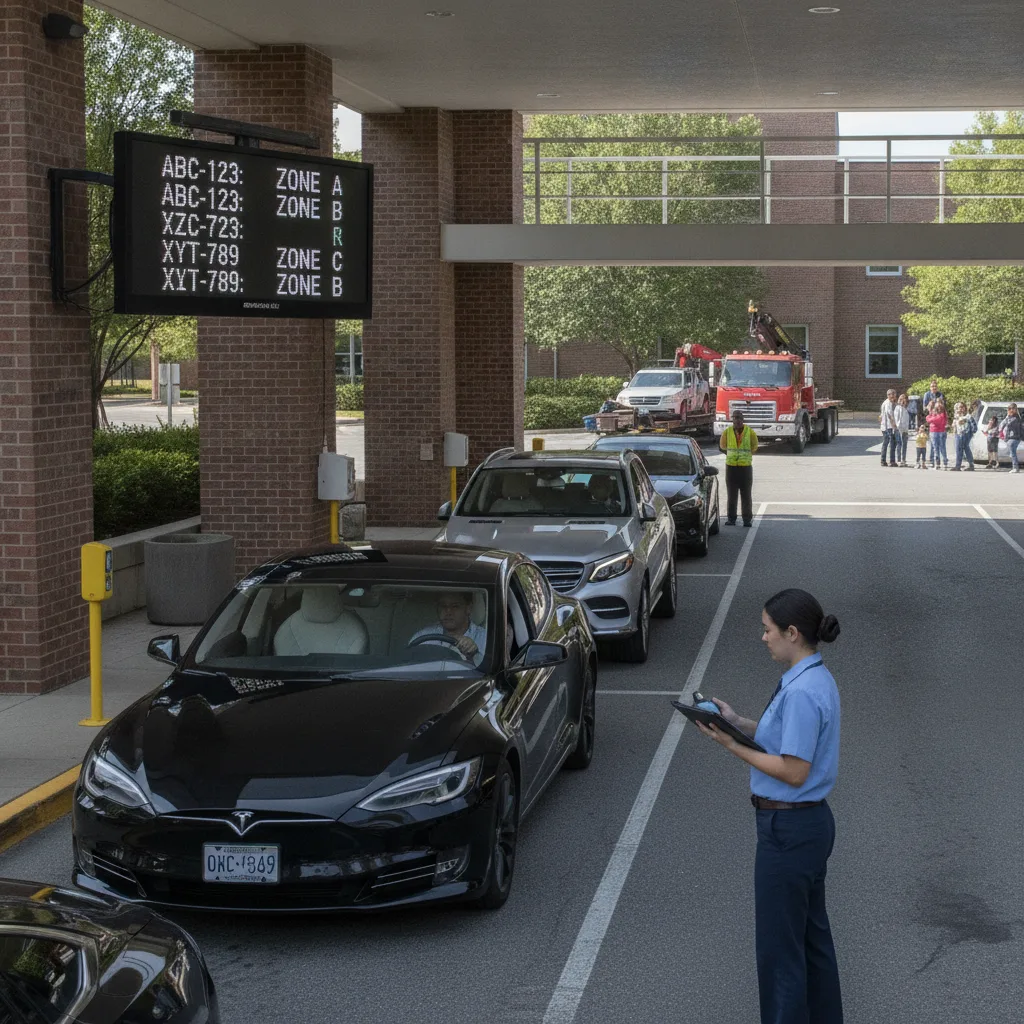
Direct answer: The bottleneck for venue parking managers isn’t finding cars — it’s the exodus surge: hundreds or thousands of guests hitting the exit within the same 20-30 minutes after a game, concert, or convention session ends. Ticketless vehicle recognition speeds retrieval by identifying a car and its parked location automatically as the guest approaches the pickup point, so runners are dispatched before the guest reaches the podium instead of after they hand over a ticket stub that a seasonal staffer then has to match to a row and space.
Why venue retrieval is a different problem than hotel or restaurant valet
A hotel valet operation deals with a trickle of departures spread across a day. A venue deals with a wave. When 8,000 people leave an arena at the same time, the constraint isn’t valet skill — it’s how fast the team can identify which of hundreds of parked vehicles belongs to the person standing at the podium, and how far a runner has to walk or drive to reach it. Any process that depends on a paper ticket, a handwritten row number, or a runner’s memory of “where we parked the silver SUVs” breaks down exactly when it matters most: at peak exit volume, with new part-time staff who were trained two hours before doors opened.
Ticketless recognition removes the matching step. The system already knows which vehicle belongs to which guest and where it’s parked, so the runner gets a location the moment the guest is in the retrieval queue — not after they’ve stood in line to hand over a stub.
Where venue lots lose time
Multiple exits, one mental map
Large venues often run several pickup points — a VIP lane, a general lot, an overflow structure a few blocks away. Runners working the general lot have no visibility into what’s parked in overflow, so a guest who parked in the “wrong” lot for their exit point adds a cross-lot trip during the busiest ten minutes of the night. A shared, searchable vehicle record (rather than lot-specific clipboards) lets any runner at any exit point look up a plate or guest name and get the actual location, not just the location for their assigned zone.
Seasonal and event-day staff
Venues lean heavily on part-time and event-day labor who may work a handful of shifts a season. They don’t have the tribal knowledge a full-time hotel valet team builds up. A system that surfaces vehicle location by plate recognition rather than requiring staff to remember a row-and-space code shrinks the training gap — a runner who started that afternoon can retrieve as fast as one who’s worked fifty events.
Staging before the crowd arrives at the podium
The highest-leverage move is dispatching the retrieval before the guest is standing at the pickup point. If recognition happens as vehicles approach the queue or as guests badge into the app/kiosk, the runner already has a head start walking to the space by the time the guest reaches the front of the line. Waiting until the guest hands over a stub to even begin the search is the single biggest cause of long lines at venue exits.
Building a retrieval plan around the exodus curve
- Map the exit curve, not just total volume. Pull historical timing (or estimate from doors-open/doors-close patterns) for how retrieval demand spikes — most venues see 60-70% of exits in the first 30 minutes after an event ends. Staff and stage runners against that curve, not an average.
- Pre-stage high-demand rows. If your system flags which sections are filling up first, position runners near those rows before the crowd hits, rather than dispatching reactively.
- Split VIP and general retrieval physically, not just administratively. Separate queues only work if the system routes lookups to the correct lane automatically; a shared paper log defeats the purpose.
- Give runners a live queue view, not a radio relay. Every “where’s car 214” question relayed over radio during peak exit is a runner pulled off retrieval. A shared digital queue that any runner can check cuts that overhead.
- Debrief every event, not just bad ones. Track average retrieval time by exit point and flag which lot or lane consistently lags — that’s usually a staffing or layout fix, not a technology fix.
What to measure
- Time from queue entry to vehicle delivered, broken out by exit point and by the first 30 minutes vs. the tail of the exodus.
- Cross-lot retrievals — trips where a runner had to leave their assigned zone, a proxy for how well vehicle location data is shared across the property.
- Runner utilization during peak — idle runners at one exit while another backs up usually means the dispatch view isn’t shared in real time.
FAQ
Does ticketless recognition work with multiple exit lanes and lots?
Yes, as long as vehicle location data is shared across the whole property rather than siloed by lot. That shared view is what lets a runner at any exit look up any vehicle.
How do we handle a guest who can’t remember where they parked?
Recognition tied to a plate or a booking record solves this directly — staff look up the guest instead of relying on the guest’s memory of a level and color-coded zone.
Will this help with part-time event staff specifically?
That’s usually where it helps most. New staff retrieving by system-provided location perform close to experienced staff from their first shift, because the lookup — not memory — does the work.
For a broader look at how ticketless systems are structured for high-volume venues, see the valet parking knowledge hub, the ticketless valet system overview, and the valet parking software built for venues.
Want to see how a large-venue retrieval workflow would look on your lot map? Book a demo and walk through your exit curve with our team.
Data source: U.S. Department of Transportation