

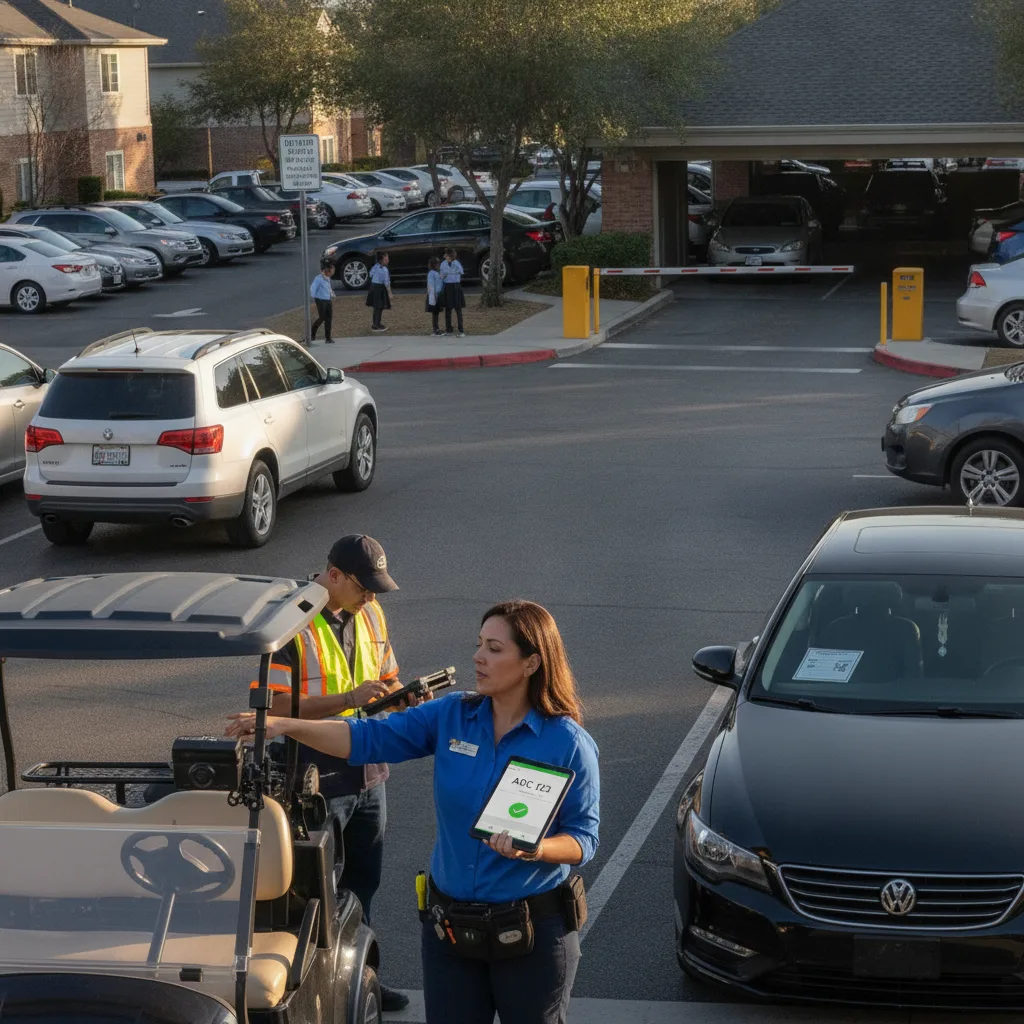
Direct answer: An apartment parking violation record needs to do more than identify the vehicle — it needs to show which specific community rule applied, whether the vehicle belonged to a current resident or guest at the time, and what the leasing office’s records showed at that moment. Because apartment tows are among the most commonly disputed decisions a property makes, the case file should let a leasing agent answer a resident’s question in minutes, not by reconstructing the story from memory.
This is written for apartment enforcement teams — courtesy patrol, third-party patrol vendors, and the leasing and property management staff who field resident calls about a tow.
Why apartment cases get disputed more than most
Residents move in, get guest passes, buy new cars, and change spaces more often than a typical commercial tenant. That turnover means a violation call can genuinely be wrong through no fault of the patrol officer — the vehicle really was authorized, just not in the data the officer was checking against at the time. A strong documentation standard protects the resident from a bad call and protects the property and patrol team when the call was actually correct.
What belongs in an apartment violation case
The specific rule, not a general label
“Unauthorized vehicle” isn’t specific enough. Record which rule applied — reserved space, expired permit, guest parking limit, fire lane, or whatever the community’s actual policy names — so a leasing agent or resident can see exactly what was violated rather than a generic category.
Vehicle, space, and signage in one shot
A plate photo alone doesn’t show where the car was parked. Include a wider shot showing the vehicle next to the space number, reserved sign, or other marker that ties the vehicle to the specific violation.
Resident and guest status at the time of the check
Record what the permit or resident list showed at the moment of the check, not what it shows now. If a resident registered a guest an hour after the patrol officer’s stop, the case record from the time of the stop is what should be reviewed, along with a note of when the guest pass was actually issued.
Notice history, if your community requires it
Many properties require a warning period or sticker before a tow. If that applies, document when the prior notice was issued and to which vehicle, so the case shows the full sequence rather than just the final tow.
Handling move-in and move-out weeks
These are the highest-dispute periods at any community. A new resident’s vehicle may not be in the system yet; an outgoing resident’s guest may still be loading a truck. During active move-in or move-out windows, add an extra check before escalating: confirm with the leasing office whether a move is in progress for that unit before a tow is authorized, rather than relying solely on the automated permit check.
When to stop and get leasing office confirmation
Set a clear rule for the patrol team: if the resident record looks recently changed, if the vehicle is in a space with any ambiguity about which unit it’s assigned to, or if there’s a visible sign of an active move — boxes, a loaded vehicle, a moving truck nearby — the officer documents the case and holds it for confirmation from the leasing office rather than proceeding straight to a tow.
Resolving a resident dispute quickly
When a resident calls upset about a tow, the leasing team should be able to pull the full case — rule cited, photo evidence, and the resident or guest status at the time of the check — in under a couple of minutes. If that takes longer, or requires calling the patrol company to reconstruct what happened, that’s a sign the documentation process needs tightening, not just the individual case.
FAQ
Who should have access to pull a case file — patrol only, or leasing staff too?
Both. Leasing staff are usually the ones fielding the resident’s call, so they need direct access to the case rather than depending on the patrol company to send it over.
How long should we keep violation records?
Long enough to cover your state’s relevant statute of limitations for a dispute and your own lease-renewal cycle. Check with your property’s counsel or management company for the specific period that applies to you.
What if the resident says they had a guest pass but it’s not showing in the system?
Check the timestamp of when the pass was actually entered against the time of the violation. If it was entered after the stop, that’s useful context for both sides — it may mean the resident registered it late, or that there was a real delay in the system the resident isn’t responsible for.
A documentation standard residents and staff can trust starts with a case file that actually holds up. See a complete parking enforcement workflow for multifamily properties or explore mobile LPR for apartment patrol, then reach out to talk through your community’s process.
Data source: U.S. Department of Transportation