

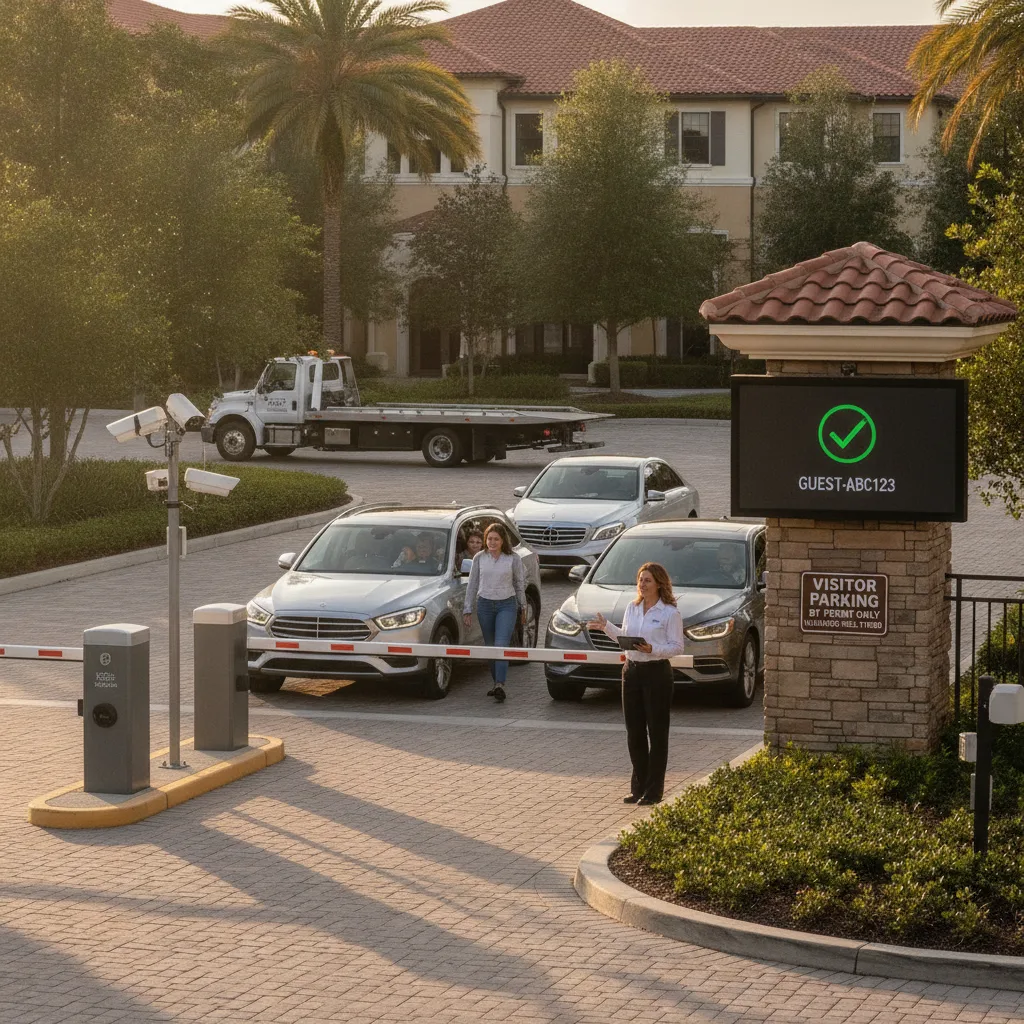
Direct answer: Gated communities stop guest-permit sharing by treating it as an access-control problem, not just a parking rule. Unlike an open community, a gated community makes an implicit security promise to residents the moment it staffs a gatehouse or installs an automated arm: only authorized vehicles get through. When a transponder, gate code, or guest permit gets passed between households or handed to someone outside the community, that promise breaks – and the fix has to happen at the access point itself, not just in a parking citation issued later.
This guide is for gated communities – associations with an actual physical access-control layer (a staffed gatehouse, an automated arm reading a transponder or code, or both) that separates them operationally from an open community relying on patrol and signage alone. That access layer is both the asset and the liability: it’s what residents are paying for, and it’s the thing that fails quietly when a credential gets shared.
Why this is a different problem than open-community guest parking
An open HOA’s guest-parking policy is enforced after the fact – a patrol vehicle or camera notes an unregistered car and issues a citation. A gated community has a chance to catch the problem before the vehicle is even inside, at the point where a credential is presented. That’s a real advantage, but it only holds if the credential itself is trustworthy. A shared transponder or a call-box PIN passed around a group chat defeats the entire point of having a gate – the system correctly reads the credential, but the credential no longer means what it’s supposed to mean.
Where sharing actually happens
- Transponders and RFID tags. Physically small, easy to hand to a visiting relative “just this once,” and hard to trace back to a specific visit without a log that ties the read to a timestamp and a vehicle.
- Call-box PINs and gate codes. The easiest credential to share, because sharing it costs nothing – a resident texts a four-digit code to a guest, who then texts it to someone else. A shared PIN has no way to distinguish who actually used it.
- Guest permits issued through a resident’s account. Often the most legitimate-looking form of sharing: a resident sponsors a “guest” who is really a regular, unauthorized occupant using the community’s amenities without ever being on a lease or a resident vehicle list.
Closing the gap without slowing down real guests
| Credential type | Sharing risk | Control that helps |
|---|---|---|
| Transponder / RFID | Medium – physical object, traceable if logged | Match transponder reads against a registered vehicle, not just a household account |
| Gate code / call-box PIN | High – costs nothing to share, no physical trace | Rotate codes periodically; log which resident account triggered each entry |
| Sponsored guest permit | High for recurring “guests” | Flag guest credentials used on a recurring schedule for a resident review, rather than an automatic renewal |
The gatehouse staff or automated system doesn’t need to police intent – it needs a record that connects each entry to a specific vehicle and a specific sponsoring resident, so a pattern (the same “guest” plate entering every weekday morning for two months) becomes visible instead of disappearing into a stack of individual visits.
Why the guard log matters as much as the gate
A staffed gatehouse adds a layer automated systems don’t have on their own: a human who can question something that looks off. But that only works if the guard log is actually reviewed, not just kept. A pattern of repeated entries on a shared credential is only useful information if someone – a patrol lead, a dispatch approver, or the community manager – looks at it on a schedule, rather than only pulling it after a resident complains.
Related PLACA.AI planning resources
Questions before tightening guest-credential rules
What’s the first sign a credential is being shared rather than used by one household?
A repeating pattern – the same guest plate or transponder entering on a fixed schedule over weeks or months – rather than the occasional, one-off visits a real guest credential should show.
Should gate codes be rotated?
Periodic rotation limits how far an old, informally shared code can spread, but it only helps if residents are also told why the code changed, so they don’t just share the new one the same way.
What blocks expanding stricter credential checks community-wide?
Unclear ownership of the guard log review, no defined threshold for what counts as a suspicious pattern, or a process that would meaningfully slow down legitimate guests at peak arrival times.
Plan a limited workflow review
Bring your current gate credential policy, a sample of the guard log, and any recent disputed entries. PLACA.AI can help evaluate a bounded pilot without assuming another property’s workflow is the right answer.
Editorial refresh: September 18, 2026. Independently confirm current product capabilities, third-party features, pricing, contracts, governing requirements, and local rules before acting.
Data source: Community Associations Institute