

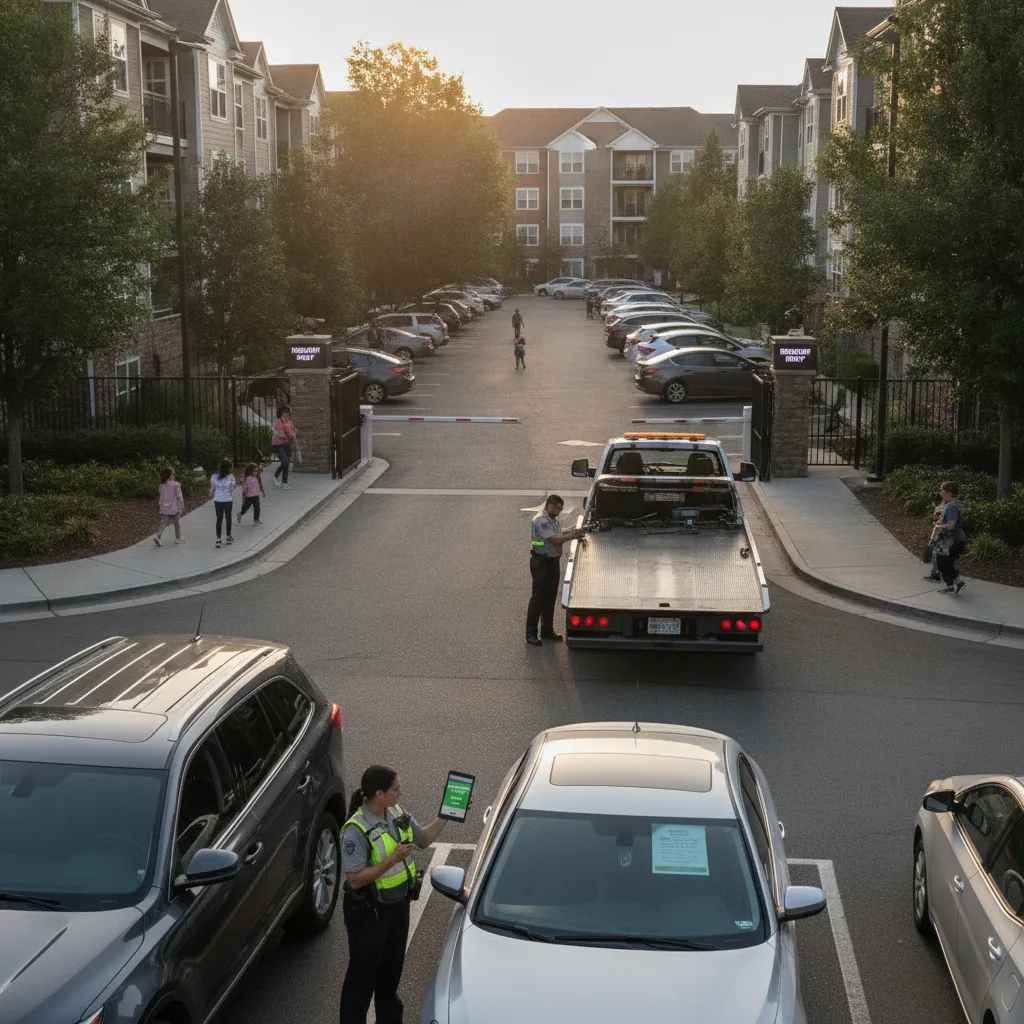
Direct answer: For apartment enforcement teams, verifying a permit faster mostly comes down to closing the gap between the leasing office’s records and what the enforcement team sees on a lot pass. Permits at an apartment community aren’t just “valid or not” the way a parking garage ticket is — they’re tied to a specific unit, a specific lease, and a resident-vs-guest distinction that changes what the correct response is. A resident’s own vehicle, a registered guest, an unregistered guest inside a grace window, and a vehicle left behind by a former tenant all look similar on a lot walk but need different handling.
Why Permit Verification Is Slower at Apartment Communities Than It Looks
Most of the delay in apartment permit enforcement doesn’t come from finding the vehicle — it comes from figuring out which record actually governs it. Property management platforms like Yardi, RealPage, AppFolio, or Entrata hold the lease and resident data, but the vehicle and permit list is often maintained separately, sometimes in a spreadsheet the leasing office updates by hand, sometimes in a dedicated visitor-parking or permit app tied to a QR code or virtual permit. When those two systems drift out of sync — a new resident moves in but the vehicle isn’t added yet, or a lease ends but the vehicle record isn’t removed — enforcement staff end up making a judgment call on the lot instead of a fast lookup.
Where this shows up in practice: a common friction point is the overnight guest situation — a vehicle parked in a resident-reserved space with no visible permit, where the resident insists they registered a guest earlier that day. The enforcement team needs to be able to confirm, on the spot, whether that registration actually exists and when it was entered, not just whether a permit is displayed on the dash.
Apartment Enforcement Teams: What a Fast Permit Check Actually Requires
| Decision point | What the enforcement officer needs to see | Typical source |
|---|---|---|
| Resident vs. guest | Which unit the vehicle is tied to, and whether it’s a resident vehicle or a registered guest | Property management system resident roster |
| Guest registration freshness | Whether a same-day guest registration exists and when it was entered | Visitor parking or virtual permit portal |
| Lease status | Whether the associated lease is still active, mid-move-out, or already ended | Leasing office / PMS lease record |
| Reserved vs. open space | Whether the space itself carries a reserved assignment separate from the vehicle’s permit | Site map / reserved space list |
Handling the Cases That Slow Teams Down
Turnover is the recurring source of stale permit data. When a resident moves out, the vehicle record doesn’t always get pulled at the same time the leasing office processes the move-out — especially if the community relies on residents to self-report vehicle changes. Building a routine that ties permit list updates to the leasing office’s own move-in/move-out workflow, rather than treating it as a separate task, closes most of that gap.
Guest registration is the other common friction point, particularly for communities that still rely on a phone call or a paper guest list at the leasing office instead of a resident-facing app or portal. A same-day registration that isn’t reflected yet on the enforcement team’s list will read as a violation even though the resident did everything right. Teams that verify permits fastest are usually the ones where guest registration writes to the same list the enforcement team checks, in close to real time, rather than to a separate log that gets reconciled later.
Move-In / Move-Out and Vendor Vehicles
Two categories of vehicle regularly fall outside the normal resident/guest permit structure: vendor and maintenance vehicles working on the property, and moving trucks or vehicles tied to an active move-in or move-out. Both need a short-duration exception path that’s distinct from the standard guest permit — one tied to a work order or a move date rather than an open-ended registration — so enforcement staff aren’t left guessing whether a box truck blocking a fire lane for two hours is authorized or not.
Implementation Checklist
- Confirm which system is the source of truth for resident vehicles, and which system holds guest registrations — and whether they sync automatically or require manual reconciliation.
- Tie permit list updates to the leasing office’s move-in/move-out process instead of a separate manual step.
- Set a short registration window for guest and vendor vehicles that doesn’t require an enforcement officer to call the leasing office to confirm.
- Document how reserved-space assignments are checked separately from general permit validity.
- Review a sample of flagged vehicles weekly during rollout to catch data-sync gaps before they cause a disputed tow.
Measuring Whether Verification Actually Got Faster
Track time from flag to resolved decision, the share of flagged vehicles that turn out to have a same-day registration the enforcement list hadn’t caught up with yet, and how often a leasing-office phone call is needed to resolve a lot-pass judgment call. A falling rate of leasing-office callbacks is usually the clearest sign that the permit data and the enforcement list are staying in sync.
Related PLACA.AI planning resources
Implementation questions
What’s the fastest way to confirm a same-day guest registration on the lot?
The enforcement team needs read access to the same guest-registration list the leasing office or resident portal writes to, ideally updated in close to real time rather than reconciled at the end of the day.
How should vehicles left behind after a move-out be handled?
Pull the vehicle from the active permit list as soon as the lease ends or the move-out is processed, and treat any vehicle still present after that point as unauthorized rather than assuming it will be moved on its own.
What’s the right way to handle vendor and moving vehicles?
Give them a short, dated exception tied to a work order or move date rather than folding them into the standard guest permit process, so they don’t linger on the active list past the day they were needed.
Plan a limited workflow review
Bring the current rule, process, exceptions, and success criteria for verifying parking permits faster for apartment enforcement teams. PLACA.AI can help evaluate a bounded pilot without assuming another property’s workflow is the right answer.
Editorial refresh: July 22, 2026. Independently confirm current product capabilities, third-party features, pricing, contracts, governing requirements, and local rules before acting.
Data source: U.S. Department of Transportation