

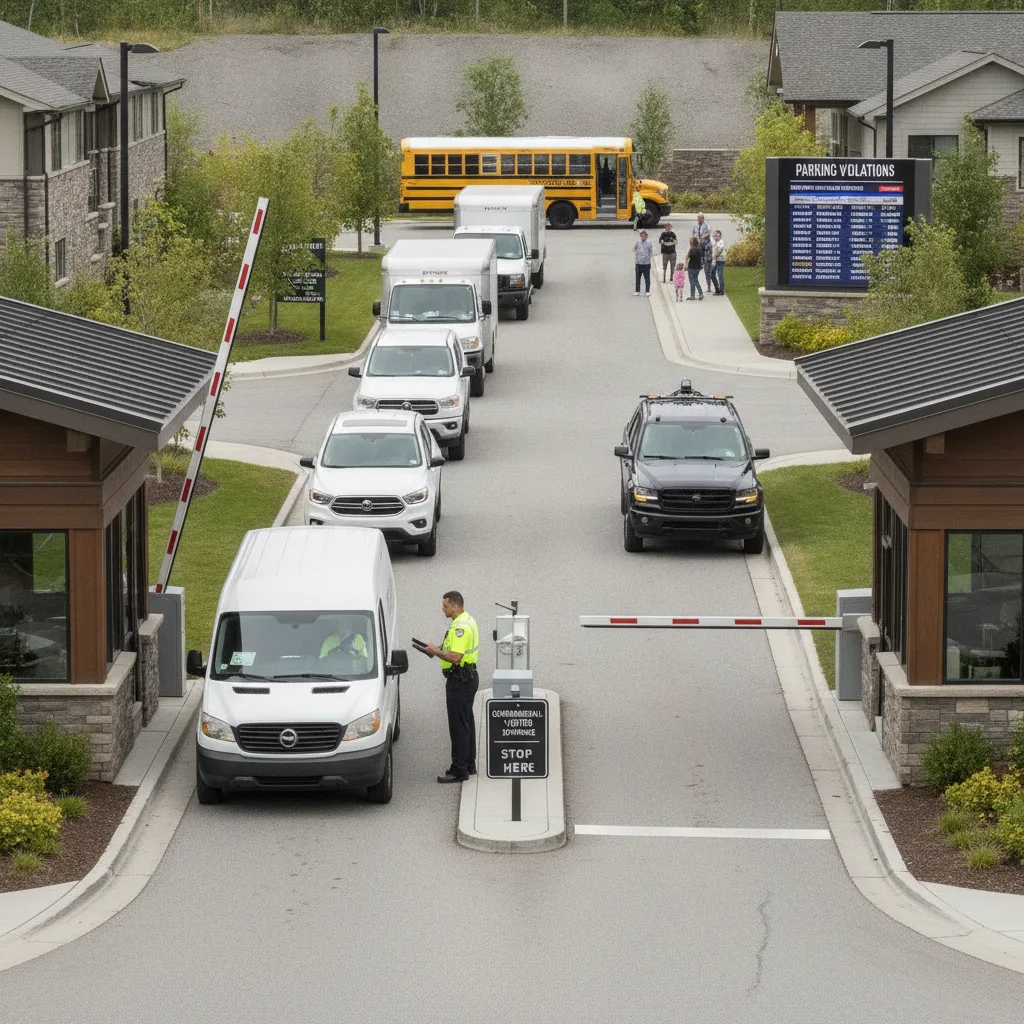
Direct answer: In a gated community, the gate itself is the natural control point for unauthorized commercial vehicles — every vehicle that isn’t a resident’s registered plate already had to present a credential or get buzzed in, which means the real problem usually isn’t detecting a commercial vehicle, it’s a stale or overly broad list of who’s allowed to use that credential.
This guide is for boards and managers running gated and guard-gated communities, where access control changes the shape of this problem compared to an open HOA. A commercial vehicle didn’t just show up — it entered through a gate, was let in by a guard, used a resident-shared code, or is on a standing vendor list, and each of those has a different fix.
Why the gate log is both the solution and the source of the problem
Gated communities tend to have stricter covenant language around commercial vehicles than open HOAs — boards in higher-amenity communities often ban visible commercial branding entirely, not just overnight storage — but stricter rules don’t help if the access system that’s supposed to enforce them has drifted. The most common failure pattern isn’t a stranger sneaking a work truck past a guard shack. It’s a landscaping crew, pool service, or pest control vendor that was issued a recurring gate code or added to a standing approved-vendor list months or years ago, and nobody has reviewed that list since. The vehicle isn’t unauthorized in the sense of having snuck in — it’s unauthorized in the sense that the authorization was never revisited.
A second pattern is specific to larger-lot gated communities: residents with the space for it store personal work trucks, boats, or trailers in side yards and driveways that are technically inside the gate and outside street view, so complaints tend to come from neighbors rather than from routine patrol. That’s a different enforcement trigger than a vehicle idling in a common area, and it usually means the complaint arrives already emotionally charged, since it’s neighbor-to-neighbor before it’s association business.
Sorting commercial-vehicle cases in a gated setting
| What’s happening | Where the record lives | Required check |
|---|---|---|
| Vendor van entering on a recurring gate code | Vendor access list / gate log | Is the vendor still active and approved, or was the code never revoked? |
| Guest or resident-buzzed commercial vehicle | Guard log or intercom record | Match against the resident who authorized entry |
| Commercial vehicle stored on a resident’s own lot | Neighbor complaint, patrol note | Check covenant language on branding, size, and storage duration separately |
| Unmatched vehicle inside the gate with no log entry | Gap in the access system | Treat as a security issue first, covenant issue second |
A workflow built around the gate, not the street
- Start at the access record, not the vehicle. Before writing a notice, check how the vehicle got in. If there’s no matching log entry at all, that’s a bigger problem than a covenant violation — it means something in the access control process failed.
- Audit the standing vendor list on a schedule, not a complaint. Recurring gate codes for landscaping, pool, and pest crews should be reviewed and re-approved periodically. Most “unauthorized” vendor vehicles turn out to be vendors nobody removed after the contract ended.
- Separate resident-owned storage from vendor access. A resident’s personal work truck parked on their own lot is a covenant question (branding, size, duration) that has nothing to do with the gate system, and should be handled through the standard notice process rather than an access review.
- Treat gate-log gaps as a guard-staffing or system issue. If a commercial vehicle is inside the gate with no record of how it got there, loop in whoever manages the gate hardware or guard staffing before assuming it’s an enforcement failure by the board.
Where this goes past routine enforcement
Disputes over whether a covenant’s branding or storage restriction actually applies, any case tied to an accessibility or caregiver vehicle, and repeated gate-system gaps that suggest a security lapse all belong with the board, the gate vendor, or association counsel — not a unilateral call by whoever reviews the log that week.
Testing this before it’s the standing process
Pull the last few months of gate access logs alongside recent commercial-vehicle complaints and see how many actually trace back to an active, approved credential versus a genuine gap. Most gated communities find the vendor list is the bigger issue than street-level enforcement — a handful of long-dormant codes account for most of the “unauthorized” traffic. Communities pairing guard logs with automated plate capture at the gate get a cleaner audit trail for this kind of review; see the HOA LPR camera planning guide for how that fits alongside existing guard and intercom systems. For the related problem of visitor overflow competing with the same gate capacity, see reducing visitor parking abuse in gated communities.
What to verify before formalizing this
- Who owns the vendor access list and how often it’s reviewed for stale entries.
- Whether guard logs and any automated gate records are actually cross-checked, or just stored separately.
- That the covenant’s commercial-vehicle definition (branding, size, storage duration) is applied consistently to resident-owned vehicles on private lots.
- A clear owner for gate-system gaps, separate from the owner for covenant notices.
- An escalation path for disputed cases that doesn’t rely on one guard shift’s judgment call.
Related PLACA.AI planning resources
Site questions
Why do gated communities still get commercial-vehicle complaints if every vehicle needs a credential to enter?
Because the credential itself often goes stale — a recurring code issued to a vendor months ago rarely gets revoked when the contract ends, so the vehicle is technically “authorized” by a record nobody has reviewed.
Is a resident’s personal work truck on their own driveway the same issue as an unauthorized vendor?
No — one is an access-control question (how did it get past the gate) and the other is a covenant question (does the branding, size, or storage duration violate the rule). They need different reviews.
What blocks scaling this process community-wide?
An unreviewed vendor access list, gate logs that aren’t cross-checked against complaints, or no clear owner when a gate-system gap looks like an enforcement failure.
Plan a limited workflow review
Bring the current rule, process, exceptions, and success criteria for managing unauthorized commercial vehicles for gated communities. PLACA.AI can help evaluate a bounded pilot without assuming another property’s workflow is the right answer.
Editorial refresh: September 18, 2026. Independently confirm current product capabilities, third-party features, pricing, contracts, governing requirements, and local rules before acting.
Data source: Community Associations Institute