

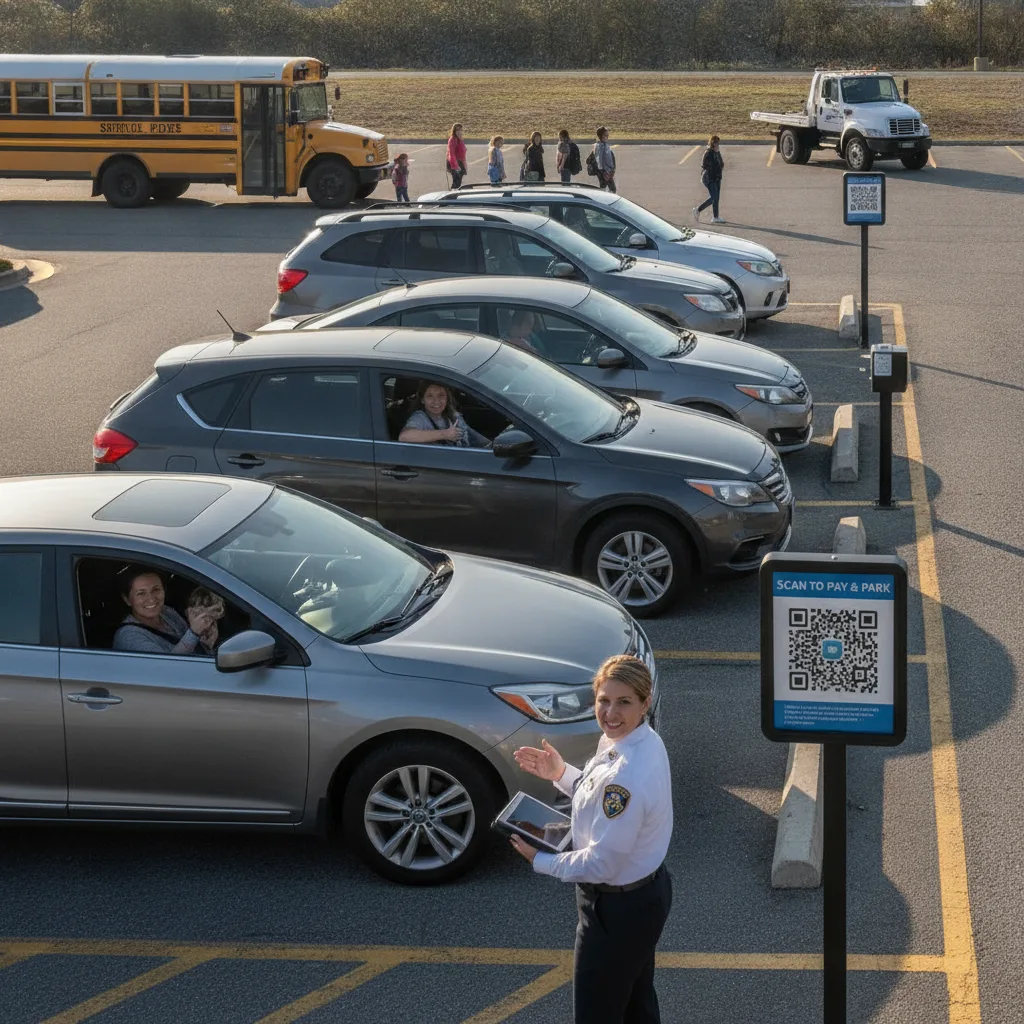
Direct answer: For event lot managers, simplifying guest parking payments means designing for two short, extreme surges — everyone arriving in the thirty to sixty minutes before an event, and everyone leaving within roughly twenty minutes after it ends — rather than the steady, spread-out arrivals a hotel or office lot handles. The fix is pre-paid and pass-based entry that resolves before a car reaches the lane, paired with an egress plan that doesn’t depend on anyone stopping to pay on the way out.
An event attendee isn’t a returning customer the way a hotel guest or office tenant is. They may be parking at this specific venue once a year, they’re often under time pressure to reach the gate before a show starts, and they’re unlikely to want to download a new app for a single visit. Simplifying payment here means reducing what a driver has to do in the ten seconds their car is in the lane, not building a personalized billing relationship.
Design for the two surges separately
Ingress and egress at an event lot are different problems. Ingress is spread over roughly an hour but still compresses most arrivals into a tight pre-show window; egress happens almost all at once, right after the event ends, with every vehicle trying to leave in a short span. A payment flow that works for ingress — even a quick tap or scan — will create a serious bottleneck if it’s also required on the way out. Design egress to require no interaction at all for anyone who already paid on the way in.
Payment paths by how the attendee arrives
| Attendee type | How they typically pay | Simplification |
|---|---|---|
| Pre-paid, ticketing-platform add-on | Bought parking alongside their event ticket through the venue’s ticketing platform | Match the plate entered at checkout against an LPR read at the gate; no stop required if it matches |
| Pre-paid, third-party pass | Bought a parking pass separately through a reservation platform | Same plate-match approach, reconciled against that platform’s order data |
| Walk-up, day-of | Pays cash or card at the gate with no advance purchase | Keep one staffed lane with a mobile reader; don’t force walk-ups through an app under time pressure |
| ADA or rideshare drop-off | Needs a dedicated lane separate from paid parking entirely | Route away from the payment flow altogether — these lanes shouldn’t share a queue with paying traffic |
Triage and resolve without slowing the line
- Resolve pre-paid matches before the car reaches the front of the lane, using the LPR read to confirm against ticketing or pass data while the vehicle is still approaching.
- Reserve exactly one lane for walk-up cash and card, staffed and sized to your slowest historical ingress, so day-of attendees never get funneled into an app they don’t have time to download.
- Keep ADA and rideshare drop-off physically separate from the paid lanes, since mixing them creates exactly the kind of gridlock that turns a minor payment mismatch into a safety issue.
- Design egress to require zero stops for anyone already matched — a barrier-free exit with LPR logging the departure is what actually prevents the post-event bottleneck, not a faster payment method at the exit gate.
When immediate handling changes
During the pre-show surge, a plate mismatch shouldn’t stop traffic at the gate — wave the vehicle through and resolve the mismatch afterward from the photo capture and ticketing data, the same way you’d handle it at any high-volume ingress. Reserve on-the-spot stops for genuine safety or capacity issues, not payment reconciliation, since holding up one car in a compressed surge affects everyone behind it.
Resolution measures
- Share of attendees matched and waved through without stopping, by entry lane
- Queue length and wait time at the walk-up lane specifically during peak ingress
- Egress time from event end to lot clear
- Post-event mismatches resolved from photo and ticketing data versus those requiring a refund or dispute
Management closure
- Confirm the ticketing platform’s plate-capture field is validated at checkout, since a mistyped plate is the most common source of a post-event mismatch.
- Verify the walk-up lane is sized to your slowest observed ingress, not an average across events.
- Check that ADA and rideshare lanes are physically separated from every payment flow, not just signed differently.
- Confirm egress requires no stop for matched vehicles before relying on it for a large event.
Related PLACA.AI planning resources
Review questions
Why does event parking need a different payment design than a hotel or office lot?
Because arrivals and departures compress into two short, extreme surges instead of spreading across a day, and most attendees are one-time or infrequent visitors unlikely to have an app already installed.
Should we require payment confirmation at the exit too?
No — requiring a stop on the way out is what creates the worst post-event bottlenecks. Resolve payment on the way in and let matched vehicles exit without interaction.
How do we handle a plate that doesn’t match any pre-paid order during the surge?
Wave the vehicle through rather than stopping traffic, capture the plate and timestamp, and resolve the mismatch afterward against ticketing and photo data.
Plan a limited workflow review
Bring ingress and egress timing, ticketing-platform integration details, and walk-up lane sizing from a recent event. PLACA.AI can help evaluate a surge-specific payment design rather than a steady-state plan borrowed from a different property type.
Editorial refresh: September 18, 2026. Independently confirm current product capabilities, third-party features, pricing, contracts, governing requirements, and local rules before acting.
Data source: U.S. Department of Transportation