

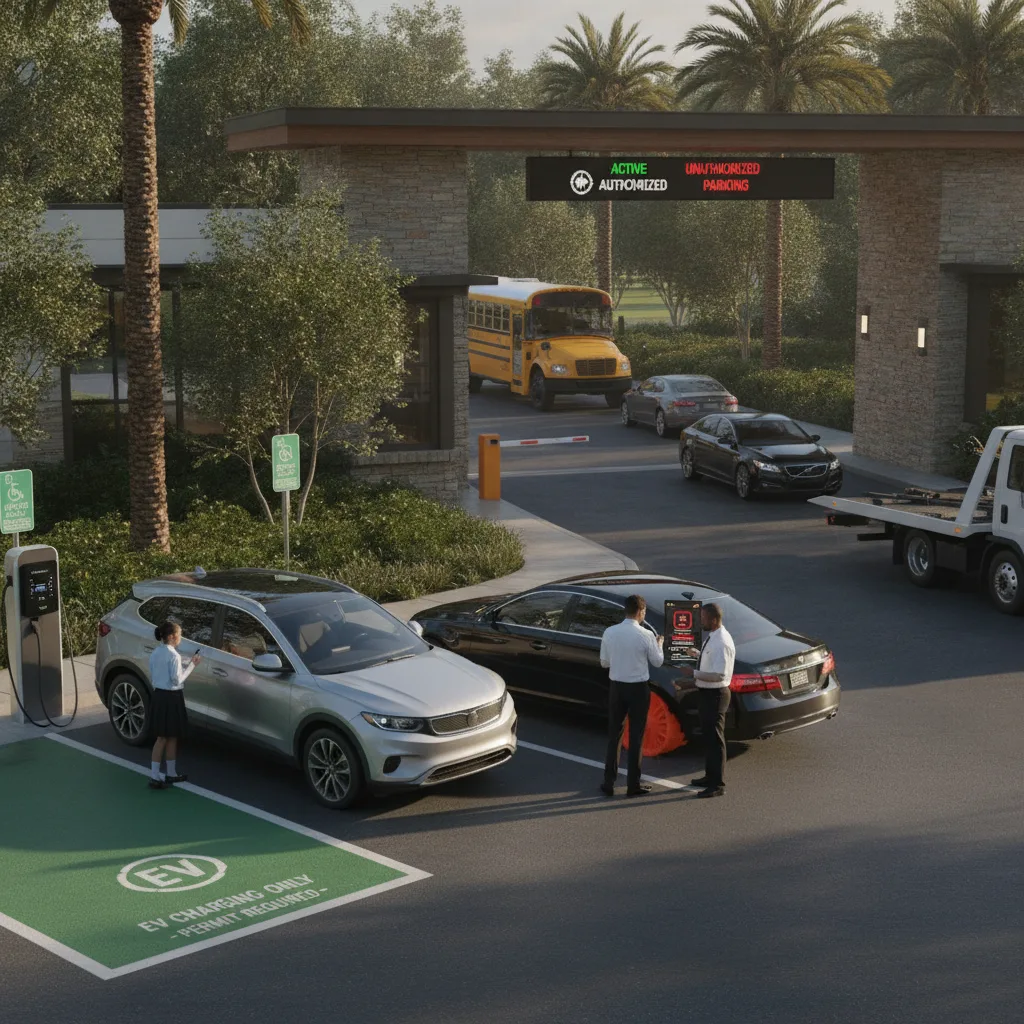
Direct answer: In a gated community, EV charging spaces are usually near a clubhouse, guest gate, or amenity center — places already covered by gate credentials and courtesy patrol, not by the on-site staff a larger apartment property might have. That means EV enforcement here has to lean on the resources the community already has: gate logs that show when a vehicle entered, and patrol rounds that already pass the charging area. Don’t build a separate charger-monitoring system from scratch — connect charging-space checks to the same patrol route and the same gate-credential record you already use for every other parking rule.
This is written for gated-community boards, on-site managers, courtesy patrol or gate staff, and the residents and guests who actually use shared charging equipment — most often at an amenity center rather than at individual driveways.
Why gated communities see this differently than open apartment lots
Shared charging stations in gated communities tend to be amenity-center amenities — closer to a clubhouse pool or fitness center than to individual units. That creates two specific problems. First, guests: a resident’s guest can gate in with a temporary credential and occupy the one or two shared chargers for hours, with no resident actively affected until someone else needs to charge and finds it blocked. Second, patrol timing: courtesy patrol on a gated property typically runs a fixed route a few times a shift, which means a fully charged car sitting idle might only get noticed once or twice, not continuously — so the dwell-time record has real gaps unless it’s tied to something more consistent than a visual pass.
Gate access itself is a useful but incomplete data point here. A gate credential tells you a vehicle is authorized to be in the community; it says nothing about whether that vehicle is actually charging, finished charging an hour ago, or never plugged in at all. Treating “gated in” as “authorized to occupy the charger indefinitely” is the single most common source of disputes at these amenity-area stations.
EV-space policy built around gate and patrol operations
| Situation | What gate/patrol can confirm | What the policy should require |
|---|---|---|
| Guest vehicle at the charger | Gate entry time and sponsoring resident on file | A posted maximum dwell for guest charging, tied to the gate entry timestamp, not an indefinite allowance |
| Resident vehicle idle after charging completes | Patrol observation at each route pass | Require two separate patrol observations before treating it as a violation, since a single pass can’t show duration reliably |
| Charger reported faulted | Resident complaint relayed to the gate desk or management office | Suspend enforcement at that unit until a manager or vendor confirms the fault, not an indefinite pause |
| Non-charging vehicle in the marked space | Plate and location from gate or patrol log | Standard reserved-space enforcement — no charging-specific evidence needed |
Putting it into the existing patrol routine
- Add the charging area to the standing patrol route, if it isn’t already covered, rather than creating a separate check.
- Log gate entry time for any guest using the charger, so a dwell dispute can be resolved against a real timestamp instead of a guess.
- Require two dated observations, not one, before escalating a dwell case. A single pass showing a car in the space doesn’t prove it’s been there long — a second pass at a defined interval does.
- Route fault reports to one person (usually the community manager) who can confirm the equipment issue and pause enforcement without waiting for a formal board meeting.
Cases that need a documented exception
A resident with an accessibility need who can’t immediately move a fully charged vehicle; a guest sponsor who’s out of town and can’t be reached to confirm how long their guest is authorized to stay; and a charger that’s intermittently faulty in a way that’s hard to confirm on a single patrol pass. Assign one person who can approve a short, dated exception and log the reason, so these don’t turn into standing arguments at the gate.
Test it before changing the community-wide rule
Run the two-observation dwell rule and the guest-timestamp requirement for one full patrol rotation before adopting it community-wide. Track how many dwell cases were confirmed on the second pass versus resolved on their own, and how many guest-charging sessions ran past the posted limit. Communities pairing this with license plate recognition at the gate and amenity areas get an automatic timestamp on every vehicle entering the charging area, which removes the reliance on a patrol officer happening to pass by at the right moment. If gate-data privacy is a concern for your board, it’s worth reviewing alongside your community’s LPR opt-out and data-handling policy before rollout.
Practical questions
What must be approved first for handling EV charging-space misuse in gated communities?
Confirm the posted dwell and guest-charging limits, who owns fault confirmation, and how patrol will document dwell cases before enforcing against any resident or guest.
What should the pilot reproduce?
A normal completed-session dwell case, a guest-charging session, and one reported equipment fault, tested across at least two patrol rotations.
When should rollout stop?
Stop when patrol can’t produce two independent observations, when a fault report hasn’t been confirmed, or when a guest sponsor can’t be reached to resolve a dwell dispute.
Related PLACA.AI planning resources
Plan a limited workflow review
Bring the current rule, process, exceptions, and success criteria for handling EV charging-space misuse in gated communities. PLACA.AI can help evaluate a bounded pilot without assuming another property’s workflow is the right answer.
Editorial refresh: July 22, 2026. Independently confirm current product capabilities, third-party features, pricing, contracts, governing requirements, and local rules before acting.
Data source: Community Associations Institute