

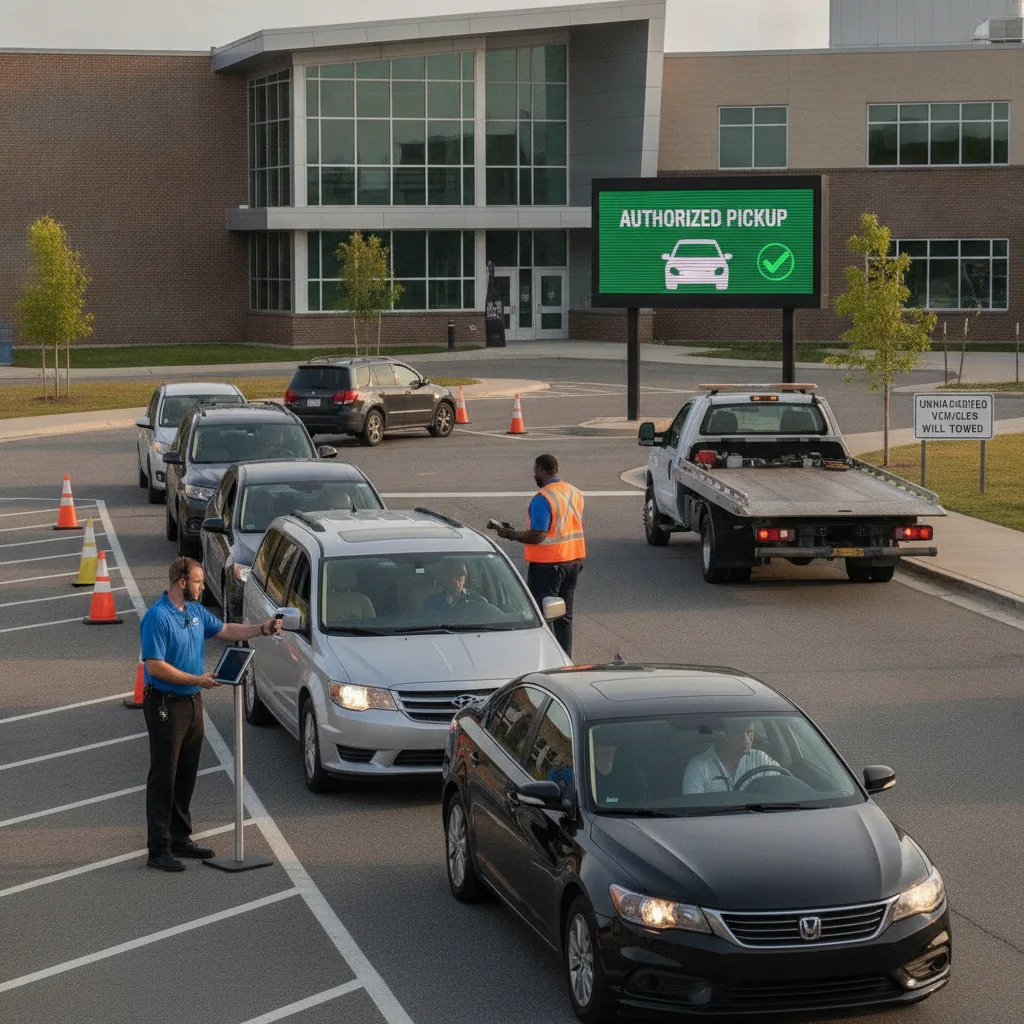
Direct answer: A district-level vehicle verification standard for pickup should not specify how a curb works — it should specify what “authorized” means, the same way, at a 400-student elementary campus and a 2,200-student high school. Define one authorized-adult data model, one same-day-change process, one override chain, and one retention rule, then let each campus run its own lane layout underneath that standard. District operations doesn’t run pickup at every campus; its job is making sure that when a family disputes a release, an attorney requests records, or a board member asks how consistency is enforced, every campus can produce the same kind of answer from the same fields.
This guide is for district operations directors, safety and security coordinators, student services staff, and the IT or SIS administrators who own the data behind pickup verification — not the people staffing any single curb, but the people responsible for what every campus is required to check before a child is released.
The problem district operations actually owns
At the campus level, verifying a pickup vehicle is one transaction: does this plate and this adult match what is on file for this student, right now. At the district level, the problem is variance. One elementary campus treats a family’s usual car as sufficient. A middle school requires the driver’s name to match a printed list. A third campus has quietly stopped checking anything consistently because the front office is short-staffed most afternoons. None of those campuses is necessarily doing something indefensible in isolation — but a district that cannot say which of those is the actual policy does not have a policy. It has a set of local habits that happen to work most days.
Example: A custody dispute reaches the district office six weeks after a release. The parent who was not contacted wants to know exactly what was checked before their child left with someone else. If campus A logged a plate match and a name confirmation with a timestamp, and campus B has nothing but a staff member’s recollection that “that car always picks him up,” the district’s exposure is not evenly distributed across campuses — it is concentrated wherever the record is weakest, and operations had no visibility into that gap until the complaint arrived.
Build one authorization data model, not one piece of software
The instinct in district operations is often to solve this by mandating a single vendor or app. That is necessary but not sufficient. What actually needs standardizing is the underlying record: who counts as an authorized adult, what “vehicle context” means (a plate on file, a same-day addition, an unmatched rideshare or rental), when a temporary change expires, and who is allowed to approve an override when the record and the car at the curb do not match. If every campus enters that information into the same fields, the district can change dismissal software, add a campus, or respond to a records request without reconstructing each site’s personal filing habits.
| District field | What it must capture | Why operations needs it |
|---|---|---|
| Authorized adult | Name, relationship, effective date, source (enrollment form, portal update, court order) | Answers “who approved this person” without a call to the campus |
| Vehicle context | Plate on file, same-day addition, or unmatched/unknown | Separates routine releases from ones that need a second look |
| Temporary change | Requestor, method (portal, call, written note), expiration at end of that day’s dismissal | Keeps a one-day exception from quietly becoming a standing authorization |
| Override | Staff name, campus, reason code, timestamp | Creates the record a legal or custody question will need later |
Standardize the form, not the front office
Campuses vary enormously in who actually staffs the curb. A large high school may have a dedicated safety officer running dismissal; a small elementary campus often relies on rotating instructional aides and parent volunteers, a staffing reality that shapes what a workable process looks like at that specific level — see how that plays out for front-line staff in the front-office guide to verifying pickup vehicles. District operations should not try to force identical staffing models onto every campus; that fight is not winnable and is not the actual goal. What operations can and should require is identical data entry: same-day change requests route through the same channel everywhere, override reasons come from the same short list everywhere, and every release — routine or exception — lands in the same reporting structure. That consistency is what makes comparing campuses possible later, and what makes a single district-wide audit answerable at all.
Custody documentation is a district liability, not a campus-by-campus one
Custody restrictions are the clearest place where inconsistent campus practice turns into a district problem. If court-ordered pickup limits live in a filing cabinet at one campus and a shared spreadsheet at another, a student who transfers mid-year — or a parent who challenges a release after the fact — exposes whichever process happens to be weakest, not whichever process the district would prefer to be judged on. Work with legal counsel to define one standard for how a custody restriction attaches to the authorized-adult record, how long that documentation is retained, and who at the district level (not only at the campus) can confirm it is current. The split-custody pickup workflow guide is useful groundwork for the specific fields a restriction record needs to carry so it travels correctly between campuses.
Rolling this out without breaking campuses that already work
Resist rolling a new verification standard out to every campus at once. Start with two or three sites that represent different ends of the staffing spectrum — one high-volume elementary campus, one site with thin front-office staffing, and one that already has reasonably strong local practice — and run the standard through a full dismissal cycle, including at least one same-day change and one genuine mismatch, before expanding further. Campuses still relying on paper car tags or laminated lists tend to surface the most friction during this transition; the paper car tag failure points are a reasonable checklist for what to expect as those sites convert to a consistent digital record. Expect resistance from principals who read this as a loss of local control; the argument that tends to land is that a standardized record protects each campus individually the first time a release is disputed.
What to report up, and how often
- percentage of releases matched to a current authorized-adult record, broken out by campus
- same-day changes approved and correctly expired at end of dismissal
- overrides by reason code, flagged wherever one campus is a statistical outlier
- unresolved cases still open at dismissal close, by campus
- time from a custody-restriction update to it actually appearing in the campus-level record
A monthly rollup is usually enough once the standard is stable; run it weekly during the pilot window so a bad field definition gets caught before ten campuses have already used it.
What district operations should keep on file
- The written definition of “authorized adult,” approved by legal counsel and distributed to every campus in identical language.
- A named owner for the standard itself, separate from whoever owns any individual campus’s dismissal operations.
- Evidence that the pilot campuses tested a same-day change, a mismatch, and at least one override before expansion.
- Confirmation of contracts, integrations, data retention, and any state or local custody-related requirements, verified independently rather than assumed from vendor claims.
- A retention period long enough to reconstruct any disputed release, correction, or override months after it happened.
Related PLACA.AI planning resources
Implementation questions
What must be approved district-wide before this goes live at any campus?
The authorized-adult definition, the custody-documentation standard, the same-day-change process, and who holds override authority when a campus record and the vehicle at the curb disagree.
What should the pilot cover?
At least one high-volume campus and one thinly staffed campus, run through a full dismissal cycle that includes a same-day change, a genuine mismatch, and one override, before the standard reaches every site.
When should district-wide rollout pause?
If a pilot campus cannot produce a complete record for a disputed release, if custody documentation is not reliably reaching the campus level, or if override reason codes are being used inconsistently across sites.
Plan a limited workflow review
Bring the current authorization definitions, campus variance, and reporting gaps for verifying pickup vehicles across the district. PLACA.AI can help evaluate a bounded pilot without assuming every campus should adopt the same rollout at once.
Editorial refresh: September 18, 2026. Independently confirm current product capabilities, third-party features, pricing, contracts, governing requirements, and local rules before acting.
Data source: National Center for Education Statistics