

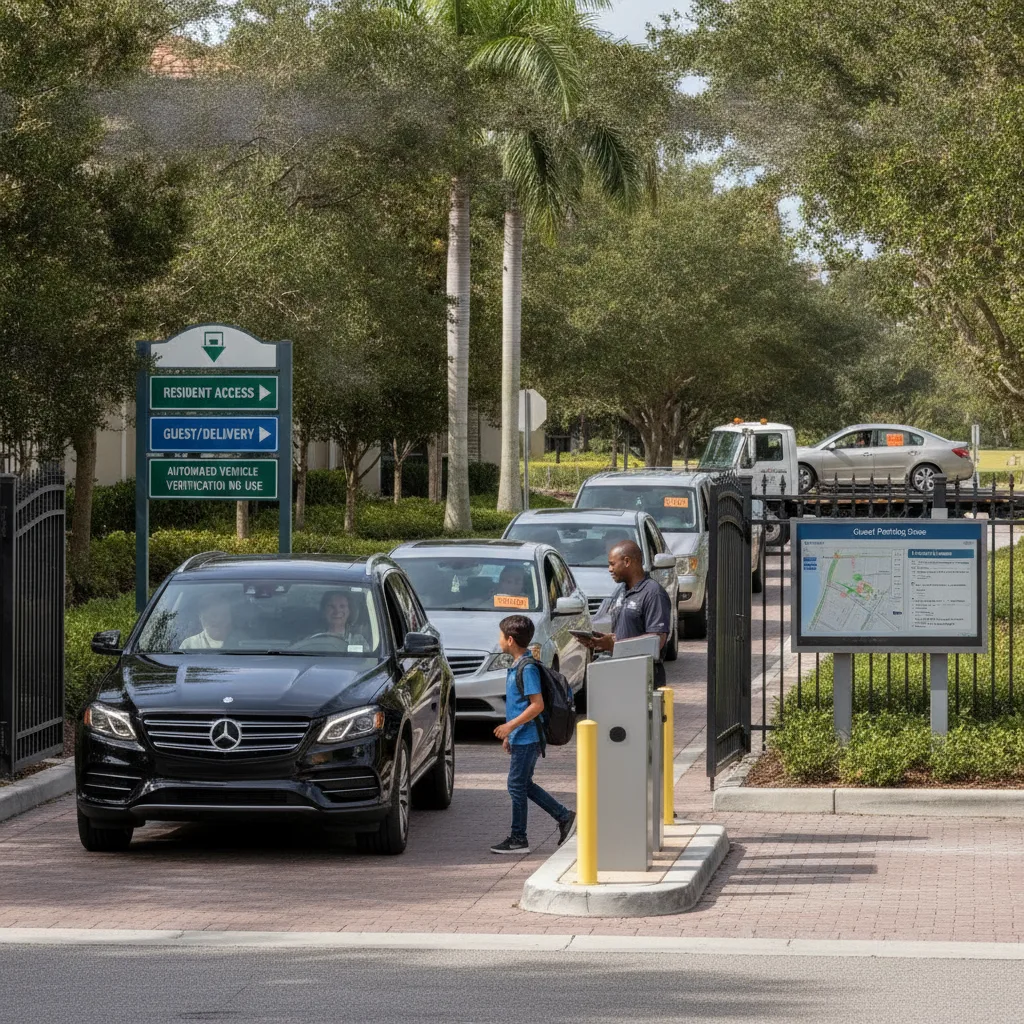
Direct answer: In a gated community, guest-space misuse is highly visible to gate staff and neighbors before it’s ever visible to the board, so the real fix is connecting the gate log — which already records who buzzed a guest in — to the guest-space assignment, instead of treating gate access and parking allocation as two separate systems.
This guide is for boards and managers of gated and guard-gated communities. The gate itself changes the shape of guest-parking scarcity: every visitor already had to be authorized by a resident or a guard to get in, which means the data needed to sort out a guest-space dispute usually already exists somewhere — the problem is that it isn’t connected to the parking record.
The gate log usually has the answer nobody’s checking
In an open HOA, a manager investigating a guest-space complaint has to reconstruct who a visitor was and who they were visiting from scratch. In a gated community, that information typically already exists: a guard logged the entry, an intercom system recorded who buzzed them through, or a resident texted ahead to add a name to a guest list. The recurring operational gap isn’t a lack of data — it’s that the gate log and the guest-parking record are two separate systems that nobody cross-references until there’s already a dispute.
Gated communities also tend to have a small, physically distinct set of guest spaces — often a cul-de-sac pull-off or a handful of spots near the gatehouse rather than distributed guest parking throughout the property — which means misuse is unusually visible. A resident’s overflow vehicle sitting in the one visible guest area near the entrance draws neighbor attention fast, and complaints tend to arrive already frustrated because everyone who drives past the gate sees the same handful of spots. That visibility is an advantage if the community uses it (patrol and gate staff can flag issues quickly) and a liability if it isn’t (a fast-escalating neighbor dispute with no documented process behind it).
Sorting a guest-space dispute using records that already exist
| What’s happening | Where to check first | Resolution |
|---|---|---|
| Vehicle in a guest space, no gate-log match | Guard log / intercom record for the relevant window | If no entry record exists, this is a bigger issue than a parking one |
| Vehicle matches a logged guest entry | Which resident authorized entry, and the stated visit length | Confirm still within the authorized window; extend or redirect if not |
| Recurring caregiver or service vehicle using guest space | Whether they’re on a standing gate access list | Formalize as a time-boxed exception tied to the existing access credential |
| Resident’s own vehicle occupying guest space | Household vehicle registration and resident parking policy | Apply resident policy, not guest allocation |
Building the workflow around the gate, not a separate parking log
- Cross-reference before assuming misuse. Before treating an unfamiliar vehicle in a guest space as a violation, check whether it matches a gate or guard log entry. Often the “mystery” vehicle is a documented guest the parking record just never captured.
- Give guard staff a simple way to flag guest-space status at the gate. If gate staff are already logging who’s visiting whom, extending that log to note which guest space they’re likely to use closes the gap between entry records and parking records without adding a separate system.
- Formalize recurring visitors through the same access credential, not a separate exception process. A caregiver or regular service provider who already has a standing gate credential should have their guest-space use tied to that same credential and reviewed on the same schedule, rather than managed as an unrelated parking exception.
- Route resident overflow to the resident policy immediately. Because gated-community guest areas are small and visible, resident vehicles parked there get noticed and reported fast — redirect these cases before they turn into a recurring neighbor dispute.
Where this needs to go beyond routine handling
Disputes over whether a gate log entry actually authorizes continued guest-space use, accessibility accommodations, and any pattern suggesting a security gap (vehicles in guest areas with no corresponding gate record at all) belong with the board, gate vendor, or security provider — not a judgment call by whoever’s reviewing the complaint.
Testing the connection between gate and parking records
Pull a sample of recent guest-space complaints and check how many could have been resolved in minutes just by checking the existing gate or guard log, versus how many required a manager to track down the resident directly. Most gated communities find the gap is procedural, not technical — the data exists, it’s just siloed. Communities that pair the guard log with automated plate capture at both the gate and the guest area get a single timestamped record instead of two disconnected ones; see the HOA LPR camera planning guide for how that fits alongside existing gate and guard systems. For the related commercial-vehicle side of gate-based access control, see managing unauthorized commercial vehicles in gated communities.
What to confirm before formalizing this
- Whether gate/guard logs and the guest-parking record are ever cross-referenced, or kept entirely separate.
- A simple way for gate staff to note guest-space intent at the point of entry.
- A standing, reviewed category for recurring caregivers and service visitors tied to their existing access credential.
- A fast redirect path for resident overflow before it becomes a visible neighbor dispute.
- Who owns the case when a vehicle is in a guest space with no matching entry record at all.
Related PLACA.AI planning resources
Record questions
Why check the gate log before treating a guest-space vehicle as unauthorized?
Because in a gated community, most legitimate guests already generated an entry record — a guard log, intercom call, or resident-added name. Checking that first resolves the majority of disputes without a confrontation.
How should recurring caregivers be handled differently from one-time guests?
Tie their guest-space use to the same standing gate credential they already use to enter, with a periodic review, rather than re-approving them as a new exception every visit.
What blocks this from working reliably?
Gate/guard logs that are never cross-referenced with the parking record, no simple way for gate staff to flag guest-space intent, or unresolved cases where a vehicle has no matching entry record at all.
Plan a limited workflow review
Bring the current rule, process, exceptions, and success criteria for protecting limited guest parking spaces for gated communities. PLACA.AI can help evaluate a bounded pilot without assuming another property’s workflow is the right answer.
Editorial refresh: September 18, 2026. Independently confirm current product capabilities, third-party features, pricing, contracts, governing requirements, and local rules before acting.
Data source: Community Associations Institute