

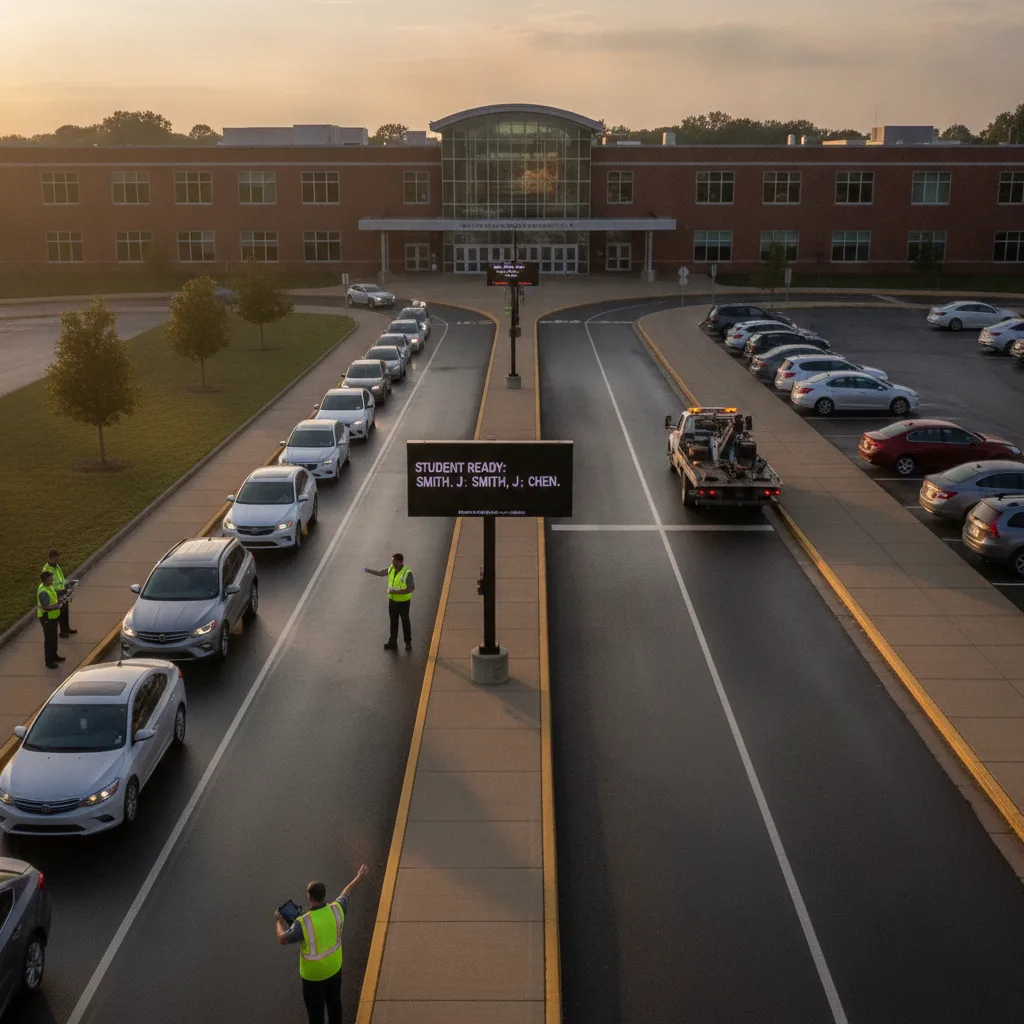
Direct answer: Late-dismissal bottlenecks become a district problem the moment two campuses handle the same situation differently — one school walks late students to a supervised holding room, another leaves them in the emptying carline. District operations teams should set one baseline policy (roster closure trigger, holding location standard, family notification language, and final-signoff requirement) that every campus follows, then let each site adapt staffing to its own building layout without changing the policy itself. The goal isn’t identical procedures at every school; it’s a defensible, documented standard that holds up the same way across every campus if something goes wrong.
This guide is for district operations teams responsible for late-dismissal policy consistency, liability exposure, and training across multiple campuses — not for running any single campus’s afternoon dismissal.
The real risk isn’t one bad afternoon — it’s inconsistency between campuses
Every campus in a district will occasionally have a late-dismissal backlog; that’s not avoidable. What creates real liability exposure is when Campus A’s late-pickup process is a documented, trained procedure and Campus B’s is whatever the front office improvises that day. If an incident happens at Campus B, the district can’t point to a consistent standard it enforced — it can only point to a policy that existed on paper but wasn’t actually followed the same way everywhere. That gap between the written policy and campus-level practice is usually where district operations teams get exposed, and it’s rarely visible until an incident forces a comparison.
The fix isn’t a thicker policy manual. It’s a short, non-negotiable baseline — the handful of steps every campus must follow the same way — paired with clear latitude for each site to handle its own layout, staffing, and family communication style around that baseline.
What belongs in the district baseline (and what doesn’t)
| District sets this | Campus decides this |
|---|---|
| The trigger for closing a grade-level roster and flagging late students | Exactly which staff member closes the roster at that campus |
| A single, approved holding-location standard (supervised, indoor or covered, siblings kept together) | Which specific room or covered area serves that function on their site |
| The identity-check requirement before releasing any student, no exceptions for familiarity | Whether that check happens against a paper list, a badge system, or a plate-based system at pickup |
| A required final-signoff step reconciling every flagged student before staff leave | Who signs off — usually the building administrator or their designee |
Standardizing without pretending every campus is the same
A common mistake in district-level rollouts is writing one procedure document and assuming it will work identically at a 300-student elementary school and a 1,400-student high school. It won’t, and campus staff will quietly work around a policy that doesn’t fit their building — which recreates exactly the inconsistency the policy was supposed to fix. The more durable approach is to standardize the outcome (every late student accounted for, identity-checked, and logged before staff leave) and let campus leadership choose the mechanics that fit their site. Reviewing a layered framework for evaluating dismissal software is a useful exercise here, since it forces the same question at the district level: which layers need to be identical everywhere, and which layers are appropriately different by campus.
Training consistency is the part that actually breaks first
Policy documents rarely fail on paper — they fail in practice, usually because a new front-office hire or substitute never got walked through the late-dismissal procedure and improvised something reasonable-sounding but off-standard. District operations teams get more value from a short, repeatable training module every campus runs the same way at the start of the year (and again after any staff turnover) than from a longer policy document nobody re-reads. Build the training around the actual failure points — sibling groups getting split, an unfamiliar adult being waved through because staff recognized the child, a family notification that doesn’t name a specific location — rather than a generic overview of the policy.
Comparing campuses without guessing
To know whether the baseline is actually being followed, district operations needs the same handful of numbers from every campus, not a narrative report from each principal. Useful comparison points: average time between roster closure and final signoff, number of late students requiring escalation versus resolved at the holding-area level, and any identity-check exceptions logged. If one campus consistently takes twice as long to reach final signoff, that’s a staffing or layout problem worth investigating directly rather than assuming the policy itself is the issue. Reviewing dismissal-related benchmarks alongside your own campus data can help calibrate what a reasonable range looks like before treating every outlier as a crisis.
Rolling out a change across every campus
- Pilot the baseline at one or two representative campuses — one elementary, one secondary — before mandating it everywhere.
- Collect the actual failure points from pilot campuses rather than assuming you already know them from the policy-writing process.
- Build the training module around those specific failure points, not a general summary of the policy.
- Set a reporting cadence so every campus sends the same small set of numbers on the same schedule.
- Review outliers by campus, not district-wide averages, since a district-wide number can hide one struggling campus behind several that are doing fine.
Before you sign off on the district-wide rollout
- Confirm the baseline is short enough that a new hire can learn it in one training session.
- Confirm every campus has a named person accountable for final signoff.
- Confirm the identity-check requirement applies without a “staff recognizes the family” exception anywhere in the district.
- Confirm the reporting cadence and who reviews the numbers.
- Confirm legal or risk management has reviewed the baseline, not just operations.
Related PLACA.AI planning resources
Practical questions
Should every campus use the same late-dismissal software or system?
Not necessarily — the district-level requirement should be the outcome (identity check, logged holding location, final signoff), not a specific tool. Standardizing the outcome usually gets more consistent buy-in than mandating identical software across very different campus sizes.
How often should the baseline policy be reviewed?
At minimum once a year before the school year starts, and again any time a campus reports an incident or near-miss tied to late dismissal, since that’s usually a sign the baseline isn’t fitting real conditions at that site.
What’s the fastest way to find which campuses are off-standard?
Compare the same handful of numbers — time to final signoff, escalation rate, identity-check exceptions — across campuses on a consistent schedule rather than waiting for an incident to surface the gap.
Plan a limited workflow review
Bring your current district-wide late-dismissal policy and a sample of how two or three campuses actually apply it. PLACA.AI can help evaluate whether a consistent, vehicle-based verification standard at final pickup would close the gap between written policy and campus practice.
Editorial refresh: September 18, 2026. Independently confirm current product capabilities, third-party features, pricing, contracts, governing requirements, and local rules before acting.
Data source: National Center for Education Statistics