

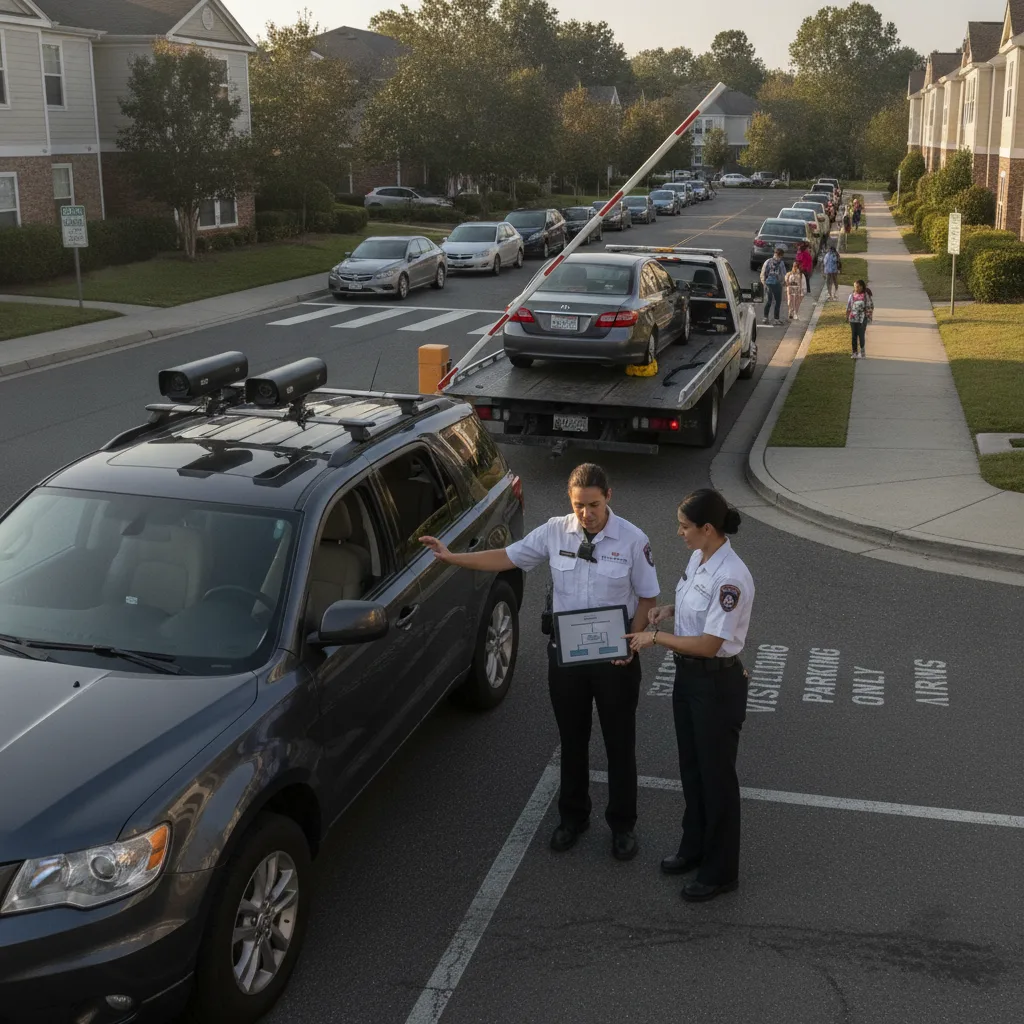
Direct answer: Apartment enforcement teams training drivers on mobile LPR need to focus training on one thing daytime patrol at a retail lot doesn’t have to worry about: telling residents, registered guests, and unauthorized vehicles apart using a resident roster that changes constantly with move-ins, move-outs, and lease renewals. The scanning mechanics are simple to teach. The judgment calls around who’s actually allowed to be parked where, on a given day, at a community with hundreds of units — that’s what takes real training time.
Why apartment communities are a different training problem than a single retail lot
A retail property has a relatively stable, small list of authorized vehicles. An apartment community can have several hundred units, each with its own permit status, guest allowances, and lease timeline — and that data changes every week as people move in, move out, buy a car, or let a lease lapse. A new enforcement driver has to learn to trust the resident/permit list as the source of truth, while also knowing exactly when that list can’t be trusted yet.
This matters because apartment enforcement carries more relationship risk than a retail lot tow. The person you might tow lives there, pays rent there, and will be filing a complaint with the same leasing office you work with every day. A wrongful tow at an apartment community doesn’t just cost a drop fee — it can become a lease dispute, a bad review, or a call the property manager has to personally handle.
Core training sequence for new enforcement drivers
1. Learn the permit and registration system before the scanner
Before touching the app, a new driver needs to understand how vehicles get authorized at that specific community: resident permits issued at move-in, permit renewal tied to lease renewal, temporary guest registration (often self-serve through an app, a call to the office, or a physical guest pass), and any reserved or assigned spaces. Have them walk the property with a supervisor and match a handful of real vehicles to their actual record in the system, so the abstraction becomes concrete.
2. Practice reading permit status, not just permit presence
A scan result of “no permit found” means different things depending on timing. Train drivers to check the vehicle’s history before treating a no-match as a violation:
- Is this a brand-new move-in where the permit hasn’t been issued yet, or is in the system but hasn’t synced?
- Is this a guest vehicle within its allowed window (many communities cap guest parking at a set number of consecutive days)?
- Is this a lease that expired days ago where the resident is mid-move-out, which some properties grace and others don’t — the driver needs to know your community’s actual policy, not guess
3. Set a clear escalation path to the leasing office
Unlike a retail lot where the driver may be the only decision-maker on site, apartment enforcement almost always has a leasing or management office to check with during business hours. Train drivers on exactly when a call to the office is required versus when they’re authorized to act independently — for example, requiring office confirmation for any vehicle belonging to a resident whose account shows a recent status change, while allowing independent action on clear unregistered-guest violations in visitor spaces.
The situations that generate the most complaints
- New move-ins. A resident moved in this week, has a lease and a key but the permit hasn’t caught up in the system. This is the single most common source of wrongful-tow disputes at apartment communities — build a specific drill for it.
- Visitor overstays. A guest who registered for a weekend and is still there ten days later looks identical in the system to someone who never registered at all. Teach drivers to check registration history, not just current status, since a pattern of repeat “temporary” parking from the same plate is a different situation than a first-time overstay.
- Reserved and accessible spaces. Assigned covered parking, reserved spots tied to a specific unit, and accessibility spaces all carry rules separate from general permit enforcement. A driver who only checks “is there a valid permit” and ignores space-specific rules will misjudge these regularly.
- Move-out overlap. A departing resident’s vehicle may sit in the lot for a few days after their lease ends. Make sure drivers know your property’s actual grace period rather than treating every post-lease vehicle as immediately towable.
Building the training program with turnover in mind
Apartment enforcement roles often see more staff turnover than a dedicated towing company’s driver pool, which means the training process itself needs to be repeatable without a lot of one-on-one supervisor time each cycle.
- Document the property-specific rules once, update them when they change. Guest limits, grace periods, reserved-space policy, and escalation contacts should live in a short reference sheet new hires read before their first shift — not knowledge passed down verbally and inconsistently.
- Shadow shift before solo shift. A new driver should ride along and watch at least one full shift of real scan-and-decide calls, including at least one edge case, before running the route themselves.
- Supervised solo period with case review. For the first one to two weeks, have a supervisor or the community manager review every tow and every “flagged but released” decision against the photo and permit evidence, catching pattern issues (too aggressive, too hesitant) early.
- Refresh training at renewal season. Lease renewal cycles and seasonal move-in spikes are when permit data gets messiest — a short refresher before your community’s typical high-turnover months keeps drivers from falling back on assumptions instead of checking the current record.
Site questions
How is apartment enforcement training different from third-party towing company training?
The core scanning skills are the same, but apartment enforcement drivers need much deeper familiarity with a constantly changing resident and lease database, and a closer working relationship with the leasing office for edge-case decisions — since the vehicles in question usually belong to the property’s own residents.
What’s the most common mistake new apartment enforcement drivers make?
Treating a “no permit on file” result as an automatic violation without checking whether it’s a recent move-in, an active guest registration, or a data sync delay. Most disputed tows at apartment communities trace back to this.
Should drivers be able to make tow decisions without office approval?
For clear-cut cases in visitor or unauthorized areas, usually yes. For any vehicle tied to a resident account with a recent change — new lease, renewal, or move-out — most communities are better served requiring a quick office confirmation first.
Related PLACA.AI resources
- Parking enforcement software for towing companies
- Mobile LPR planning guide
- Parking enforcement LPR workflow guide
Want to see how PLACA.AI keeps resident and guest permit data current for apartment enforcement teams? Get in touch or book a demo.
Data source: U.S. Department of Transportation