

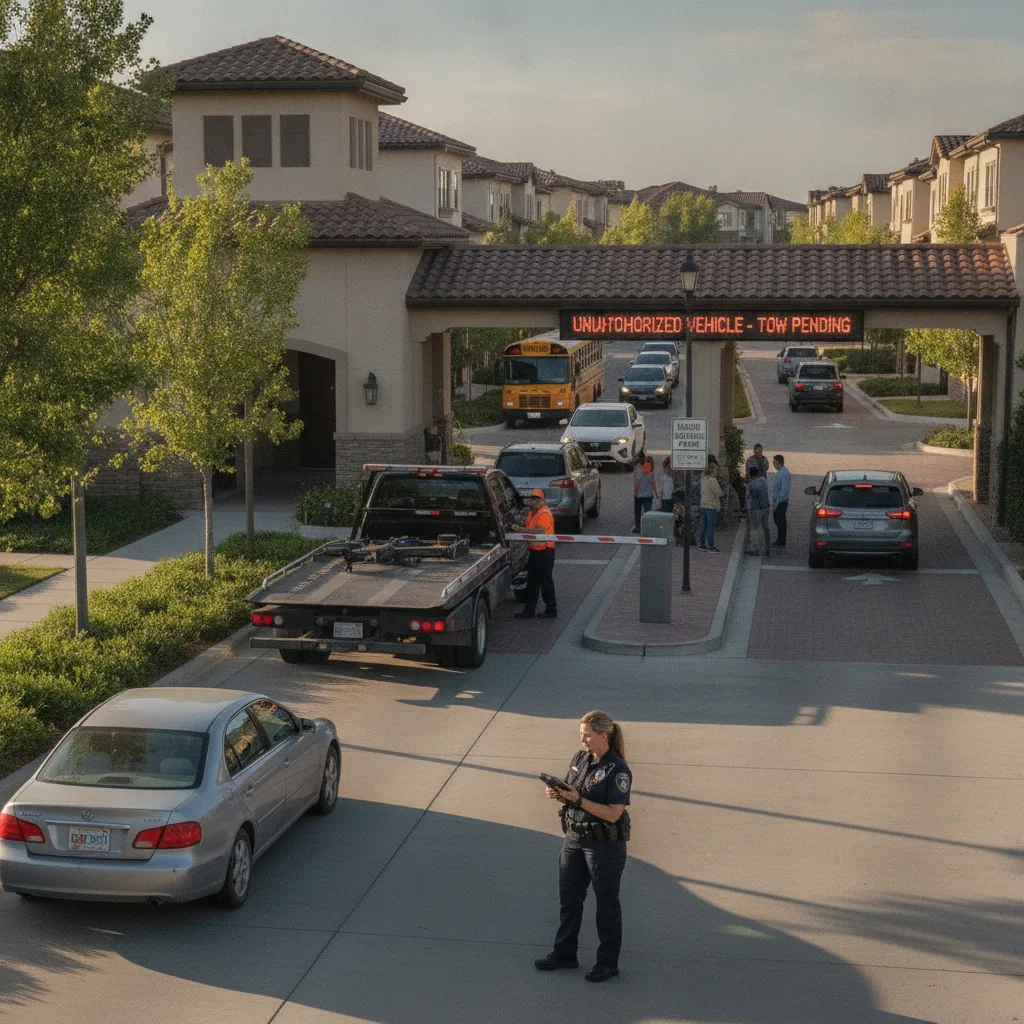
Direct answer: Reduce disputes by checking the current HOA rule, permit source, exact location, observation requirement, notice history, exception list, and tow approval before dispatch; preserve the same evidence for resident review.
This guide is for HOA patrol operators, community managers, tow partners, boards, and residents and addresses reducing disputed tows during HOA patrol. The people affected by the rule should be able to understand how a correction or exception works.
Find the bottleneck
Patrol speed can outpace resident record changes, temporary authorizations, sign updates, and board-approved exceptions.
Example: A resident whose replacement plate was approved that morning should not be towed because the patrol device has not synchronized; the freshness check should stop the case.
HOA tow-dispute prevention gate
| Decision point | Evidence or control | Required response |
|---|---|---|
| Current rule | policy version, signs, zone, authority | confirm applicable restriction |
| Resident authorization | permit source, recent changes, exception | check freshness |
| Violation evidence | vehicle, location, timing, notice | meet board standard |
| Tow release | named approval and partner acknowledgment | dispatch or stop |
Sequence daily work
- Step 1. For current rule, verify policy version, signs, zone, authority and then confirm applicable restriction.
- Step 2. For resident authorization, verify permit source, recent changes, exception and then check freshness.
- Step 3. For violation evidence, verify vehicle, location, timing, notice and then meet board standard.
- Step 4. For tow release, verify named approval and partner acknowledgment and then dispatch or stop.
Expansion should stop when required evidence is missing.
Fallback route
When data is stale, signs are unclear, the vehicle may qualify for an exception, or evidence is incomplete, pause the tow and route the case to the property owner.
Correct the record, approve a bounded exception, deny under the written rule, or escalate to the named authority; do not leave the case unresolved.
Bounded pilot
Run a limited test long enough to observe the recurring pattern and at least one correction or fallback.
- tows with a complete pre-release check
- cases stopped for recent resident changes
- evidence packets available to appeals
- disputes upheld or corrected by reason
- tow-partner acknowledgments retained
Define who counts each measure, the observation window, and the result that blocks expansion.
Acceptance evidence
- State the purpose and non-goals for reducing disputed tows during HOA patrol.
- Assign owners for the normal path, correction, exception, and final approval.
- Test live conditions with the people who administer and experience the workflow.
- Confirm contracts, pricing, support, integrations, data handling, and governing requirements independently.
- Retain enough evidence to reproduce each approval, denial, correction, or escalation.
Related PLACA.AI planning resources
Practical questions
What must be approved first for reducing disputed tows during HOA patrol?
Approve the purpose, owner, evidence standard, decision rule, and exception path before scaling.
What should the pilot reproduce?
Test the normal process and the named exception while collecting tows with a complete pre-release check and the other listed measures.
When should rollout stop?
Stop when ownership is unclear, required evidence is missing, a serious exception lacks a safe route, or the result conflicts with the approved rule.
Plan a limited workflow review
Bring the current rule, process, exceptions, and success criteria for reducing disputed tows during HOA patrol. PLACA.AI can help evaluate a bounded pilot without assuming another property’s workflow is the right answer.
Editorial refresh: July 22, 2026. Independently confirm current product capabilities, third-party features, pricing, contracts, governing requirements, and local rules before acting.
Data source: Community Associations Institute