

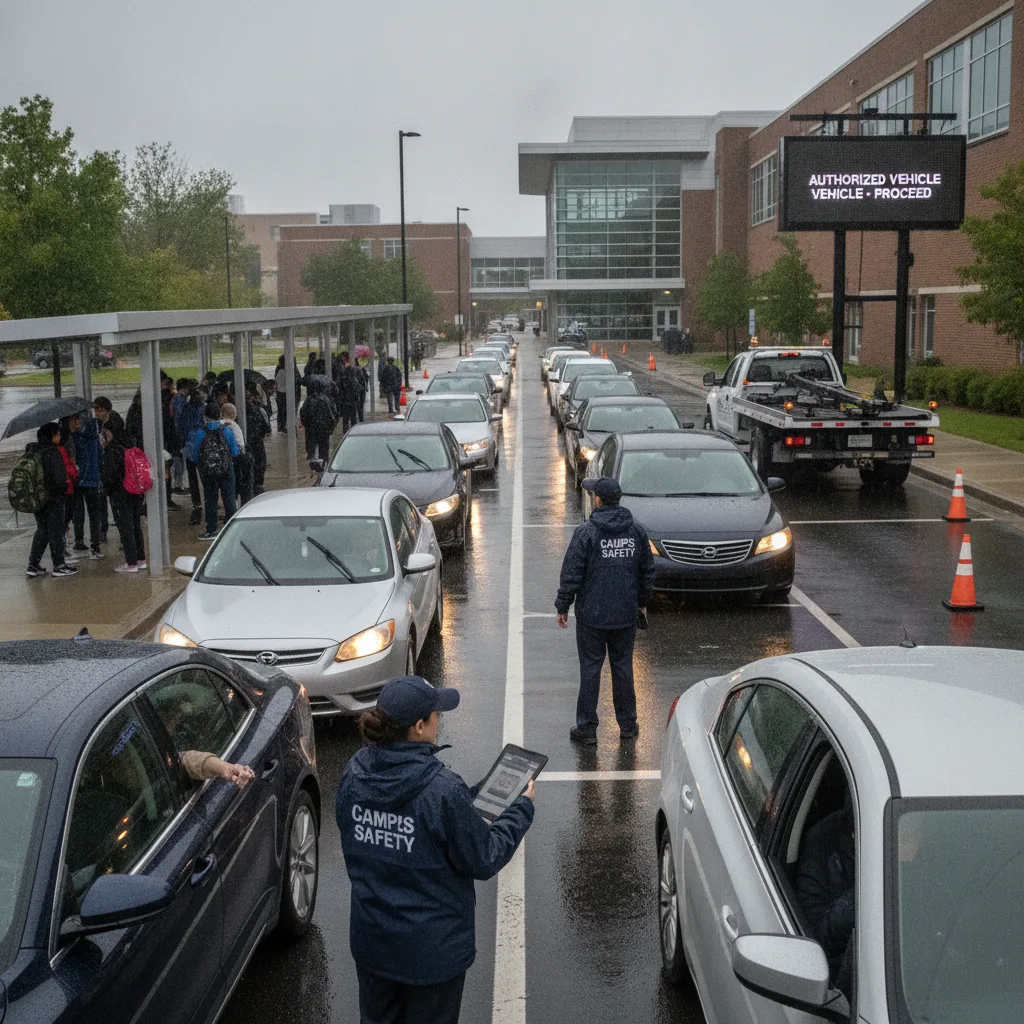
Direct answer: Rain doesn’t just slow the carline down for campus safety – it degrades the exact things a safety officer depends on to do the job: sightlines across the lot, the ability to read a plate at a distance, and radio clarity when everyone is talking at once about a backed-up line. Treat heavy rain as a visibility-reduction event, not just a traffic-management one. Move plate and identity checks to a point with better cover and lighting, hand off routine backup management to non-safety staff so the safety channel stays clear, and set a firm, pre-agreed threshold for when weather itself – not just traffic – requires pausing the carline entirely.
This guide is for campus safety officers, school resource officers, and security staff who monitor dismissal, addressing specifically what a rain event does to detection and communication, separate from the general logistics of a rainy carline.
Rain is a visibility problem before it’s a traffic problem
A dry-day safety posture assumes you can see a vehicle clearly enough to confirm a plate, spot a driver who doesn’t match the family on record, or notice a vehicle behaving oddly at the edge of the lot. Heavy rain, low light, and fogged windshields degrade all three at once, at exactly the time of day – dismissal – when the lot is busiest and staff attention is already split across a dozen moving vehicles. A safety plan that doesn’t explicitly account for reduced visibility is really just a dry-day plan being run in worse conditions and hoping it holds.
Example: During a heavy downpour, a vehicle idles near the edge of the visitor lot longer than usual. On a clear day, an officer would notice the plate doesn’t match any record within a few seconds of watching. In the rain, with windshield glare, the vehicle’s outline blurred by water on the lens or on the officer’s own line of sight, and attention split toward the backed-up carline, that same vehicle could sit unnoticed for several minutes – exactly the gap a genuine security concern needs.
What rain degrades, and how to compensate
| What rain degrades | Why it matters for safety | Compensating control |
|---|---|---|
| Sightlines across the lot | Slower to spot a vehicle that doesn’t belong | Position staff where cover and lighting are best, not just where traffic flows |
| Plate legibility at a distance | Manual visual checks take longer and are less reliable | Move the check point closer, or rely on an automated match rather than eyesight alone |
| Radio clarity and channel volume | Genuine alerts compete with routine backup-management chatter | Route routine rain-delay traffic to a separate channel from safety alerts |
| Staff attention, split toward traffic control | Less capacity left to watch for behavioral anomalies | Hand off pure traffic-flow tasks to non-safety staff during weather events |
Set a weather stop threshold before you need one
Lightning and flooding are the obvious triggers most plans already name, but the threshold for pausing dismissal shouldn’t only be about student exposure – it should also account for when conditions have degraded far enough that your own detection capability can no longer be trusted. If staff cannot reliably confirm a vehicle’s identity or notice one that doesn’t belong, that is itself a reason to slow or pause the carline, independent of how the weather affects the children waiting to be picked up. Agree on that threshold in advance, in writing, so the decision to pause doesn’t fall to whichever officer happens to be on duty and has to make the call alone in the moment. Review this alongside the broader Standard Reunification Method planning, since a weather-driven pause and an emergency-driven pause should use recognizably similar language and escalation steps so staff aren’t learning a new procedure mid-storm.
Let automated matching do what eyesight can’t in the rain
The specific failure mode rain creates – a human eye trying to read a plate through water, glare, and motion – is precisely the kind of check that benefits from not depending on human eyesight at all. An automated plate match at the gate performs the same regardless of weather, which means the safety team’s attention stays available for the judgment calls that do require a person: an unfamiliar driver, an odd pattern of movement, a vehicle that circles rather than approaches. That division of labor matters most exactly when conditions are worst, which is also when staff bandwidth is thinnest. It complements the work of verifying authorized pickup vehicles under normal conditions – the rain scenario is simply the stress test for whether that verification process still holds up when eyesight alone would fail.
What to measure before expanding the process
- vehicles matched automatically versus requiring a manual visual check in the rain
- time to notice a genuinely unmatched vehicle during a weather event
- routine backup chatter kept off the safety channel
- weather-triggered pauses activated within the agreed threshold
- staff positioned with adequate sightlines during active rain
Owner sign-off
- State the purpose and non-goals for the rainy-day safety posture.
- Name who owns the weather-pause threshold and who can call it in the moment.
- Test the actual rain-day sightlines and staff positions, not just the dry-day layout.
- Confirm contracts, pricing, integrations, data handling, and governing requirements independently.
- Retain a record of any weather-related pause, its trigger, and its resolution.
Related PLACA.AI planning resources
Frequently asked questions
What must be approved first for a rainy-day campus safety posture?
The weather-pause threshold, where staff reposition for the best sightlines, and how routine backup traffic stays off the safety radio channel.
What should the pilot reproduce?
An actual heavy-rain dismissal with normal staffing, at least one manual identity check attempted under poor visibility, and a measured response to one deliberately unmatched test vehicle.
When should rollout stop?
If staff cannot reliably confirm vehicle identity in active rain, if the safety channel stays clogged with routine traffic chatter, or if the weather-pause threshold isn’t being followed consistently.
Plan a limited workflow review
Bring the current rule, process, exceptions, and success criteria for managing rainy-day carline backups through campus safety. PLACA.AI can help evaluate a bounded pilot without assuming another campus’s workflow is the right answer.
Editorial refresh: September 18, 2026. Independently confirm current product capabilities, third-party features, pricing, contracts, governing requirements, and local rules before acting.
Data source: National Center for Education Statistics