

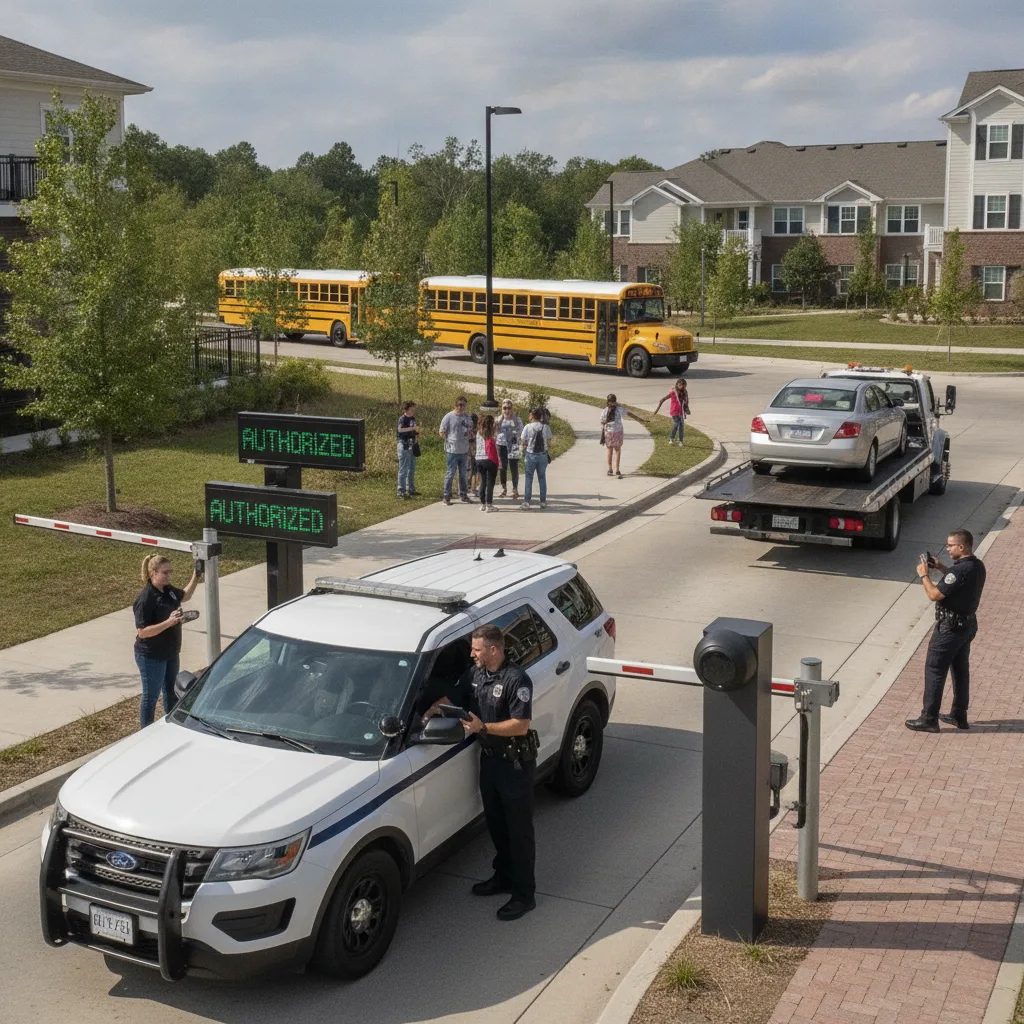
Direct answer: For an HOA, the patrol tool that wins the comparison isn’t the one with the fastest scan — it’s the one that ties back cleanly to the community’s actual governing rules, keeps a record the board can review regularly, and makes it easy to separate a homeowner’s vehicle from a guest’s before anything gets towed. Because HOA enforcement decisions often end up in front of a board or an appeals process, the audit trail matters as much as the initial catch.
This is written for HOA patrol operators — whether patrol contracted directly by the association or a third-party vendor working under a management company — along with board members and community managers who review enforcement activity and hear appeals.
Why HOA enforcement is different from an apartment or commercial lot
An HOA isn’t a landlord-tenant relationship. Residents are homeowners governed by CC&Rs and rules the board adopted, often after a vote or public comment period. That changes what “correct enforcement” looks like: the rule being applied has to trace back to an actual governing document, not just a generic no-parking sign, and a homeowner who disputes a violation may take it to the board, not just call a leasing office.
A patrol platform built for HOA work should reflect that. It’s not only about accurate plate reads — it’s about the case file being complete enough to hold up if a resident appeals it at a board meeting weeks later.
What to compare beyond the plate scan
Rule mapping to actual governing documents
Ask whether the platform lets you attach the specific rule or CC&R section to each violation type, so a citation for a guest-parking violation on a private street cites the actual community rule rather than a generic label. This matters the moment a homeowner asks which rule, exactly.
Guest registration and visitor portals
Many communities let residents register guests online or through a resident portal. Confirm how quickly a guest registered that afternoon shows up to the patrol officer, and what happens if the resident forgot to register but calls the management company to vouch for the guest afterward.
Common areas versus private property
HOA patrol often covers a mix of association-owned common areas (guest lots, clubhouse parking) and private driveways or streets the association has authority over by rule. Check that the tool lets you configure different rules and evidence requirements for each, since the authority to act isn’t identical across all of them.
Reporting the board can actually use
Most boards want a periodic summary: violations issued, tows authorized, disputes and how they were resolved. Compare how easily each platform generates that report versus requiring someone to manually assemble it from case notes.
A realistic trial for a single community
Run both finalists across a normal patrol cycle — two to four weeks covers most communities’ actual pattern — and track:
- How many violations cited the correct specific rule versus a generic category
- How fast a registered guest’s vehicle cleared without a flag
- Time to produce a complete case packet for a homeowner appeal
- Whether common-area and private-street rules were applied correctly and separately
- How complete and usable the board or manager found the resulting activity report
If your community has a known trouble spot — a shared visitor lot that regularly fills up, a street where guest parking is routinely contested — run that spot specifically rather than relying on an average across the whole property.
Where a human needs to step in
Set a clear stop condition: any case involving a recent rule change, an ongoing dispute, or a resident who has an open appeal on a related issue should route to the community manager for review rather than proceeding to a tow automatically. HOA enforcement carries more governance weight than a standard commercial lot, and that extra review step is what protects the board from a bad outcome.
FAQ
Can patrol software enforce CC&Rs directly?
It can document a violation of a specific rule and route it for review, but the board — or its designated authority under the governing documents — still makes the enforcement decision. Independently confirm what your governing documents and state law require before automating any part of that decision.
How do we handle a homeowner who disputes a violation after the fact?
Pull the full case file — photo, location, timestamp, and the specific rule cited — and review it against the resident’s account before the next board meeting or hearing, rather than defending the citation from memory.
Does every common area need the same enforcement rules as private streets?
No. Configure them separately, since the association’s authority and the applicable rule can differ between a shared amenity lot and a homeowner’s private driveway.
An HOA’s enforcement record should hold up to scrutiny from residents and the board alike. See how enforcement software supports a documented, board-ready process or review mobile LPR options built for community patrol, then reach out to walk through your community’s specific rules.
Data source: Community Associations Institute