

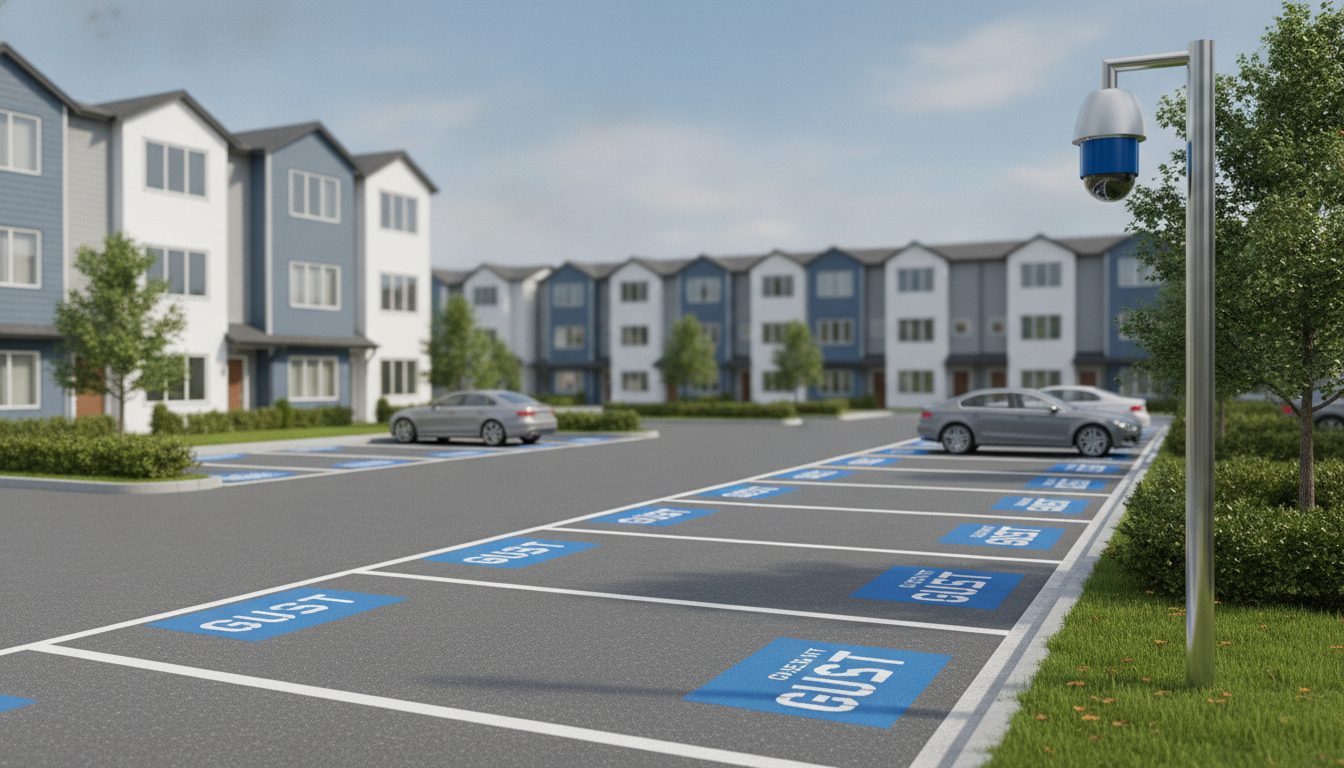
Direct answer: Texas HOAs reduce visitor parking abuse by making the resident sponsor — not the guest — the accountable party, and by building a correction window into the process before any tow or fine, since Texas private-property towing carries its own signage and notice requirements that are easy to get wrong under time pressure.
This guide is for Texas HOA boards, managers, and parking committees who need a visitor-parking process that survives both a resident dispute and a look from the association’s counsel. The core distinction this page draws is between a correctable mistake and an actual pattern of abuse, because Texas associations that tow first and sort out the difference later tend to end up dealing with the dispute rather than the parking problem.
Separate the correction path from the escalation path
Visitor parking becomes contentious in Texas HOAs for a specific reason: the rule is usually broad (“guests must register” or “no overnight guest parking without a permit”) but the evidence for any individual case is inconsistent, and residents can tell when enforcement feels arbitrary. A guest plate entered with one wrong digit and a vehicle that’s been parked in guest spaces for three weeks after two prior notices are not the same problem, but a process without a clear correction step treats them the same way — and that’s what generates the “why did you tow my sister’s car” complaint that lands on the board’s desk.
Example: A guest whose plate was mistyped during registration should have a same-day correction path that resolves the case without escalation. A vehicle repeatedly occupying visitor spaces after two documented notices should move to the board-approved enforcement step. The file needs to show why these two cases were handled differently — not just that they were.
Visitor-parking decision path
| Decision point | Evidence or control | Required response |
|---|---|---|
| First observed stay | Check plate against sponsor registration and posted rule | Notice to sponsor, or resident confirmation |
| Registration error | Confirm dates and sponsoring resident directly | Same-day correction window before any escalation |
| Repeated unauthorized use | Document dates, locations, and prior notices to the sponsor | Board-approved enforcement step, following towing signage and notice rules |
| Medical, caregiver, or emergency visit | Documented exception path tied to the sponsoring resident | Temporary, renewable authorization with a review date |
Making the sponsor accountable, not just the guest
Under most Texas HOA governing documents, the resident who invites a guest is responsible for that guest’s compliance — which means notices and correction requests should go to the sponsor, not just sit with an unreachable visitor. Build the registration system around this from the start: every guest authorization needs a named resident sponsor, and repeat violations count against that resident’s record, not just the vehicle’s. This also gives residents a direct incentive to register guests properly instead of treating visitor parking as unmonitored.
Build the workflow in stages
- Write the visitor definition and maximum stay in plain language, and confirm every notice references the sponsoring resident by name.
- Give residents one reliable way to register or correct a guest plate, with a same-day correction window before any case escalates.
- Require an evidence record before escalation — dates, locations, and prior notices to the sponsor, not just the vehicle’s plate history.
- Confirm towing compliance separately. Texas private-property towing has its own signage, notice, and consent requirements that are distinct from your association’s internal fine process — verify current requirements with the association’s towing vendor and counsel before any tow, not case by case in the field.
Correction, appeal, and fallback
Texas associations should have counsel or a qualified adviser review governing documents, notice requirements, towing rules, and local obligations before finalizing this process — this page provides an operational framework, not legal advice. Every off-normal case still needs a traceable end state: corrected, approved as an exception, denied under the written rule, or escalated to the board, never left as an informal “we’ll deal with it” note. Our guide on stopping guest permit sharing in Texas HOAs covers the closely related problem of one sponsor’s authorization being used for multiple different vehicles.
Pilot scorecard
Limit the first run to a manageable cohort and document both the cases that resolved cleanly and the ones that needed manual intervention.
- visitor registrations corrected via the same-day path before any escalation
- repeat unauthorized stays after a documented notice to the sponsor
- complaints resolved without reaching the board
- evidence records meeting the standard the board actually approved
- towing cases that followed the confirmed signage and notice requirements
Pre-launch review
- Write the purpose and non-goals for reducing visitor parking abuse in a Texas HOA and name the accountable owner for each step.
- Verify the process with the actual board, managers, and residents who will use, administer, or review it.
- Test a correction case, a repeat-offender case, and the caregiver exception described above.
- Confirm current towing, notice, and signage requirements directly with counsel and the towing vendor — not from a generic template.
Related PLACA.AI planning resources
Questions for the implementation team
Should every first violation result in towing?
A board should follow its governing documents and approved enforcement ladder; a same-day correction or warning stage reduces avoidable disputes over what are often simple registration errors.
Can plate records replace posted parking rules?
No. Documentation can support enforcement, but the association still needs clear rules, proper signage, sponsor-based notice, and an authorized process consistent with Texas towing requirements.
Who should be notified when a guest overstays — the guest or the resident?
The sponsoring resident, since they’re accountable under most governing documents for guests they invite. Notices sent only to the vehicle or an unreachable visitor rarely resolve the underlying issue.
Map a Texas visitor-parking pilot
Bring the rules, current process, known exceptions, and success criteria for reducing visitor parking abuse in a Texas HOA. PLACA.AI can help evaluate a limited pilot without presuming that another property’s hardware or workflow is the right answer.
Editorial refresh: September 18, 2026. Before using this framework for reducing visitor parking abuse in a Texas HOA, independently confirm current product capabilities, third-party features, pricing, contracts, governing requirements, and local rules.
Data source: Community Associations Institute