

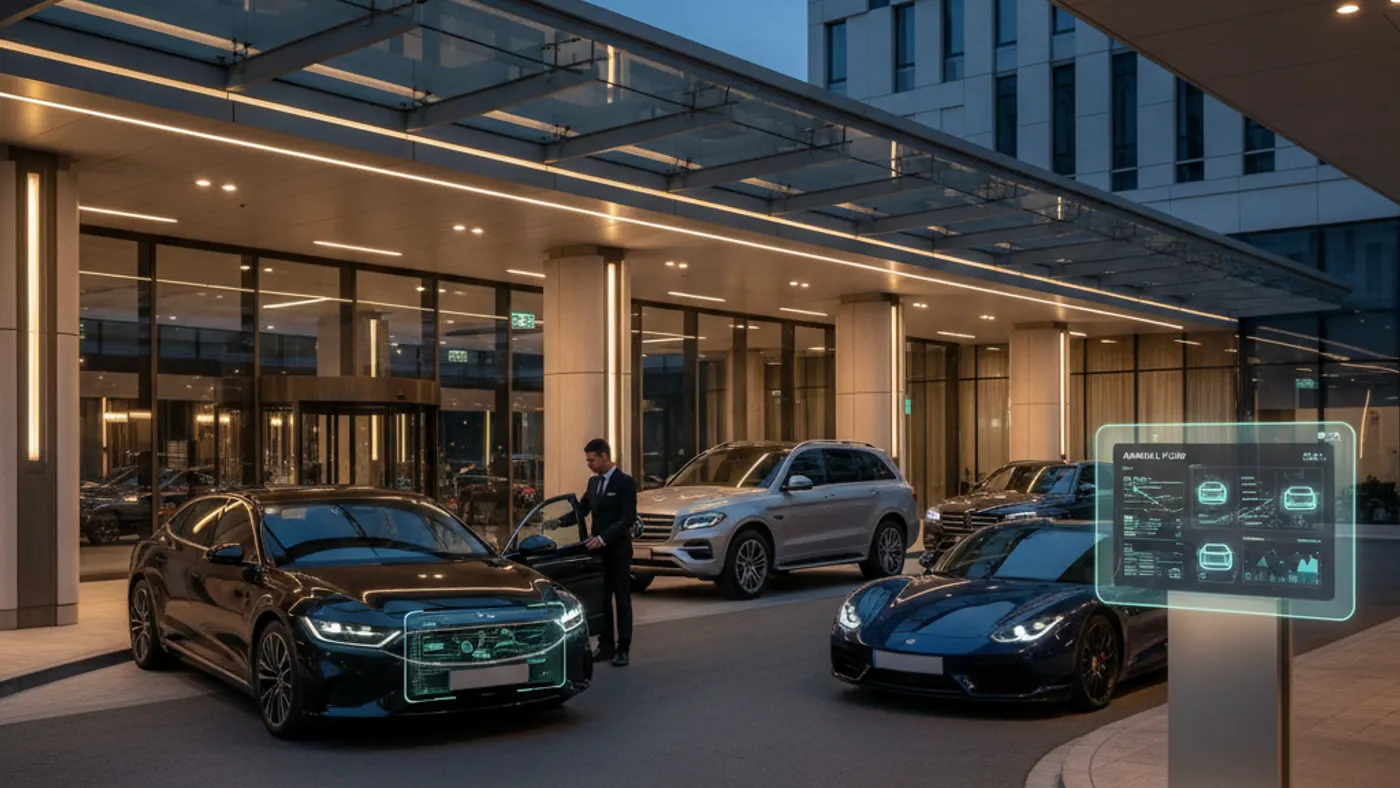
Short answer: Event valet companies manage peak arrival surges by treating every booking as a one-night operation with its own arrival curve — built from the event’s guest count and start time, not a generic staffing formula — and by walking the site in advance to plan curb positions, key storage, and overflow before a single guest arrives. Because you rarely work the same driveway twice, the planning has to happen on paper (or a tablet) before the surge, not through instinct built up over months at one location.
Unlike a hotel or restaurant valet team, an event company doesn’t get to learn a curb over a season. You might run a wedding at a vineyard on Friday, a corporate gala at a downtown hotel on Saturday, and a fundraiser at a private estate on Sunday — three different curbs, three different guest counts, three different arrival windows, often with a crew that includes day-of staff who’ve never worked together before. The surge risk isn’t abstract: a ceremony start time or a red-carpet arrival window can compress 150–300 cars into 20–30 minutes, and there’s no second night to fix what goes wrong the first time.
Plan the arrival curve from the event, not from habit
Every event has a predictable arrival shape if you know the format. A wedding ceremony creates a hard compression right before the start time, then a long lull, then a second surge at the end of the night. A gala with a step-and-repeat or red carpet compresses arrivals into whatever window the program specifies. A corporate event with assigned arrival times spreads guests more evenly — until the keynote is running late and everyone shows up at once anyway.
Before the event, get three numbers from the client or venue coordinator: expected guest count, the scheduled start time, and whether there’s a hard cutoff (a ceremony, a performance, a dinner service) that will pull most arrivals into a narrow window. That’s enough to size your crew and decide how many curb lanes and greeters you need without guessing.
Site-specific planning checklist
Because the venue changes every time, do a walkthrough (in person or by phone with the venue’s event coordinator) that covers:
- Curb geometry. How many cars can queue without blocking a public road or a fire lane, and where the legal boundary of “your” space ends.
- Key and vehicle staging. Where keys are held, how vehicles are staged if there’s no dedicated garage, and how far runners have to walk or drive to reach parking.
- Overflow lot. A pre-identified overflow location and the trigger point for using it — decided before the event, not improvised when the primary lane backs up.
- Accessibility and emergency access. Which lanes must stay clear regardless of volume.
- Vehicle records. How you’re capturing plate, arrival time, and any pre-existing damage for every car — this matters more at events than anywhere else, since a one-night crew has no ongoing relationship with the guest to fall back on if a dispute comes up later.
Staffing the compression window
A common mistake is staffing for the average arrival rate across the whole event instead of the worst 20-minute window. If 250 guests arrive with 200 of them compressed into a 30-minute pre-ceremony window, your greeter-to-lane ratio and runner count need to be sized for that 30 minutes, not for the event’s average. Build the schedule backward from the compression window, then let staff step down once the surge passes and departures haven’t started yet.
Illustrative example: for a wedding with a 6:00pm ceremony and 220 expected guests, a workable plan might staff two greeters and four runners for the 5:30–6:00pm window, then reduce to one greeter and two runners once the ceremony starts, since arrivals essentially stop and departures won’t begin until the reception ends.
The end-of-night surge is often worse than the start
Arrival surges get the planning attention, but departures at the end of an event are frequently harder — everyone wants their car within the same ten minutes, it’s dark, guests may have been drinking, and your crew is tired after a long shift. Reserve your strongest runners and clearest communication for closing, and make sure the vehicle record from arrival (which car, which key, which guest) is easy to pull up quickly rather than searched from a paper stub pile at 11pm.
What to confirm before every booking
- Guest count, start time, and any hard-cutoff moment (ceremony, program start, dinner service).
- Curb capacity and a pre-identified overflow location with a clear trigger.
- Insurance and venue-specific requirements (certificate of insurance, load-in/load-out windows, parking restrictions).
- How vehicle records will be captured and by whom, especially for a large or unfamiliar crew.
- A named point of contact at the venue for emergencies or access changes on event day.
FAQ
How far in advance should we plan for a large event?
Get the guest count and schedule as early as possible, but finalize curb and staffing plans within a week of the event once RSVP counts and the run-of-show are close to final.
What’s the biggest difference between event valet and hotel or restaurant valet?
You don’t get repeat exposure to the same curb, so planning has to be explicit and documented rather than built on team familiarity with the location.
Should we always plan for an overflow lot even for smaller events?
Yes — identify one even if you don’t expect to need it. A last-minute guest count increase or a delayed program is common enough that having the option costs little and saves a lot.
PLACA’s valet parking knowledge hub and valet software built for venues and events cover more on planning single-night operations, and the ticketless vehicle recognition system overview explains how plate-based records work without a physical ticket to manage across a one-night crew.
Planning a large event and want to talk through your curb layout and staffing plan? Contact PLACA or book a demo to see how it fits a single-night operation.
Data source: U.S. Department of Transportation