

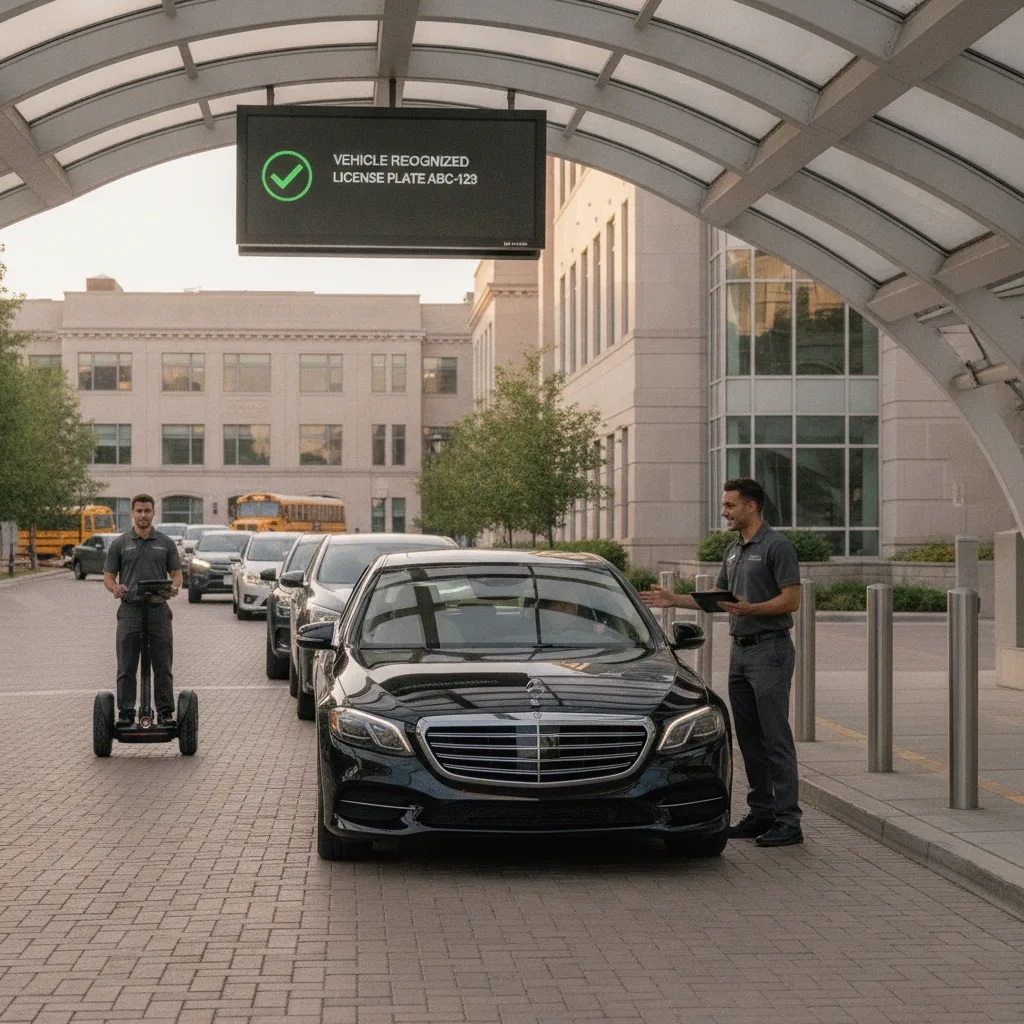
Direct answer: Event valet companies move from paper tickets to ticketless valet by solving a problem hotel and restaurant valet don’t have in the same intensity: matching hundreds of cars to hundreds of guests inside a departure window that’s often twenty minutes long, not staggered over a day. A wedding or concert doesn’t end gradually – it ends all at once, and a lost paper ticket in that crush is far more likely than at a hotel where the guest has the ticket in their room for days. Ticketless valet fixes the failure point that matters most for events: the retrieval moment, not the drop-off.
This guide is for event valet companies – operators contracted to run valet for a single wedding, concert, gala, or private event at a venue they usually don’t own or staff permanently. That temporary, mobile setup is the defining difference from hotel or casino valet, which runs on fixed infrastructure the operator controls every day.
Why event valet fails differently than hotel valet
A hotel valet team loses a paper ticket occasionally, spread across a full day of arrivals and departures with time to sort it out. An event valet team faces a single mass arrival before the event starts and a single mass departure the moment it ends – and a lost or damaged ticket during that crush turns into a guest standing at the stand with nothing to hand over while a line builds behind them. Paper tickets get soaked at outdoor weddings, crushed in evening bags, or simply never make it out of a coat pocket that got checked. The problem isn’t that paper tickets are unreliable in general – it’s that events concentrate every failure into the same twenty-minute window.
What “ticketless” actually needs to solve for an event
- Fast identity verification without a token. When the paper claim is gone, the guest needs another reliable way to prove which car is theirs – a plate match tied to the arrival record, confirmed against a name or phone number, works without relying on a physical object that can be lost.
- Departure prediction, not just retrieval. Because the event ends at a known time, the biggest efficiency gain isn’t faster lookup – it’s staging cars in the queue before the crowd hits the stand, based on the event’s actual schedule rather than reacting to the rush as it happens.
- An offline fallback that works on temporary equipment. Event valet often runs on mobile stands, generators, and a connection that wasn’t installed by the venue – the ticketless process needs a manual backup that a runner can execute by hand if a device or connection fails mid-event, without stopping the line.
Staffing a temporary, single-night operation
| Stage | Event-specific challenge | What helps |
|---|---|---|
| Setup | Crew and equipment arrive at a venue they don’t run day-to-day | A pre-event walkthrough confirming lane layout, staging area, and connectivity before guests arrive |
| Mass arrival | Most guests arrive in a short window before the event starts | Extra runners staged specifically for the arrival surge, not spread evenly across the whole shift |
| Mass departure | Nearly every car is requested within minutes of the event ending | Cars pre-staged in retrieval order based on the venue’s own program or schedule |
| Breakdown | Equipment and any temporary infrastructure leave with the crew | A closing reconciliation confirming every vehicle logged in was logged out before the crew departs |
Why the departure window is the real design problem
Most valet workflows are optimized around the drop-off, because that’s where the guest’s first impression happens. For event valet, the departure is where the process actually gets tested – a wedding reception or concert doesn’t trickle guests out over hours, it releases most of them within the same short window, often exactly when a band finishes or a program ends. A ticketless system that only speeds up the counter lookup doesn’t fix this; what fixes it is knowing the event’s schedule well enough to have cars already staged before that window opens, so the line moves because the cars are ready, not because the lookup got faster.
Related PLACA.AI planning resources
- valet operations knowledge hub
- ticketless valet system guide
- vehicle recognition for valet operations
Before rollout
What’s the first decision for an event valet company moving to ticketless?
Confirm how identity gets verified without a paper token – typically a plate match against the arrival record, backed by a name or phone lookup – and make sure every runner can execute the offline version by hand.
What belongs in the pilot?
Run it at one event type first – a single-venue wedding season or a recurring concert series works well – so the crew can refine the mass-departure staging before taking it to an unfamiliar venue.
What blocks expansion to larger events?
No reliable offline fallback for connectivity failures, a crew that hasn’t rehearsed the mass-departure staging, or a venue walkthrough that never happened before doors opened.
Plan a limited workflow review
Bring your current paper-ticket process, one recent event’s departure-window timing, and any lost-ticket incidents. PLACA.AI can help evaluate a bounded pilot without assuming another property’s workflow is the right answer.
Editorial refresh: September 18, 2026. Independently confirm current product capabilities, third-party features, pricing, contracts, governing requirements, and local rules before acting.
Data source: U.S. Department of Transportation