

Direct answer: For front office staff, “standardized dismissal” means one thing in practice: the phone script, the walk-up ID check, and the last-minute-change form work the same way whether you’re covering your home campus or filling in at another school in the district. If a parent calls at 2:15 to say Grandma is picking up instead of Mom, the steps you take — who you verify, what you write down, who signs off — shouldn’t change based on which building you happen to be sitting in that day.
This is for front office staff, registrars, and administrative assistants who handle dismissal-related calls, walk-ups, and last-minute changes — often at more than one campus over the course of a school year, whether through a shared-staffing model, a mid-year transfer to a different school, or simply covering for a colleague who’s out.
Why the Desk-Level Process Drifts Even When the District Policy Doesn’t
District policy documents tend to say the same thing everywhere: verify the adult, confirm authorization, log the change. What actually happens at the front desk drifts campus to campus based on who trained you, how busy the office is that afternoon, and what the previous office manager decided was “close enough.” One school’s front office asks for ID on every unfamiliar face; another, staffed by people who’ve worked there for fifteen years and know most families by sight, has quietly stopped asking because it feels redundant — until a new front office hire, or a sub covering the desk, doesn’t know that local shortcut and either over-checks a familiar face awkwardly or under-checks someone they don’t recognize.
The Situations That Need the Same Answer Everywhere
| Situation at the window or phone | Standardized answer | Why it can’t vary by campus |
|---|---|---|
| Unfamiliar adult arrives for pickup | Ask for ID, check against the authorized list, no exceptions for “they look fine” | The riskiest moment is exactly when staff feel most tempted to skip the check |
| Parent calls after 2:00 p.m. to change pickup | Written or logged confirmation, relayed to the classroom before dismissal begins — not a verbal pass-along | Same-day changes are the highest-risk category for miscommunication district-wide |
| Sibling at a different campus needs the same change | Check whether the record updates automatically or requires a separate call to that campus | Families assume one call covers all their kids; systems don’t always agree |
| Front office is short-staffed or a sub is covering | The verification steps don’t relax — coverage gaps get an extra set of eyes, not a shortcut | This is exactly when errors are most likely, not a reason to loosen the process |
A Shift-Change Test Worth Running
A useful way to find where your campus’s process actually differs from the “official” one: have someone who normally works at a different campus cover your front desk for an afternoon, and watch what confuses them. The gap between what they expect and what your office actually does is usually the exact spot where a standardization effort needs to focus — not the parts of the policy manual that already match reality everywhere.
Building a Desk-Level Checklist That Travels
- Write the ID-check rule for unfamiliar adults as a script, not a paragraph — something you could hand to a first-day sub and have them follow correctly.
- Log same-day pickup changes in the same system every campus uses, not a sticky note or a verbal message to the classroom.
- Confirm whether a change entered for one sibling automatically reaches that student’s other campus, or whether it requires a second call — and if it’s the latter, flag that as a gap, not a normal workflow.
- Keep the verification steps identical whether the regular front office staff member is on duty or a substitute is covering.
- Compare notes with front office staff at one or two other campuses quarterly — the informal shortcuts each office has developed are usually where drift is happening.
Metrics That Matter at the Front Desk
- ID checks completed for unfamiliar pickup adults, logged consistently rather than remembered
- Same-day change requests that reached the classroom before dismissal began, versus after
- Sibling-record updates that required a duplicate call to another campus
- Coverage days (sub or shared staffing) where the verification process was followed without shortcuts
Where a Vehicle Check Reduces the Guesswork
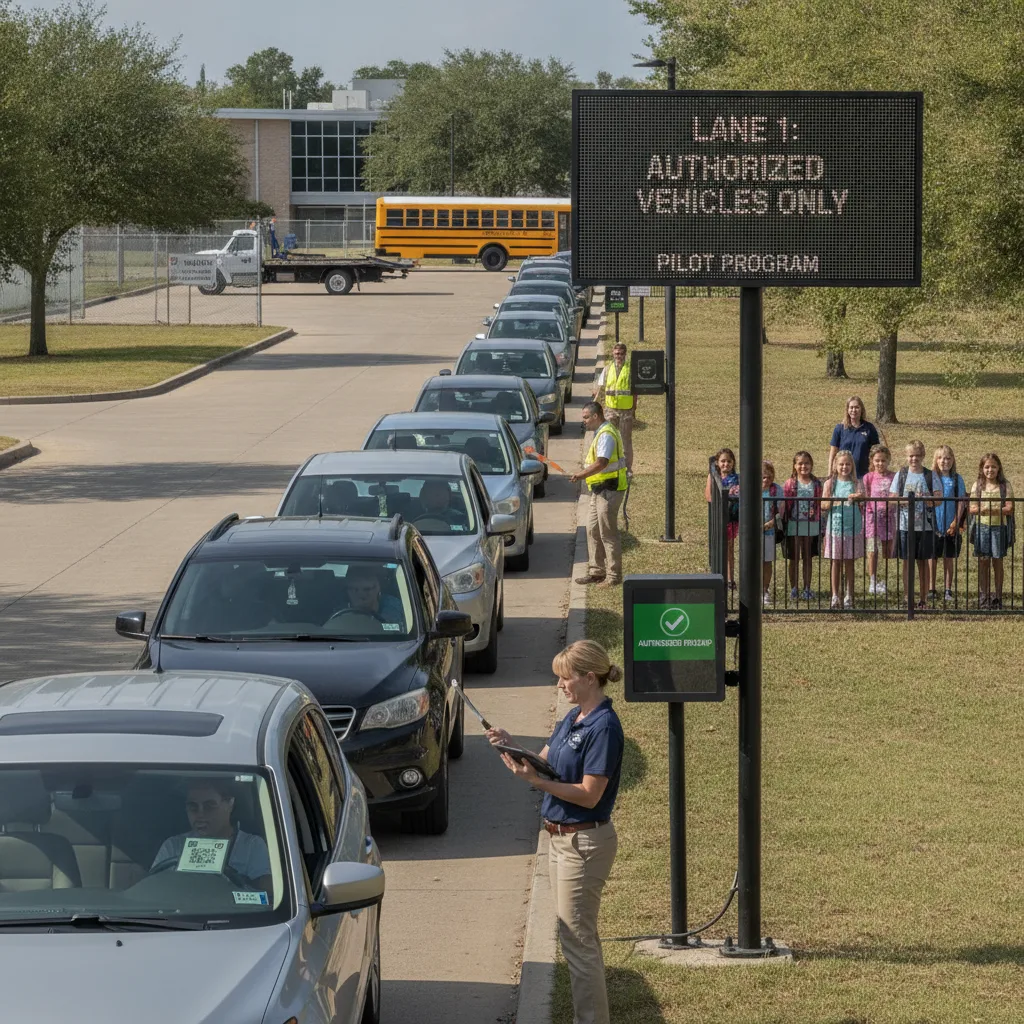
A plate-based check at the carline doesn’t replace the front office’s judgment calls at the window, but it does take one variable out of the equation: staff no longer have to rely on recognizing a car by sight, which is exactly the kind of “I know this family” shortcut that drifts differently at every campus. Matching the vehicle against the same authorized-pickup record used at every school in the district means a front office covering an unfamiliar campus gets the same information a regular staff member there would have. It pairs well with the walk-up ID process described in how custody restrictions get enforced during carline, which covers the escalation side of the same problem.
Related PLACA.AI planning resources
Common Questions
What if a family’s “regular” pickup adult isn’t on the official authorized list?
Don’t make an exception based on familiarity — get the list updated through the parent or guardian of record, and log the correction. This is the single most common source of front-office drift between campuses.
How should a front office handle a sub covering the desk?
Give the sub the same script and the same authorized-pickup access a regular staff member has — don’t assume they’ll “figure it out” by asking around the office.
What’s the fastest way to spot where our process differs from another campus?
Swap coverage for an afternoon. The questions the visiting staff member asks are your standardization gap list.
Give every front desk the same authorized-pickup record
Placa.ai’s license plate recognition checks the same authorized-pickup list at every campus, so a front office covering an unfamiliar school gets the same information a regular staff member would have. If you’re comparing desk-level process across campuses, we can help you see where it actually diverges.
Editorial refresh: July 22, 2026. Independently confirm current product capabilities, third-party features, pricing, contracts, governing requirements, and local rules before acting.
Data source: National Center for Education Statistics