

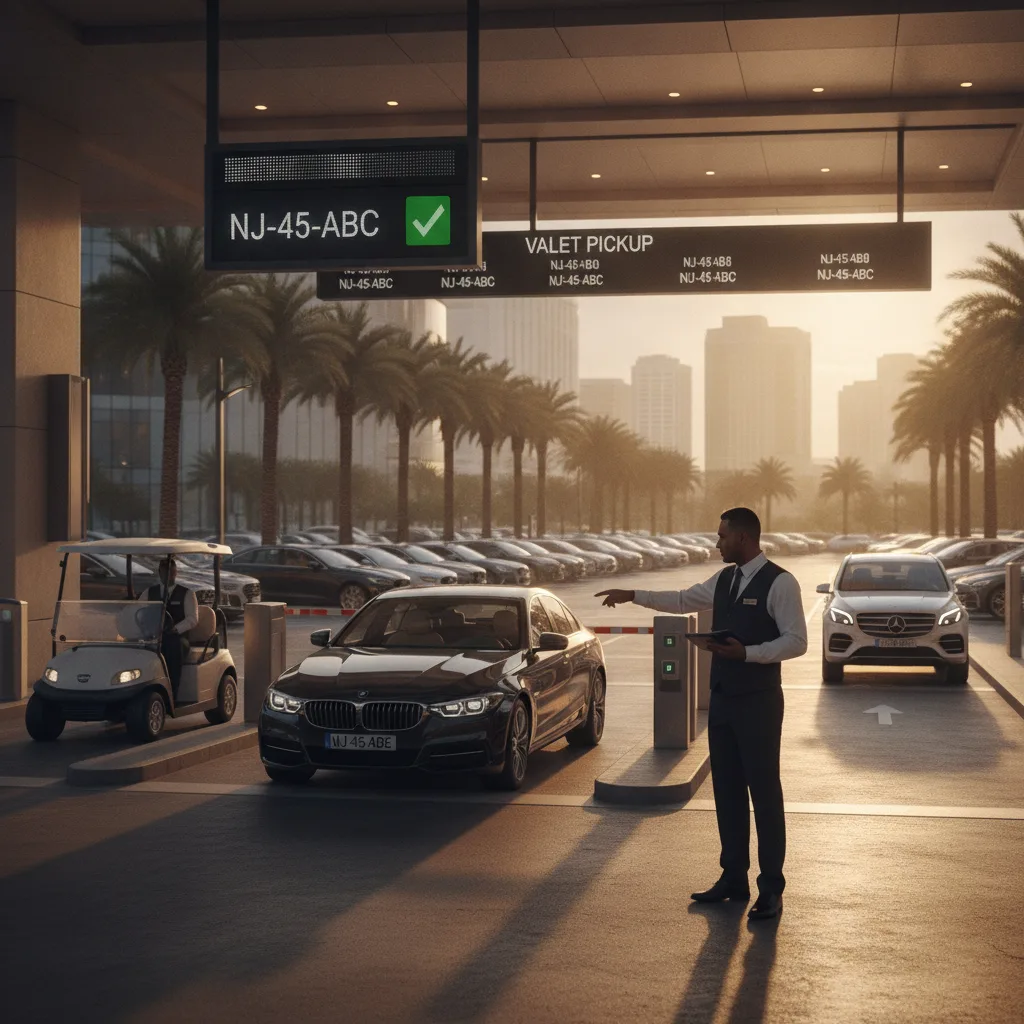
Direct answer: Casino parking runs 24/7 with multiple demand sources that spike independently — a show letting out, a restaurant turning tables, hotel checkout, and gaming floor traffic can all surge at the same time from different entrances. Ticketless vehicle recognition speeds retrieval by giving every entrance and every intake channel (valet stand, app, host request) one shared, real-time view of what’s parked where, so a request from the theater exit doesn’t sit behind a request phoned in from the players club desk just because they hit different queues.
Why casino retrieval is a multi-source problem, not a single-wave one
A stadium empties once. A casino resort never really empties — it has several independent peaks running on different clocks. An 8pm show lets out while dinner reservations are still turning over and hotel guests are checking out for late flights. Each of those creates its own retrieval surge, often through a different door, and they can overlap unpredictably. A valet operation with separate paper logs or radio channels per entrance ends up with runners doubling up on one entrance while another backs up, because nobody has a single view of total demand across the property.
The fix isn’t more staff at every entrance around the clock — it’s making sure whichever entrance a request comes through, the system already knows where that vehicle is and can route the nearest available runner, instead of only the runner assigned to that specific stand.
Where casino valet operations lose time
Requests arriving through different channels for the same guest
A guest might request their car through the valet kiosk, then also ask a passing host, then text the number on their receipt — three requests, one car. Without a shared, deduplicated queue, that turns into either a wasted duplicate dispatch or, worse, two runners converging on the same space while other requests wait. One queue that recognizes the vehicle regardless of which channel the request came through prevents both.
VIP and high-value guest handling
Casinos routinely run tiered service — players club status, high-roller hosts, comp’d parking — that changes who should get priority and who’s authorized to request a given vehicle on a guest’s behalf. That tiering has to be built into the queue logic itself, not handled as a side conversation on the radio, or it becomes a source of both delay and disputes about who cut the line.
Security and surveillance coordination
Casino garages are typically among the most heavily monitored parking facilities anywhere, and retrieval sometimes intersects with security holds — an intoxicated guest, a dispute over vehicle ownership, a request flagged for review. A system that logs who requested a vehicle, when, and through which channel gives security and valet leadership a clean record to work from instead of a she-said/he-said reconstruction after the fact.
24-hour staffing across shift changes
Retrieval speed shouldn’t dip every time a shift changes at 11pm or 7am. If vehicle location is stored in the system rather than in the outgoing shift’s head, the incoming crew can pick up mid-queue without a knowledge-transfer gap.
Building a retrieval plan for continuous, multi-source demand
- Unify intake channels into one queue. Kiosk, app, host request, and walk-up should all write to the same ordered list, deduplicated by vehicle, not by channel.
- Build known peaks into staffing, but plan for overlap. Show times, meal periods, and checkout windows are predictable individually — the plan needs to account for what happens when two land at once.
- Define priority rules for VIP requests in advance. Write down who can request a comp’d or high-roller vehicle and how that request is flagged in the queue, so runners aren’t making judgment calls on the fly.
- Give security read access to the retrieval log. A shared record of requester, timestamp, and vehicle location shortens any dispute resolution and avoids pulling a runner off retrieval to answer a security question.
- Make handoff between shifts a queue review, not a verbal briefing. The incoming shift should be able to see exactly what’s in the queue and what’s already dispatched.
What to measure
- Retrieval time by entrance and by hour — casinos rarely have one peak; track enough granularity to see where overlapping surges actually happen.
- Duplicate requests caught before double-dispatch, a direct measure of whether channels are actually unified.
- VIP request handling time separately from general queue time, since that’s the segment most likely to generate a complaint that reaches management.
FAQ
How does this handle a guest requesting through multiple channels?
Requests are matched to the vehicle, not the channel, so a kiosk request and a text request for the same car resolve into a single queue entry instead of a duplicate dispatch.
Can VIP or comp’d vehicles get priority routing?
Yes, as long as the priority rule is defined in the system rather than left to whichever runner happens to take the call — that consistency is what prevents disputes.
Does retrieval speed drop during shift changes?
It shouldn’t, if vehicle location and queue status live in a shared system rather than the outgoing shift’s memory — the incoming team can pick up mid-queue immediately.
For more on how ticketless systems support high-volume, multi-entrance properties, see the valet parking knowledge hub, the ticketless valet system overview, and valet parking software for venues.
Running valet across multiple entrances with overlapping show, dining, and hotel traffic? Book a demo and see how a unified queue would work on your floor plan.
Data source: U.S. Department of Transportation