

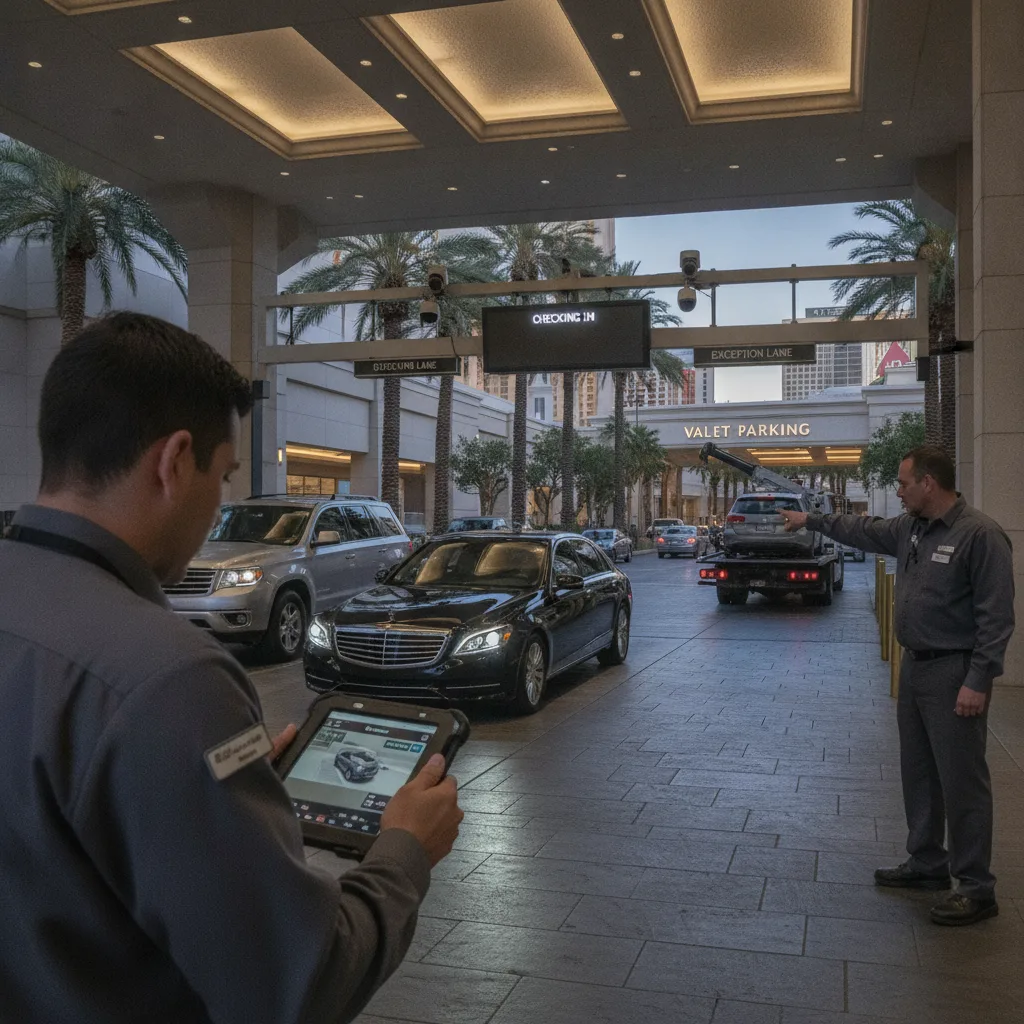
Direct answer: Casino valet and self-park lots run around the clock, handle a disproportionate share of high-value vehicles, and serve guests whose complaints carry outsized reputational weight. Condition documentation needs to happen automatically, at every hour, without relying on a night-shift attendant to remember the process at 3am — tie every arrival to a plate scan, a timestamp, and a photo set, and keep it linked to your existing surveillance and security systems rather than as a separate silo.
What makes casino parking different
A casino property parking team deals with a few things most other valet operations don’t have to plan around simultaneously: 24-hour operation with no natural lull for a documentation routine, a guest mix that includes a meaningful number of high-value and exotic vehicles where even minor cosmetic disputes get expensive fast, VIP and high-roller guests whose experience directly affects player retention and host relationships, and an existing security and surveillance infrastructure that condition documentation should plug into rather than duplicate. Add graveyard shifts that are harder to staff consistently and higher fatigue-related error rates, and you have an environment where a manual, paper-based condition process reliably breaks down exactly when you need it most — overnight, understaffed, on a high-value car.
Building a 24-hour condition documentation routine
1. Automate the capture so it doesn’t depend on shift quality
The graveyard shift is where manual documentation habits erode fastest. A system that automatically reads the plate and timestamps the arrival — independent of whether the attendant remembers to open a camera app at 4am — closes that gap. The goal is a documentation standard that doesn’t degrade based on which shift, or which specific employee, is on the podium.
2. Connect the valet record to existing surveillance
Most casino properties already run extensive camera coverage for gaming floor and perimeter security. Valet condition documentation shouldn’t operate as a disconnected system. Where possible, cross-reference arrival timestamps and plate data with existing camera footage covering the valet lanes and self-park entrances — it gives your security team a second, corroborating source when a dispute needs more than photos to resolve, and it means your surveillance team isn’t starting from scratch when valet asks for footage from a specific arrival window.
3. Flag high-value vehicles for extra scrutiny, consistently
Exotic and luxury vehicles deserve a more thorough walk-around — but that needs to be a defined trigger (vehicle type, guest tier, or both), not something left to staff judgment in the moment. Define which vehicle categories or guest tiers automatically get the expanded photo set, and make sure every shift, including the 5am shift, applies the same trigger.
4. Build a fast-response path for VIP disputes
When a high-value player or VIP guest raises a condition concern, speed and discretion matter as much as accuracy. Have a defined escalation path — who on shift can pull the record immediately, who can authorize an on-the-spot resolution within a set dollar threshold, and who needs to be looped in for anything larger. A slow or visibly disorganized response to a VIP’s concern can cost you more in player relationship terms than the actual repair.
Handling a condition dispute on the floor
- Pull the record immediately, regardless of shift or time of day. The whole point of automated capture is that a 4am arrival has the same evidence quality as a 9pm one.
- Loop in security when the vehicle or guest tier warrants it. For a high-value vehicle or a VIP host relationship, get security and, where relevant, the host or player development team aware of the situation before it escalates.
- Document the resolution, not just the complaint. Whatever the outcome — acknowledgment, repair authorization, or a documented denial — record it the same way you’d record any other operational incident, with a name, a timestamp, and a decision.
- Protect the guest relationship. A calm, well-documented process that resolves quickly reads as professionalism. A visibly confused or slow one reads as risk, and casino guests — especially repeat players — notice.
What to review monthly
Casino parking operations benefit from a monthly pattern review, the same way gaming floor operations track other metrics: how many condition disputes came in by shift, whether disputes cluster on specific shifts or specific staff, how many involved the expanded-scrutiny vehicle category, and how long resolution took from complaint to close. If graveyard shift consistently shows more disputes or slower resolution than day shift, that’s a staffing or training gap worth addressing directly rather than treating each incident as isolated.
FAQ
Does condition documentation need to be different for self-park versus valet?
Self-park has less exposure since staff aren’t handling the vehicle, but entry and exit condition capture at gate cameras still matters for disputes involving lot damage, theft claims, or fender-benders in the structure. Valet exposure is higher because staff physically drive and park the car.
How do we handle a dispute involving a vehicle owned by a comped or hosted guest?
Keep the documentation and resolution process identical regardless of guest tier — the record needs to be consistent to hold up — but the speed and discretion of the response, and who’s authorized to resolve it on the spot, can reasonably differ for VIP relationships.
Should security or valet own the condition record?
Valet operations typically own day-to-day capture since they’re the ones handling the vehicle, but the record should be accessible to security and risk management, and ideally cross-referenced with existing camera systems rather than kept in a separate silo.
See PLACA.AI’s valet parking software for venues page and the ticketless valet system overview for how automated plate-based documentation fits into a high-volume, round-the-clock operation. The valet parking knowledge hub has broader operational guidance.
Running valet or self-park at a casino property? Talk to PLACA.AI about building a 24-hour condition documentation process that holds up on every shift.
Data source: U.S. Department of Transportation