

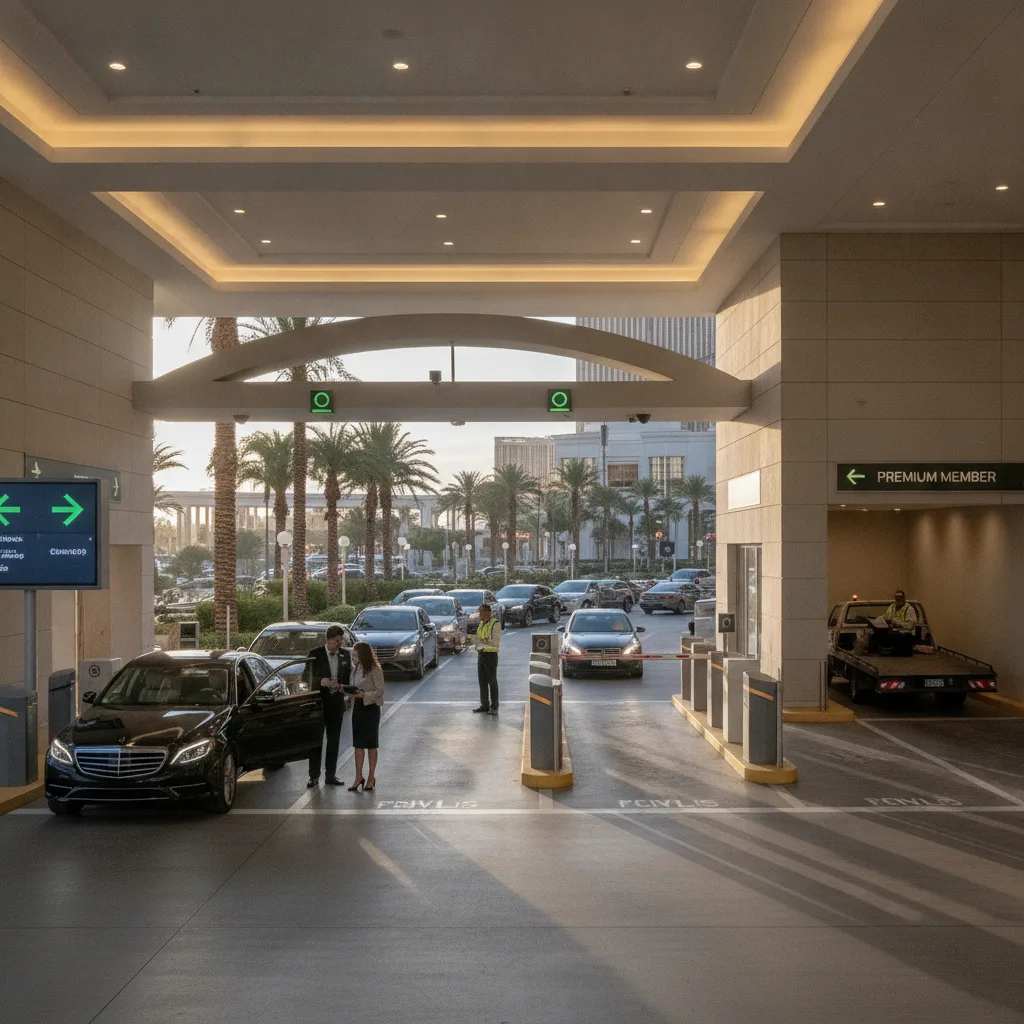
Short answer: Casino parking teams manage peak arrival surges by separating VIP and host-driven arrivals from general valet traffic, coordinating staffing across shift changes rather than around a single “rush hour,” and treating a concert, fight night, or high-roller event as a distinct surge with its own plan — layered on top of the casino’s baseline 24-hour traffic rather than replacing it.
Casino valet doesn’t have the clean daily rhythm a hotel or restaurant has. There’s no single dinner rush or checkout window — arrivals are heavy at multiple points across a 24-hour cycle, and the biggest surges are often tied to something happening on property (a concert, a fight, a poker tournament, a high-roller’s arrival) rather than a predictable time of day. That makes the planning problem different: you’re managing a continuous baseline load with occasional sharp spikes layered on top.
Separate VIP flow from general valet
Most casinos with a valet operation also run a host program — casino hosts who coordinate arrivals for top-tier players and comp guests. When a host is bringing in a VIP for a scheduled arrival, that guest usually needs a faster, more discreet handoff than the general valet queue, often at a separate entrance or with advance notice to staff. Mixing VIP arrivals into the same queue as general guests during a surge creates two problems at once: the VIP experience suffers, and general valet throughput slows down because staff are pulled aside to handle the special case.
The fix is procedural, not just staffing: hosts should notify valet of an expected VIP arrival with enough lead time that a runner can be pre-positioned, and there should be a clear rule for which entrance or lane VIP arrivals use versus general traffic.
Plan around shift changes, not just clock-time peaks
A casino valet operation runs shifts around the clock, and a shift change that lands in the middle of a surge — say, a concert letting out at 11pm right as the overnight crew is taking over from evening staff — can cause a worse backup than the surge itself would. Build the schedule so shift changes are deliberately placed in low-traffic windows, and when that’s not possible (because the event schedule doesn’t cooperate), overlap the outgoing and incoming shifts by 30–60 minutes rather than doing a hard handoff during heavy traffic.
Event-driven surges need their own plan
A concert, boxing match, or major tournament pulls a large volume of guests onto the property in a compressed window that has nothing to do with normal gaming-floor traffic. These surges are usually knowable in advance from the event calendar, which means they should get their own staffing plan rather than being absorbed into standard valet coverage.
- Forecast from the event, not history. Ticket sales or expected attendance for a specific show is a better predictor than “what a typical Saturday looks like.”
- Coordinate with self-park. When valet overflows, guests need a clear, well-signed path to self-parking rather than circling the valet lane looking for an opening — coordinate with the garage team on capacity and signage before the event, not during it.
- Loop in security early. Large simultaneous arrivals and departures are exactly when crowd flow and vehicle traffic intersect with security’s job — agree on lane control and staffing before doors open, not after the first backup.
A worked example
Consider a casino with an attached arena hosting a fight card. Doors open at 6pm for an 8pm main event, and the casino’s normal weekend valet traffic is already running through the same entrance. A workable plan separates the two: event ticket-holders are routed to a dedicated event valet lane or self-park structure with clear signage from the arena side, while the casino’s regular hotel and gaming valet continues on its normal lane, with a named coordinator watching both queues and able to shift runners between them if one backs up faster than the other.
What to check before a known surge event
- Pull the event calendar at least a week out and flag any date with expected attendance meaningfully above baseline.
- Confirm shift schedules don’t force a handoff during the expected peak window.
- Confirm the VIP/host notification process is active and staff know the separate-lane procedure.
- Confirm self-park overflow capacity and signage are ready before doors open.
- Brief security on expected volume and lane control needs.
Recording vehicles during high-volume, high-turnover shifts
Casino valet sees a lot of one-time guests alongside frequent repeat players, often across long stays and multiple entrances. Whatever method you use to record arrivals — plate, time, condition note — needs to hold up consistently across a 24-hour operation and multiple shift changes, since a gap in the record is exactly what turns a routine retrieval into a disputed one at 3am when the crew that took the car in isn’t the crew working the desk.
FAQ
How is casino valet different from hotel valet if the casino has a hotel tower attached?
The hotel side follows a more predictable check-in/checkout rhythm, but the casino floor and event calendar add spikes that don’t correlate with hotel occupancy at all — the two need to be planned somewhat separately even when they share a valet stand.
Should VIP arrivals always use a separate physical lane?
Where the property layout allows it, yes — even a designated position within the same lane, with advance notice from the host, reduces disruption to general valet flow.
How much lead time do we need for an event-driven surge?
Aim for at least a week to adjust staffing and coordinate with self-park and security; for a major event, start planning as soon as the date is confirmed.
See PLACA’s valet parking knowledge hub and valet software for venues and event-driven operations for more on planning around scheduled surges, and the ticketless vehicle recognition overview for how plate-based records hold up across shift changes.
Want to talk through staffing and lane planning for your next major event? Contact PLACA or book a demo.
Data source: U.S. Department of Transportation