

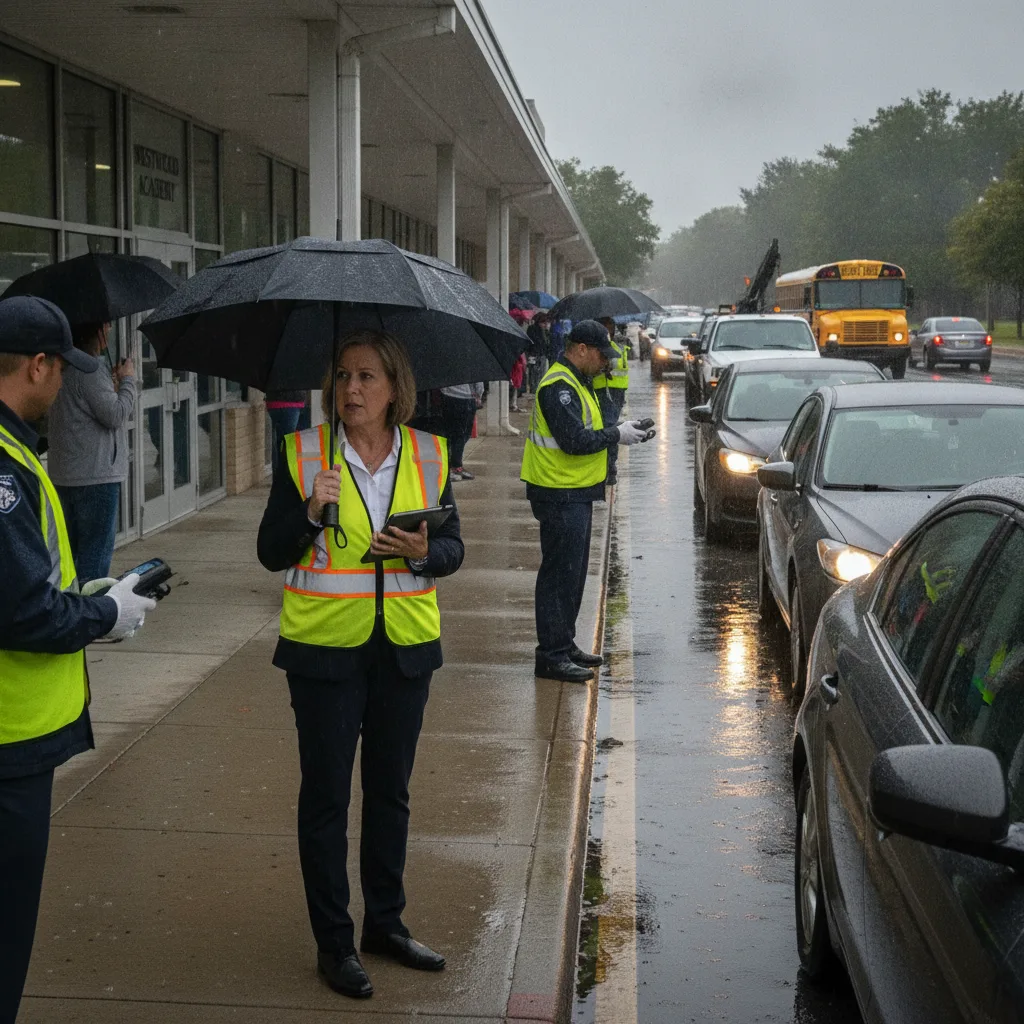
How School Transportation Directors Can Manage Rainy Day Carline Backups With Better Vehicle-Based Workflows
Direct answer: Rain doesn’t just slow the carline — it collides with your bus schedule. The fix is a rain-day sequencing plan that holds buses in a protected zone until car traffic clears the shared exit lanes, gives dispatch a trigger point for switching to the wet-weather route order, and keeps radio communication between the carline monitor and bus drivers on a single, rehearsed script instead of improvised calls.
Key Takeaways
- Rain-day delays are a sequencing problem between buses and cars, not just a carline speed problem.
- Define a trigger point for switching to wet-weather routing before the first bus is stuck behind carline traffic.
- Protect bus loading zones from car overflow with physical separation, not just a painted line.
- Track late departures, missed connections, and driver radio calls to see whether the rain plan is actually holding.
Where the Carline and the Bus Schedule Collide
On a clear afternoon, cars and buses can usually share a campus without much conflict because each has its own rhythm — buses load on a fixed schedule, cars trickle through at a variable pace. Rain breaks that rhythm. Parents who would normally walk their kids to a distant lot instead drive closer, cars idle longer waiting for kids to get buckled in under an umbrella, and the carline backs up into space that buses need to pull through or stage in. If your bus loop shares any pavement, curb cut, or exit lane with the car pickup line, a rainy afternoon is when that shared geometry becomes a real problem — a bus running two minutes behind because it’s boxed in by carline overflow turns into a missed connection at the transfer point or a late route across the rest of your run.
This is fundamentally a transportation director’s problem, not a front-office problem, because the fix usually isn’t “tell parents to hurry up.” It’s deciding, in advance, which zone gets priority when both are congested at once, and building a switch-over point that dispatch and campus staff both recognize the moment it happens.
Build the Rain Trigger Into the Route Plan
The most useful rain-day tool a transportation department can build isn’t a new lane — it’s a clear, low-ambiguity trigger for switching to wet-weather sequencing. That trigger might be a rainfall threshold, a call from campus staff, or simply “carline queue exceeds X cars.” Whatever it is, drivers and dispatch need to know it applies the same way every time, because a driver guessing whether today counts as a rain day is a driver who either switches too late or switches when it wasn’t necessary, throwing off the rest of the route.
Once the trigger fires, the plan should answer three questions immediately: which zone does the bus use to stage safely away from car traffic, what’s the revised departure order if buses are held, and how does the driver communicate a delay to dispatch without pulling attention away from loading. Campuses that keep buses and cars on physically separate approach paths handle this far more smoothly than campuses where the two share an entrance — if your site currently mixes the two, this workflow for handling bus technology failures during dismissal is a useful companion reference, since the same staging principles apply when either the bus route or the app supporting it breaks down mid-dismissal.
Decision Framework for Transportation Directors
| Question | Why it matters | Useful metric |
|---|---|---|
| What’s the rainfall or queue-length trigger for switching to wet-weather sequencing? | Removes guesswork for drivers and dispatch on a given afternoon | Minutes between rain onset and trigger activation |
| Where do buses stage if the normal loop is blocked by car overflow? | Prevents buses from idling in traffic they can’t control | Average bus dwell time on rain days vs. dry days |
| How does a driver flag a delay without leaving their post? | Keeps radio traffic short and dispatch informed in real time | Radio calls per rain-day dismissal |
| What’s the cutoff for adjusting downstream route timing? | Limits how far a single delay cascades across a run | Routes arriving more than 10 minutes late |
Coordinating With Campus Staff Without Slowing Buses Down
Front-office and carline staff are focused on getting cars through; that’s their job. But if nobody on campus is watching for the moment carline overflow starts encroaching on bus space, transportation ends up finding out about the conflict from a driver’s radio call instead of preventing it. The most reliable rain-day plans assign one campus staff member — not transportation department staff — to watch the shared zone and call the trigger the moment overflow starts, since they’re physically present and transportation dispatch usually isn’t.
That single point of contact should have a direct line to dispatch, not a general front-office number, and should know the wet-weather plan well enough to describe it in one sentence over the radio. If your carline is chronically slow even without rain, the underlying congestion will make every rain day worse for your buses regardless of how good your trigger is — this breakdown of common carline delay causes is worth reviewing with campus leadership before rainy season starts.
Measurement Plan for Rain-Day Performance
Track a small, specific set of numbers after every rain event rather than trying to measure the whole dismissal process: minutes between rain onset and trigger activation, average bus dwell time in the loading zone, number of routes departing more than ten minutes behind schedule, and radio calls related to carline conflict. Compare these against a dry-day baseline so a “bad rain day” has a number attached to it instead of just being a memory staff bring up in the next planning meeting.
Review this data after the first few rain events of the season while the plan is still fresh, then move to a seasonal review once the trigger and staging plan are stable. If dwell times or late-route counts aren’t improving, the problem is usually the trigger itself — either it’s firing too late to matter, or campus staff aren’t consistently calling it.
What to Avoid
The most common mistake is treating rain-day delays as a communication problem to solve after the fact, rather than a sequencing problem to design around in advance. A radio call telling drivers “just wait it out” isn’t a plan. The second mistake is assuming the same trigger and staging plan works at every campus — a school with a shared bus/car entrance needs a fundamentally different rain plan than one with separate loops, and applying one district-wide template to both usually protects neither well. The third mistake is not closing the loop with campus staff after a rain event to confirm whether the trigger fired on time and the staging held.
Internal Resources
Related Resources
For a deeper commercial overview, see Placa.ai’s student pickup / school dismissal solution. Technical teams may also want to review related automation workflows and compare them with supporting use cases.
Field Questions Operators Ask
What should school administrators, district operations teams, and campus safety leaders confirm before evaluating manage rainy day carline backups school pickup line automation?
They should confirm the exact rule they want to enforce, the vehicle data needed to support that rule, who reviews exceptions, and what outcome will prove the workflow is better than the current manual process.
What is the most useful first use case for student pickup / school dismissal?
A practical first use case is when a school starts with authorized pickup vehicle matching for one dismissal lane before changing the entire parent pickup process. That keeps the pilot narrow enough to train staff, check data quality, and measure whether the process actually improves.
Which questions would an operator usually ask about manage rainy day carline backups school pickup line automation?
Operators usually ask what happens when a plate is misread, how temporary vehicles are handled, whether staff can review the evidence, how long records are kept, and how the workflow prevents unfair enforcement.
What data should the team collect, and what should it avoid collecting?
Collect only the operational data needed for the workflow: plate, time, location, permit or account match, event history, and reviewer notes. Avoid collecting unrelated personal details or keeping records longer than the policy requires.
What does Placa.ai usually recommend as the safest rollout path?
Placa.ai’s opinion is that teams should start with a written policy, a limited pilot, a warning or education period, and a clear human review step before enforcement decisions become routine.
How can a team make the article’s advice unique to its own operation?
Add the real failure points staff see every week, the current workaround, one example dispute or bottleneck, the policy language used today, and the metric leadership already cares about.
What is a useful field example for this topic?
A useful example is a team comparing manual notes against plate-based event history for the same workflow. If the plate record reduces lookup time, missing evidence, or repeated manual checks, the workflow has a stronger business case.
How should exceptions be handled?
Exceptions should be documented in the same system as normal events. Temporary permits, rental cars, caregivers, vendors, emergency situations, and data entry corrections all need a review path that staff can explain later.
Which metrics prove the workflow is helping?
The best metrics are operational: fewer disputes, faster review time, fewer unauthorized vehicles, shorter queues, more complete evidence, fewer manual lookups, and fewer staff hours spent reconciling spreadsheets or paper notes.
When should a team avoid automating this workflow?
A team should wait if the policy is unclear, the vehicle data is outdated, staff do not know who owns exceptions, or leadership cannot define what success should look like after the pilot.
Plan Your School Pickup Line Automation Rollout
If your team is evaluating manage rainy day carline backups school pickup line automation, Placa.ai can help map the policy, vehicle data, and operating workflow before you roll it out.
Data source: National Center for Education Statistics