

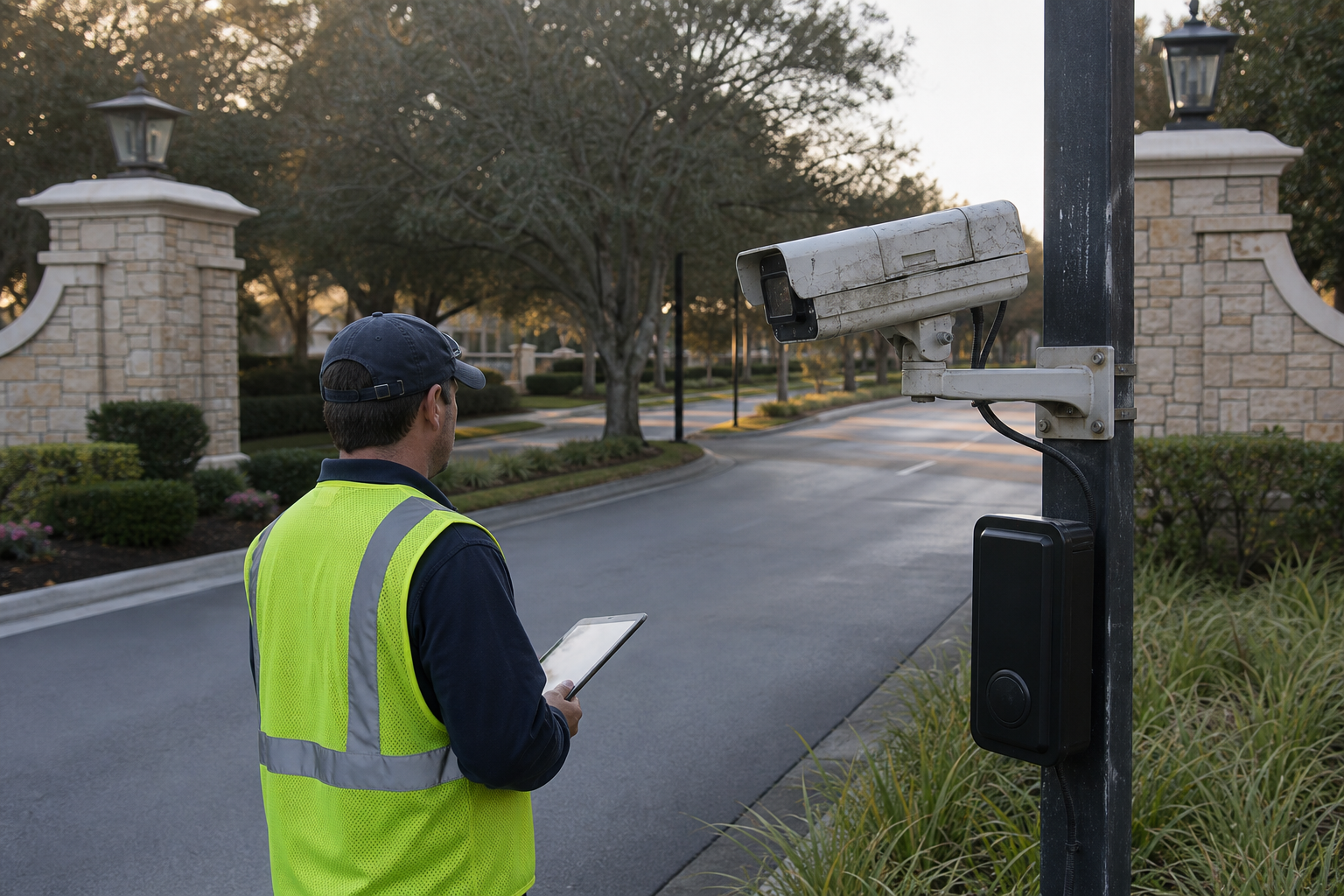
An HOA should factor camera vandalism and resident backlash into LPR due diligence, but not as a scare tactic. The practical question is whether the board can explain the purpose, protect the equipment, limit data access, and keep coverage usable if a camera is damaged or a vendor relationship changes.
Key Takeaways
- Resident backlash is a governance signal, not proof that a camera project is right or wrong.
- Before approving any ALPR system, the board should confirm whether it needs plate evidence, general security video, or both.
- Contract review should cover hardware replacement, support response, data ownership, access logs, retention, and breach notification.
- A visible, narrowly written use policy can reduce confusion more effectively than vague promises about safety.
- If the association cannot explain who uses the data and when, it is not ready to deploy.
What This Workflow Involves
This workflow gives an HOA board a structured way to evaluate camera resilience before it signs, renews, or replaces an automated license plate reader contract. The board starts by writing down the operational job: entrance records, gate access review, visitor accountability, parking enforcement support, investigation evidence, or a broader security objective.
That distinction matters because an ALPR system is not the same thing as a general surveillance-camera network. A plate reader can help identify a vehicle event at an entrance or exit, but it may not answer every question residents associate with security video, such as who approached a pool gate, who damaged a mailbox, or what happened near a clubhouse.
The board then reviews four continuity questions: how equipment is mounted, who pays if it is damaged, how quickly coverage can be restored, and whether the association can export or preserve records if it changes vendors. Those questions belong in the same due-diligence packet as price, privacy, and legal review.
Why This Problem Is Showing Up Now
Public debate around Flock Safety and automated license plate readers has intensified in July 2026. The Guardian reported on July 25, 2026 that anti-Flock actions have included damaged or obstructed cameras across multiple states, while also noting broader privacy objections to ALPR networks. Treat that as context for board planning, not a reason to encourage unlawful behavior or overstate risk.
On July 23, 2026, Axios reported that the Douglas County Sheriff’s Office in Colorado planned to move from Flock to Axon after trust concerns, including a report that one Flock camera had been left exposed online before the company detected the problem. Separately, the Los Angeles Times reported on July 14, 2026 that LAPD was renegotiating Flock terms around storage, sharing, ownership, breach notice, and safeguards.
Those are public-agency examples, not HOA case studies. Still, they raise the same diligence categories private communities should review: data control, vendor response, access boundaries, resident communication, equipment continuity, and whether the chosen tool fits the job the community actually needs done.
The Core Operational Problem
The core problem is expectation mismatch. A board may say it wants safety. Residents may hear that as a promise of general video evidence. A vendor may be selling plate reads, vehicle attributes, alerts, and searchable records. If those expectations are not aligned before installation, the camera itself becomes the symbol of a process residents never understood.
That mismatch can create two avoidable failures. First, supporters may be disappointed when plate data does not solve incidents that require broader video context. Second, opponents may assume the association is joining a wide law-enforcement surveillance network even if the board intended a narrower private-property workflow.
PLACA.AI’s Flock Safety alternatives for HOA communities resource is useful when the board is comparing vendors, but the first decision is simpler: define the evidence problem before buying the equipment.
Evidence And Source Context
A public HOA discussion observed on July 25, 2026 asked for experience with Flock adoption while the board was split between strong supporters and opponents. The useful signal was not any individual comment. It was the repeated language around due diligence, security expectations, video versus plate evidence, resident division, and vandalism concern.
Flock’s own LPR policy says customer LPR data is owned by the customer, customers choose whether to share data according to their laws and policies, low-confidence reads are not sent to the user, users should confirm translations before acting, and default retention is a rolling 30 days unless changed for a customer requirement. Those statements are helpful, but boards should still verify the actual contract, not rely only on web copy.
Fresh news sources show why this review cannot stop at a price quote. The practical board question is whether the association can document purpose, data access, retention, auditability, outage handling, damage response, resident notice, and offboarding before any camera is mounted.
A Four-Part Board Decision Framework
| Failure mode | Board question | Evidence to request |
|---|---|---|
| Wrong tool for the job | Do we need plate records, video context, gate access, or all three? | Incident examples, camera coverage map, sample event record, limitations list |
| Resident trust failure | Can we explain what is recorded, who can search it, and when it is shared? | Use policy, signage language, retention schedule, access-role matrix |
| Continuity failure | What happens if a camera is damaged, covered, offline, or removed? | Replacement terms, service-level expectations, insurance notes, fallback patrol plan |
| Vendor transition failure | Can we leave without losing needed records or hardware value? | Ownership terms, export process, renewal date, cancellation window, offboarding plan |
Checklist Before The Board Votes
- List the actual incidents the association wants to solve, using categories instead of names.
- Separate plate-only needs from general video needs.
- Map every proposed camera location and mark whether it is visible, powered, solar, LTE-dependent, or exposed to tampering.
- Ask the vendor who pays for replacement if a device is damaged and how long restoration normally takes.
- Require written retention, sharing, access, audit-log, and breach-notice terms.
- Confirm whether the association owns hardware, data, both, or neither after cancellation.
- Prepare a resident notice that explains purpose, limits, review process, and complaint handling.
- Decide who can search records and require a documented reason for each search.
- Have counsel review governing documents, state law, signage rules, and law-enforcement sharing before installation.
- Run a short pilot or board demo before committing to a long renewal cycle.
Risks, Limits, And Exceptions
Vandalism risk should not be exaggerated. Many communities operate cameras without damage, and no board should treat unlawful camera damage as normal or acceptable. The board’s job is to plan for service continuity and resident communication, not to assume every camera will be targeted.
Privacy concerns also should not be dismissed. Plate readers collect vehicle events, timestamps, and locations. Even when a vendor says the system does not use facial recognition or identify drivers, residents may still reasonably ask who can search records, how long records exist, and whether outside agencies can access them.
There are communities where a broad public-safety network may fit the board’s stated goal. There are also communities where a narrower private-property system is more appropriate because the association needs gate records, visitor review, parking workflows, and board-controlled access. The right answer depends on the job, the contract, local rules, and resident expectations.
Worked Example: Split Board, One Entrance, Two Security Goals
Consider a 180-home gated community with one entrance, a pool parking lot, and a recent series of overnight parking complaints. Half the board wants Flock because neighboring communities use it. Other residents worry the system will become a police-access network and will not help with incidents near the pool.
A better process starts by dividing the goal into two lanes. For the entrance, the board may need plate-based vehicle events tied to resident and visitor lists. For the pool area, the board may need ordinary video coverage or access-control records instead of ALPR. Combining those into one vague camera purchase would create confusion.
The board then compares vendors using the same evidence packet: entrance geometry, retention policy, data-sharing controls, replacement terms if equipment is damaged, export terms if the contract ends, and a resident-facing use policy. If PLACA.AI is evaluated, it should be considered for the private-property LPR lane, not as a substitute for every general security camera need.
Frequently Asked Questions
Should an HOA reject Flock just because cameras have been vandalized elsewhere?
No. Camera damage elsewhere is a reason to ask continuity and communication questions, not an automatic reason to reject a vendor. The board should understand replacement terms, mounting choices, resident sentiment, and fallback coverage before approving any system.
Is an ALPR camera the same as a neighborhood security camera?
No. An ALPR system is primarily designed to capture vehicle and plate events. Some communities also need general video cameras, gate access logs, lighting, signage, or patrol procedures. The board should not let one tool stand in for every security need.
What should residents be told before installation?
Residents should be told the purpose, locations, data collected, retention period, who can search records, whether records can be shared outside the association, how complaints are handled, and who approved the policy.
What contract terms matter if a camera is damaged?
The board should review replacement cost, warranty or protection-plan coverage, service response time, temporary coverage options, insurance responsibilities, and whether damage affects billing or renewal obligations.
How does this affect a PLACA.AI comparison?
Compare PLACA.AI against the same due-diligence checklist: private-property workflows, camera ownership, data access, retention controls, installation fit, support response, and what the association needs if it later changes systems.
Related PLACA Resources
- Start with the Flock Safety alternatives for HOA communities hub if the board is comparing replacement options.
- Use the HOA license plate recognition camera planning guide to evaluate entrance layout, camera placement, and private-property workflows.
- Review the PLACA.AI vs Flock Safety comparison when ownership, data control, and contract fit are central to the decision.
- Check Flock Safety pricing and ownership questions before comparing first-year cost with longer-term obligations.
Next Step
Before the board votes, gather the current quote, camera map, desired evidence types, retention expectations, sharing policy, and contract renewal date. PLACA.AI can help compare whether a private-property LPR workflow fits the association’s actual security job.
Data source: Community Associations Institute