

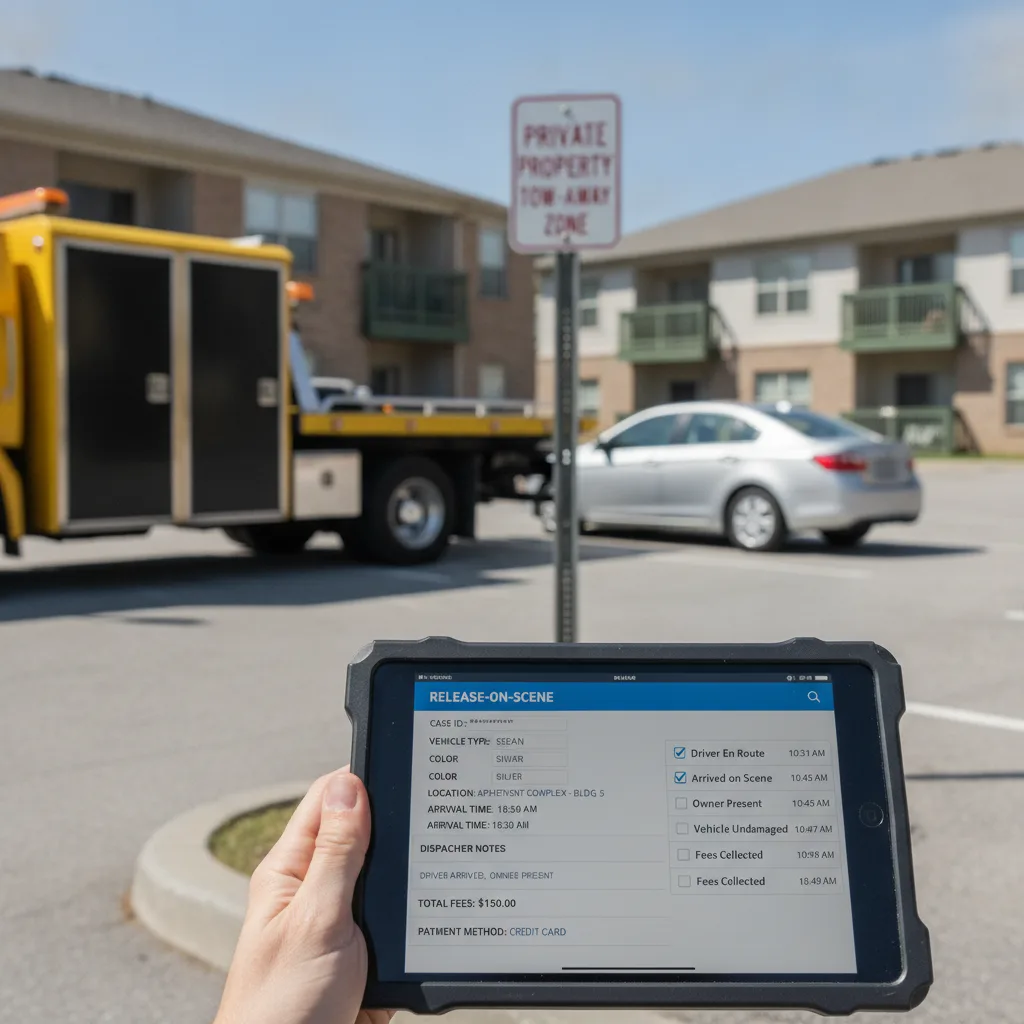
A release on scene towing workflow should create a separate record for the owner-arrival moment: document tow status, property authorization, rule evidence, fee disclosure, payment or refusal, release decision, safety notes, and final closeout before the driver leaves. Treat it as a documented branch, not a verbal side conversation.
Key Takeaways
- The release moment is operationally different from the pre-tow evidence packet and the post-tow dispute file.
- Local law controls whether a vehicle must be released, whether a drop fee is allowed, and how fees must be disclosed.
- Drivers need a simple field workflow that captures what changed after the tow started.
- Dispatch should record the final disposition: released, moved by owner, continued to storage, cancelled by property, or escalated.
- Mobile LPR and photos support the record, but legal review and company policy still control the final action.
What This Workflow Involves
This process starts when a tow has moved beyond ordinary patrol review and a vehicle owner, driver, resident, tenant, guest, or property representative arrives before the truck leaves the property. The driver pauses the normal sequence, opens a separate event note, and records the exact status of the vehicle at that moment. Was the truck only staged? Was the vehicle hooked? Was it lifted? Was it already in transit? Was the owner able and willing to move the vehicle? Those details matter because release and fee rules often turn on timing and status.
The record should then connect four pieces of context: the original violation, the property authority, the owner interaction, and the closeout decision. A useful note does not simply say owner arrived or paid drop. It shows the posted rule, lot or zone, scan or photo timestamp, property authorization source, fee disclosure, payment outcome, refusal or release reason, and whether the vehicle was left compliant afterward.
Why This Problem Is Showing Up Now
Towing transparency remains active in public policy and consumer-facing material. California SB 1112 had an Assembly Appropriations action on August 5, 2026, and current bill text addresses vehicle-owner notices, towing/storage practices, and potential civil fines. Connecticut Public Act 26-24 includes towing-rate and drop-fee language in an official 2026 public act. Public legal-help and agency pages also continue to explain drop-fee and private-property towing questions to vehicle owners.
For towing operators, the practical lesson is not that one state’s rule applies everywhere. The lesson is that weak records are harder to defend when a driver claims they arrived in time, were not told about a release option, were quoted the wrong fee, or were not allowed to correct the issue. A private lot can have a valid rule and still end up with a messy complaint if the release interaction is not documented.
The Core Operational Problem
Most tow documentation systems are built around two stages: evidence before dispatch and records after storage. The release-on-scene event sits between those stages. It is fast, emotional, and easy to under-document. A driver may be handling traffic, property-manager pressure, a frustrated owner, payment questions, and safety concerns at the same time.
That is why the workflow needs a short, repeatable branch. The goal is not to make drivers write essays in the field. The goal is to make sure the same minimum facts are captured every time: what was the tow status, who arrived, what was disclosed, what did the person do, what did the driver do, and why did the event close the way it did?
Release On Scene Towing Workflow Checklist
Use this checklist as an operations template, then have counsel adapt it to each jurisdiction and tow category.
- Open a release event: separate it from the original violation note so the timeline remains clear.
- Record vehicle status: staged, contacted, hooked, lifted, secured, moving within property, or already in transit.
- Confirm property rule: link the event to the posted restriction, permit status, visitor rule, fire lane rule, or manager authorization.
- Preserve evidence: keep the LPR event, location, time, plate record, photo set, and driver note together.
- Document arrival: record when the owner or driver appeared and whether they could lawfully and safely move the vehicle.
- Disclose the applicable process: note the release option, fee, no-fee correction, or escalation path required by local policy.
- Capture payment outcome: paid, refused, unable to pay, disputed amount, property waived, or not applicable.
- Log safety concerns: blocked lane, confrontation risk, occupied vehicle, police requested, property manager requested pause, or driver left scene.
- Close the event: released on site, owner moved vehicle, tow continued, cancelled by property, cancelled by supervisor, or escalated for review.
Where Vehicle Recognition Fits
Vehicle recognition helps most when it keeps the release event tied to the original observation. A driver should not have to reconstruct which plate was scanned, what property zone triggered the alert, or which photos were captured before the owner arrived. The system should make those facts available in one case view.
For towing teams using parking enforcement software for towing companies, the useful workflow is not automatic towing. It is automatic context. The driver sees the plate event, permit state, property rule, and images, then follows company policy for release, fee disclosure, and escalation. Teams comparing platforms can also review how a Towbook alternative for mobile LPR evidence workflows handles field evidence alongside dispatch records, or how PLACA.AI vs PatrolWorks for LPR parking enforcement differs when the core need is plate-event documentation.
Evidence And Source Context
Texas Law Help’s public towing FAQ shows why vehicle owners ask about drop fees and mid-tow release rights. Texas Department of Licensing and Regulation towing information provides official consumer-facing context for private-property towing charges. These sources should not be copied into a national operator policy; they show the type of disclosure and timing questions operators must be ready to answer locally.
Fresh policy signals point in the same direction. California SB 1112 had an August 5, 2026 action and addresses towing and storage transparency, while the current SB 1112 bill text discusses owner notices and civil fine exposure for certain practices. Connecticut’s 2026 public act on towing and storage includes drop-fee and rate-schedule language. Together, the sources support a narrow operational conclusion: release interactions deserve a clean, jurisdiction-aware record.
Risks, Limits, And Legal Review
Do not turn this checklist into a universal legal rule. Some locations may require release before removal from private property. Some may allow a drop fee only after a certain stage. Some may distinguish consensual, non-consensual, police-ordered, private-property, residential, commercial, or storage-related tows. Some property contracts may also require a supervisor or manager to approve a release.
The workflow should therefore include a jurisdiction field and a policy version field. If a driver is working across city or county lines, the app should make the local rule set obvious. If the driver is unsure, the safe operational path is escalation, not improvisation. The record should also avoid unnecessary personal data. Capture the facts needed to document the event; do not collect unrelated identity details, arguments, or private statements that do not affect the tow decision.
Worked Example: Apartment Permit Tow With Owner Arrival
A patrol driver scans a vehicle in an apartment visitor lot at 11:14 p.m. The plate is not in the overnight visitor list. The posted sign and property rule require a valid permit after 10 p.m. The driver captures the plate event, two context photos, and the zone location, then receives dispatch approval at 11:19 p.m.
At 11:23 p.m., after the truck is positioned and the vehicle is being prepared, a resident arrives and says the permit was submitted through the property portal earlier that evening. The driver opens the release event. Dispatch checks the property record and finds no active visitor permit. The driver records owner arrival time, tow status, fee disclosure according to local policy, and the resident’s claim that a permit request exists. The resident pays the permitted drop fee, moves the vehicle to an assigned resident space, and the case closes as released on site after payment, owner moved vehicle, permit not active at time of scan.
If the property later receives a complaint, the file shows more than a plate scan. It shows the rule, the status of the tow when the owner arrived, the disclosure made, the payment outcome, the correction made, and the reason the vehicle was not removed.
Frequently Asked Questions
Is a drop fee always allowed when an owner arrives?
No. Drop-fee rules are local and fact-specific. Some rules depend on whether the vehicle is hooked, whether it has left private property, whether the driver can safely move it, and what type of tow is involved. Operators should have counsel review the policy before drivers apply it.
What is the minimum record for a release-on-scene event?
At minimum, record the owner arrival time, tow status, property rule, authorization source, fee or no-fee disclosure, payment/refusal outcome, safety notes, and final disposition. The event should connect back to the original plate scan or violation record.
Should the driver keep towing if the owner disputes the fee?
The answer depends on local law and company policy. Operationally, the driver should document the dispute, avoid arguing in the field, contact dispatch or a supervisor when required, and record the reason for the final action.
Can mobile LPR decide whether to release the vehicle?
No. Mobile LPR can document the plate event, location, timestamps, and supporting images. The release decision still depends on the law, property authorization, driver safety, company policy, and any supervisor review required for that jurisdiction.
How should property managers be included?
Property managers should define the rule, authorization process, notice expectations, and escalation contact before patrol begins. During a release event, the towing team should record whether the property manager confirmed, waived, cancelled, or asked for supervisor review.
Related PLACA Resources
Start with PLACA.AI’s parking enforcement software for towing companies hub to understand the broader tow-enforcement workflow. For teams that already use dispatch tools and need stronger plate-event evidence, compare the Towbook alternative for mobile LPR evidence workflows. If digital permitting and mobile enforcement are part of the buying decision, review PLACA.AI vs PatrolWorks for LPR parking enforcement.
Next Step
Choose one property and audit the last ten owner-arrival events. If the file does not clearly show tow status, disclosure, payment outcome, and closeout reason, tighten the workflow before expanding patrol volume.