

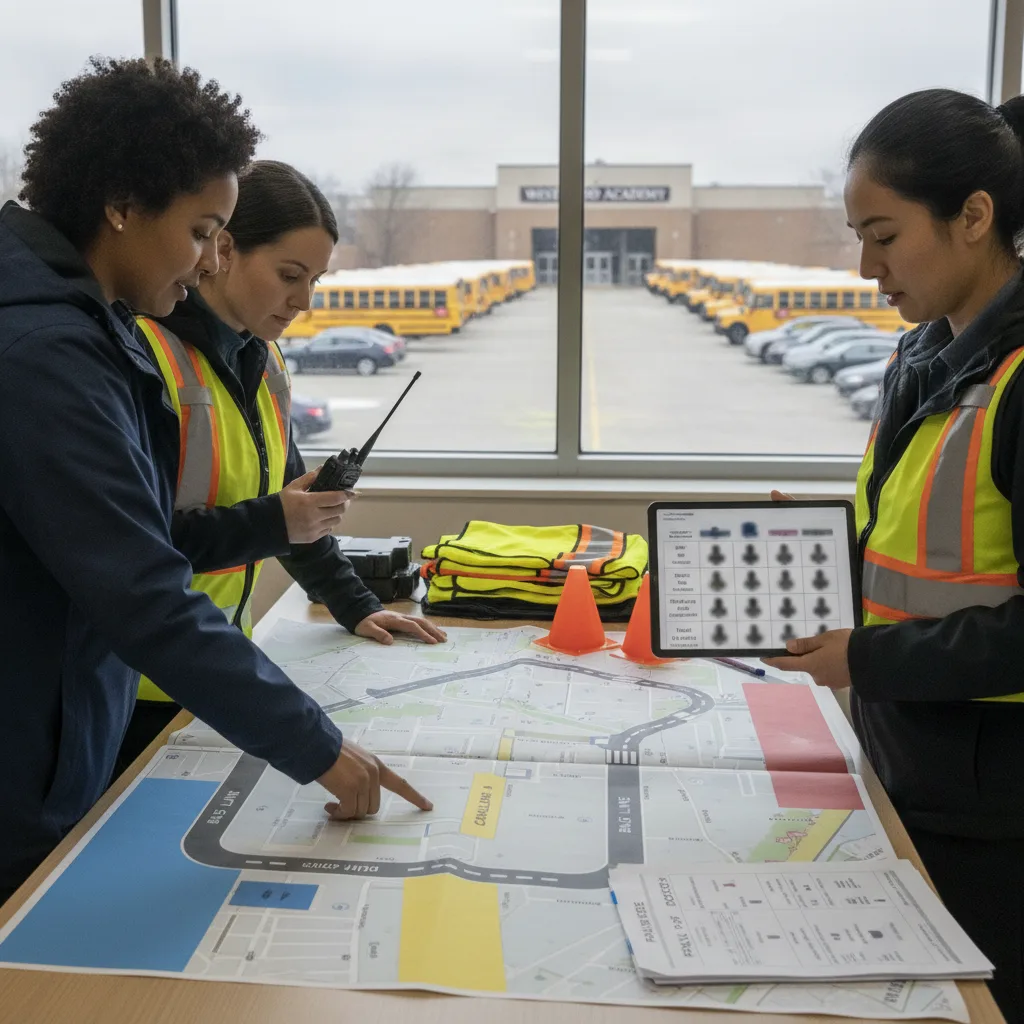
An emergency dismissal drill workflow should treat the drill as a controlled change to normal pickup: freeze the release roster, notify families, separate buses and carline, verify approved adults, document exceptions, and reconcile every student before the drill closes.
Key Takeaways
- An early-release drill is not just a bell-schedule change; it is a temporary release-control workflow.
- Schools should freeze dismissal modes before the drill so staff know who is a bus rider, car rider, walker, after-school student, or office exception.
- Family notice, common language, and calm staff behavior reduce confusion during practice events.
- Vehicle recognition can support carline context and logs, but staff still make student-release decisions.
- The drill is not complete until every release, hold, exception, and no-show is reconciled.
What This Workflow Involves
This process starts several days before the drill. The school confirms the local requirement, selects the release window, and writes the operational goal in plain language. The goal should not be to move everyone faster at any cost. The goal is to test whether the campus can change dismissal timing while preserving student release records, family communication, transportation separation, and exception handling.
The front office then prepares the current dismissal roster. That roster should show each student’s expected mode for the drill: bus, carline, walker, bike/walk group, after-school program, office pickup, or hold. Same-day changes need a cutoff time and a named owner. If changes keep arriving by phone, email, classroom note, and parent app at the same time, the drill will test inbox chaos instead of release readiness.
The campus also needs a physical map. Buses should not compete with carline staging. Walkers should not cross the loading lane without a controlled checkpoint. Office pickups should not crowd the main entrance if that is also the exception desk. Staff posts should be visible to the internal team, but the public version should avoid tactical emergency details.
Why This Problem Is Showing Up Now
School safety and traffic procedures are active public issues during the 2026 back-to-school period. The Louisiana Center for Safe Schools lists school-safety legislation with an August 1, 2026 effective-date signal, including drill-related requirements for the school year. Fort Lauderdale school-zone safety coverage on August 10, 2026 and Texas back-to-school traffic reporting from August 4, 2026 show that school arrival and dismissal windows are also under renewed traffic attention.
Official drill guidance points in the same operational direction. New York State Education Department guidance describes emergency dismissal, also called an early dismissal drill, as a yearly drill that tests early-release emergency response procedures and requires advance family notice. 2026 school safety drill guidance from NASP, NASRO, and Safe and Sound Schools emphasizes communication, developmentally appropriate practice, participant warning, feedback, and physical and psychological safety.
For school leaders, the practical lesson is narrow: a drill can be compliant on paper and still weak operationally if pickup authorization, transportation modes, adult verification, and post-drill reconciliation are not controlled.
The Core Operational Problem
Normal dismissal works because staff repeat the same sequence every day. A drill deliberately changes that sequence. The bell may move, buses may stage differently, after-school programs may need a separate hold, families may arrive early, and teachers may be focused on drill instructions instead of routine carline handoff. That is where release errors can happen.
The hardest part is exception ownership. A parent may call to change a child from bus to car pickup. A route may run late. A grandparent may arrive who is not in the usual carline record. A student may be absent from the staging area. If every staff member handles these exceptions differently, the drill produces a crowd-control exercise instead of an accountability test.
Use PLACA.AI’s school pickup line license plate recognition guide when the campus needs to keep vehicle pickup orderly during unusual release conditions. The point is not to automate away staff judgment; it is to give staff a clearer vehicle and release record while they follow the drill plan.
Emergency Dismissal Drill Workflow Checklist
| Step | Decision to make | Record to keep |
|---|---|---|
| Confirm authority | Which state, district, or campus rule controls the drill? | Policy reference and drill owner |
| Freeze modes | Which students are bus, carline, walker, after-school, office pickup, or hold? | Roster timestamp and change cutoff |
| Notify families | What will families know, and what details stay internal? | Notice date, channel, translation, and help contact |
| Separate traffic | Where do buses, cars, walkers, and office exceptions go? | Drill-day traffic map and staff posts |
| Control authorization | Who can release a student, and how are approved adults verified? | Approved adult record and exception notes |
| Route exceptions | Where do late changes, no-shows, and unclear pickups go? | Exception desk log and resolution owner |
| Reconcile closeout | Who confirms all students are released, held, absent, or escalated? | Final drill reconciliation sheet |
Where Vehicle Recognition Fits
Vehicle recognition is useful only in the part of the drill where vehicles are part of the release path. If a student is expected in carline, a plate event can help staff identify an arriving vehicle earlier and compare it with the expected pickup record. If the student is a bus rider or walker for the drill, the carline team should see that the student is not expected at the loading point.
The automated school student dismissal workflow should preserve staff control. A plate match can surface context, but it should not release a child by itself. The staff member still needs the approved adult record, any custody or authorization restrictions available to authorized personnel, and the ability to route uncertainty to an exception desk.
The practical value is audit continuity. When the schedule changes, the system should still show who arrived, which student was expected, who approved the release, what exception occurred, and how the case closed.
Evidence And Source Context
Louisiana’s school-safety legislation page is a fresh 2026 signal that school safety drill obligations are not abstract policy. Requirements vary by state and district, so the article does not treat one state’s rule as a national legal standard.
New York State Education Department’s school safety drill guidance provides useful operational context for emergency dismissal, parent/guardian notification, common response terms, and trauma-informed drill practices. A public rapid dismissal drill notice from Harrison Central School District shows why family-facing release language matters: schools ask families to keep emergency contacts current and avoid release to adults who are not listed.
The 2026 school safety and lockdown drills guidance from NASP, NASRO, and Safe and Sound Schools reinforces the need for a communications plan, feedback, and physically and psychologically safe practice. Current school-zone safety coverage, including Fort Lauderdale school-zone reporting and Texas back-to-school traffic reporting, adds context for why release procedures and traffic separation matter at the start of the school year.
Risks, Limits, And Privacy Boundaries
Do not publish or distribute sensitive response tactics in a public parent notice. Families need the time change, pickup expectations, authorized-adult reminders, transportation changes, and support contact. Staff may need more detailed internal instructions, but those belong in district-controlled plans and training channels.
Do not treat this checklist as legal advice. A school in New York, Louisiana, Texas, Florida, or any other state may have different drill schedules, notice rules, consent rules, disability accommodations, transportation obligations, and district policies. The campus should have district leadership and counsel review the operating plan before using it.
Privacy matters during reconciliation. The drill log should capture only the facts needed for accountability: student release status, expected mode, release time, staff approver, exception type, and resolution. Avoid unnecessary notes about family conflict, medical issues, custody details, or personal circumstances in general traffic logs.
Worked Example: Early Release Drill At A Busy Elementary School
A 700-student elementary school schedules an early-release drill ten minutes before normal dismissal. Three days before the drill, the office freezes default dismissal modes and sends family notice with the drill time, carline expectations, bus timing, walker process, and a reminder to update approved pickup adults before the cutoff.
On drill day, buses stage in the bus loop, car riders remain in classroom groups until vehicle pickup begins, walkers gather at a staff-controlled checkpoint, and after-school students are held in the cafeteria. The exception desk owns late calls and unclear adult approvals. Carline staff see expected vehicle pickups only; they do not search through bus or walker rosters while cars are moving.
At closeout, the drill owner compares the release log with the roster. Two students were absent, one changed from bus to office pickup before cutoff, one route ran late, and one adult was sent to the office because the approval record was unclear. The school records those four exceptions and updates the next drill plan.
Frequently Asked Questions
Is an early dismissal drill the same as a reunification drill?
No. An early dismissal drill usually tests whether the school can release students earlier than normal through controlled dismissal procedures. Reunification is a broader emergency process for returning students to approved adults after a crisis or relocation. Some records overlap, but the workflows are not the same.
Should families receive the exact drill time?
Follow state and district policy. Some drill types require advance family notice, while other details may stay internal. The safest operational rule is to communicate what families need to act responsibly without exposing sensitive response details.
What should the school do with late pickup changes?
Set a cutoff and route exceptions to one owner. If the change arrives after cutoff, staff should follow the written fallback policy instead of letting classroom teachers, carline staff, and office staff make separate decisions.
Can license plate recognition replace adult pickup verification?
No. A plate event can identify an arriving vehicle and connect it to the expected pickup workflow. It should not replace staff-controlled release approval, approved adult checks, custody restrictions, or exception review.
What proves the drill worked?
A useful drill record shows that every student ended in a known status: released to the correct mode, absent, held, transferred to after-school care, or escalated. Queue speed matters less than complete release accountability.
Related PLACA Resources
- Start with the school pickup line license plate recognition guide when carline vehicle context is the main release bottleneck.
- Use the automated school student dismissal workflow to connect rosters, staff approvals, and exceptions.
- Review school pickup line statistics and operational benchmarks before deciding whether the drill exposed a true capacity problem or a process problem.
Next Step
Before the next drill, run a tabletop review with the dismissal owner, front office, transportation lead, campus safety contact, and after-school coordinator. If they cannot identify the roster freeze time, exception desk, traffic map, and reconciliation owner, tighten those four items before practicing with students.