

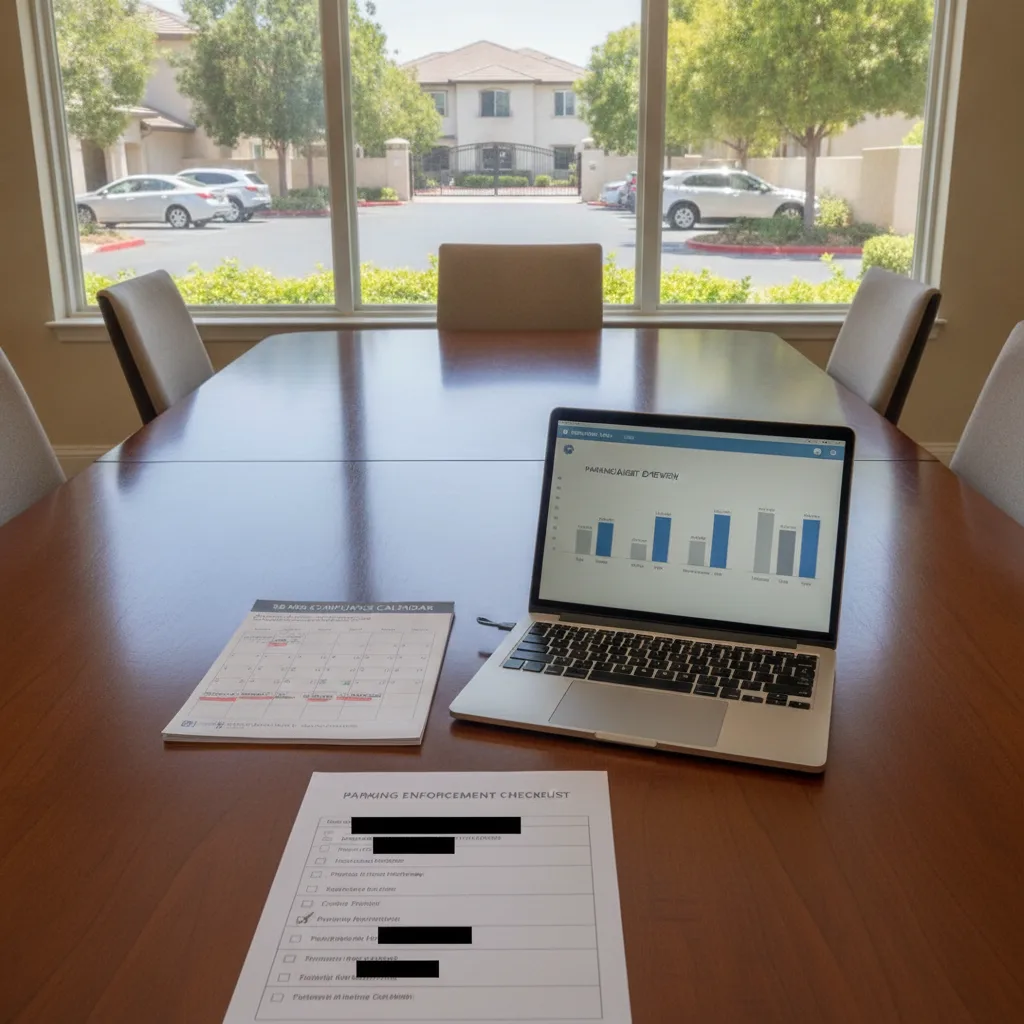
Georgia HOA parking enforcement should be reviewed before SB 406 deadlines. Boards should confirm association registration planning, governing-document authority, resident notice language, evidence retention, attorney-fee handoffs, and tow-referral rules before using LPR records or permit logs to support fines or escalation.
Key Takeaways
- SB 406 is a Georgia community-association law, not a parking technology rule, but it changes the documentation environment around fines, fees, records, complaints, and enforcement authority.
- Parking teams should separate plate evidence from legal authority: an LPR event can show vehicle activity, but counsel-approved rules decide whether a fine, fee, lien, tow referral, or collection step is available.
- Section 7 took effect on July 1, 2026 for actions filed on or after that date; most other SB 406 provisions take effect on January 1, 2027.
- A clean parking workflow should show the rule, notice, resident correction opportunity, review decision, evidence packet, escalation owner, and retention location.
- Georgia boards should use this as a readiness check before expanding automated parking enforcement or changing resident vehicle rules.
What This Workflow Involves
This workflow turns a parking violation into a documented board process. A manager or patrol team first confirms that the vehicle event maps to a written parking rule: resident-only space, guest permit limit, commercial vehicle restriction, fire lane, driveway blockage, expired registration rule, overnight rule, or another covenant-based restriction. The team then confirms whether the association has authority to enforce that rule and whether the notice path matches counsel-approved language.
The second step is evidence control. If the community uses license plate recognition, gate cameras, patrol photos, permit software, or resident registration records, the board needs to know which record is the source of truth. The evidence packet should include the plate event, location, time, rule, resident account or unit link when applicable, image-quality note, exception review, notice sent, correction deadline, and final decision.
The third step is escalation discipline. Not every parking issue should become a fine, attorney-fee claim, lien, or tow referral. SB 406 makes that distinction more important because Georgia associations now face additional attention on registration, records, notices, complaint rights, and collection practices. Parking enforcement should be consistent, but consistency does not mean automatic escalation.
Why This Problem Is Showing Up Now
Kiplinger reported on August 12, 2026 that Georgia has adopted SB 406, the Georgia Property Owners’ Bill of Rights Act, with annual registration requirements and new limits around enforcement powers for qualifying associations. The public question is clear for boards outside the legal department: if an HOA cannot prove its compliance posture, what happens to ordinary rule enforcement such as parking fines?
The signed bill text is the primary source. The official Georgia SB 406 PDF says the act is known as the Georgia Property Owners’ Bill of Rights Act and adds a new owners’ association registration chapter. The bill text also states that an association or its agent generally may not collect fines or fees, file or record liens, or initiate foreclosure proceedings unless the association is registered under the new section, with nonregistered associations facing separate limits.
The timing matters. The bill’s effective-date section states that most of the act becomes effective on January 1, 2027, while Section 7 becomes effective on July 1, 2026 for actions filed on or after that date. For parking enforcement, that means boards should not wait until the end of 2026 to clean up notices, attorney-fee handoffs, and records.
The Core Operational Problem
The core problem is not whether an HOA may ever enforce parking rules. The problem is whether each parking action can be traced from rule to notice to evidence to escalation without a gap. A plate read that shows a vehicle in a guest space at 2:00 a.m. may be useful. It does not, by itself, prove that the resident received the right notice, that the governing documents authorize the consequence, or that the association’s registration and collection posture is current.
That distinction matters most when a routine parking issue becomes expensive. A warning letter is one level of risk. A fine is higher. Attorney-fee recovery, lien activity, foreclosure, booting, or a private-property tow can create a more serious resident dispute. Even when a board believes the vehicle violated the rule, a weak process can make the enforcement action harder to defend.
Use the HOA license plate recognition camera planning guide for the technology and governance layer, but keep the legal authority review separate. PLACA.AI can help organize plate events, permits, resident records, and audit trails. It should not be treated as the source of legal authority for a Georgia association.
Evidence And Source Context
The fresh evidence is Kiplinger’s August 12, 2026 coverage of Georgia’s HOA registration law. It frames the public question around HOA oversight, fines, liens, foreclosure, registration, and whether similar reforms could appear elsewhere. That article is a current news hook, not the legal authority.
The primary authority is the official signed SB 406 text from Georgia. The bill creates the Georgia Property Owners’ Bill of Rights Act, defines owners’ association terms, creates registration requirements, references records relating to assessments, fines, fees, liens, and foreclosures, and sets phased effective dates. A Georgia attorney should decide how each section applies to a specific community.
HunterMaclean’s community association analysis of SB 406 is useful because it translates the law into operational deadlines: fees and collections effective July 1, 2026, mandatory registration effective January 1, 2027, foreclosure notice changes, foreclosure threshold changes, records, complaint processes, and policy preparation. LegiScan’s public SB 406 bill page was used only to cross-check the bill identity and public summary.
Georgia HOA Parking Enforcement Checklist
| Checkpoint | Board question | Record to keep |
|---|---|---|
| Association status | Is the association registered or preparing to register under the applicable SB 406 timeline? | Registration owner, calendar date, counsel note |
| Rule authority | Which covenant, rule, policy, lease exhibit, or board resolution authorizes this parking action? | Rule citation, approval date, resident-facing copy |
| Vehicle record | How is the plate tied to a unit, resident, guest, permit, vendor, or unknown vehicle? | Resident registration record, permit record, exception note |
| Evidence quality | Does the LPR or patrol record clearly show the vehicle, location, time, and rule context? | Plate event, photo, location, confidence or review note |
| Notice path | What warning, cure period, or hearing right applies before a fine or fee escalates? | Notice template, delivery method, deadline |
| Attorney-fee handoff | Has counsel approved the required itemization and timing before any fee recovery step? | Itemized fee packet, date sent, reviewer |
| Tow referral | Is this a safety/access issue, repeated documented violation, or rule-change confusion that needs review first? | Tow authorization, property manager approval, evidence packet |
| Retention | Where are parking fines, fees, notices, images, and appeal records retained? | Records location, retention owner, export policy |
How To Separate Warnings, Fines, And Tow Referrals
Start with a warning or correction path when the issue is registration-based or rule-change-based. Examples include a resident who has not updated a plate, a guest permit entered with a typo, or a newly announced overnight rule that has not been fully acknowledged. A warning record should still be formal enough to show date, vehicle, rule, and next step.
Use fines only when the governing documents, state law, notice process, and board policy support that consequence. The fine packet should show the rule, violation evidence, prior warning if required, notice delivery, response window, reviewer, and final decision. If the vehicle evidence comes from LPR, add an image-quality or human-review note so the resident can see that a plate read was not blindly accepted.
Tow referrals need a tighter standard because they change the resident’s immediate access to the vehicle. A blocked fire lane, accessible route, emergency access point, gate, or driveway may require faster action than a permit typo. For general towing-law context, use PLACA’s state-by-state HOA towing rule overview, but Georgia boards should still ask counsel how SB 406, governing documents, local ordinances, and tow statutes interact.
Resident Vehicle Records And LPR Audit Trails
Resident vehicle data should be accurate enough to support fair enforcement and limited enough to avoid unnecessary privacy exposure. The board should define who can add a plate, remove a plate, change a guest permit, override a match, issue a notice, and approve escalation. Those roles should be visible in an audit trail.
The resident vehicle registration and access workflows page is relevant because many parking disputes start with stale resident data, not deliberate misconduct. A household may change cars, receive a temporary plate, borrow a caregiver vehicle, or enter a guest plate incorrectly. If the correction path is easy and documented, fewer cases need to become fines.
Apartment and mixed-use operators face similar operational issues even when they are not Georgia HOAs. The apartment license plate recognition workflows page can help teams map resident, guest, vendor, and enforcement records, but property type and legal authority still need separate review.
Risks, Limits, And Legal Review
This article is not legal advice. Georgia SB 406 is complex, and its effect can vary by association type, governing documents, registration choice, POA Act status, condominium status, apartment ownership model, public versus private street control, local towing ordinances, and counsel’s interpretation. A named editor should verify every legal statement before publication.
Do not use automation to make enforcement look stronger than it is. A dashboard can create a clean record, but the board still needs a valid rule, fair notice, a documented correction path, and human review for exceptions. The stronger the consequence, the more careful the review should be.
Also avoid promising that PLACA.AI prevents disputes. Better records reduce uncertainty, but residents can still challenge the rule, the notice, the association’s authority, the quality of the plate read, the tow decision, or the fairness of how the rule was applied.
Worked Example: Guest Permit Dispute In A Georgia HOA
A Georgia HOA uses plate-based guest permits for a small visitor lot. A resident’s adult child parks overnight three weekends in a row. The system shows the plate in the guest lot after the allowed window, and the manager prepares a fine notice.
Before issuing the fine, the manager checks the rule citation, confirms the association’s SB 406 readiness owner, reviews whether the resident received the current guest-parking policy, and compares the plate to the resident’s account. The reviewer finds that the family entered the vehicle as a temporary caregiver vehicle but never completed the updated permit step. The first notice becomes a correction notice with a clear deadline, not an immediate escalation.
Two weeks later, the same plate appears again after the deadline. This time the packet includes the rule, prior correction notice, plate events, human review note, and resident response history. The board can decide the next step with a cleaner record. If the matter later moves to counsel, attorney-fee and collection requirements are handled through the approved legal process instead of an ad hoc email chain.
Frequently Asked Questions
Does SB 406 ban Georgia HOAs from enforcing parking rules?
No. The practical issue is not a blanket ban. Boards need to understand how registration, notice, records, complaint rights, attorney-fee provisions, and governing documents affect each enforcement step.
Can an LPR record support a Georgia HOA parking fine?
It can support the factual record if the image, time, location, rule, and vehicle account are clear. It should be paired with the governing-document authority, notice record, and human review required for the consequence.
Should Georgia HOAs pause all parking fines until 2027?
Not necessarily. Boards should ask counsel which current actions are affected now, especially actions filed on or after July 1, 2026, and which procedures must be ready before January 1, 2027.
What should managers review before sending a tow referral?
Review the rule, property authority, resident notice history, safety or access risk, local tow rules, photo evidence, plate match, property-manager approval, and whether the issue is a correctable registration problem.
How long should parking evidence be retained?
SB 406 includes records-retention concepts for association records, and the exact application should be reviewed by counsel. Operationally, boards should know where parking notices, fines, images, appeals, and payment records are stored and who can export them.
Related PLACA Resources
- Use the HOA license plate recognition camera planning guide when mapping plate reads, privacy controls, and board approval.
- Review resident vehicle registration and access workflows before escalating a stale-plate or guest-permit issue.
- Compare property workflows with apartment license plate recognition workflows when a community has renters, vendors, and shared guest parking.
- Use the state-by-state HOA towing rule overview only as broad context before asking Georgia counsel about a specific tow policy.
Next Step
Before the next parking fine batch, build a Georgia SB 406 enforcement packet for one real parking scenario: rule citation, resident record, plate evidence, notice template, correction window, review owner, escalation rule, attorney-fee handoff, and retention location. If any field is blank, hold escalation until the board has a documented answer.