

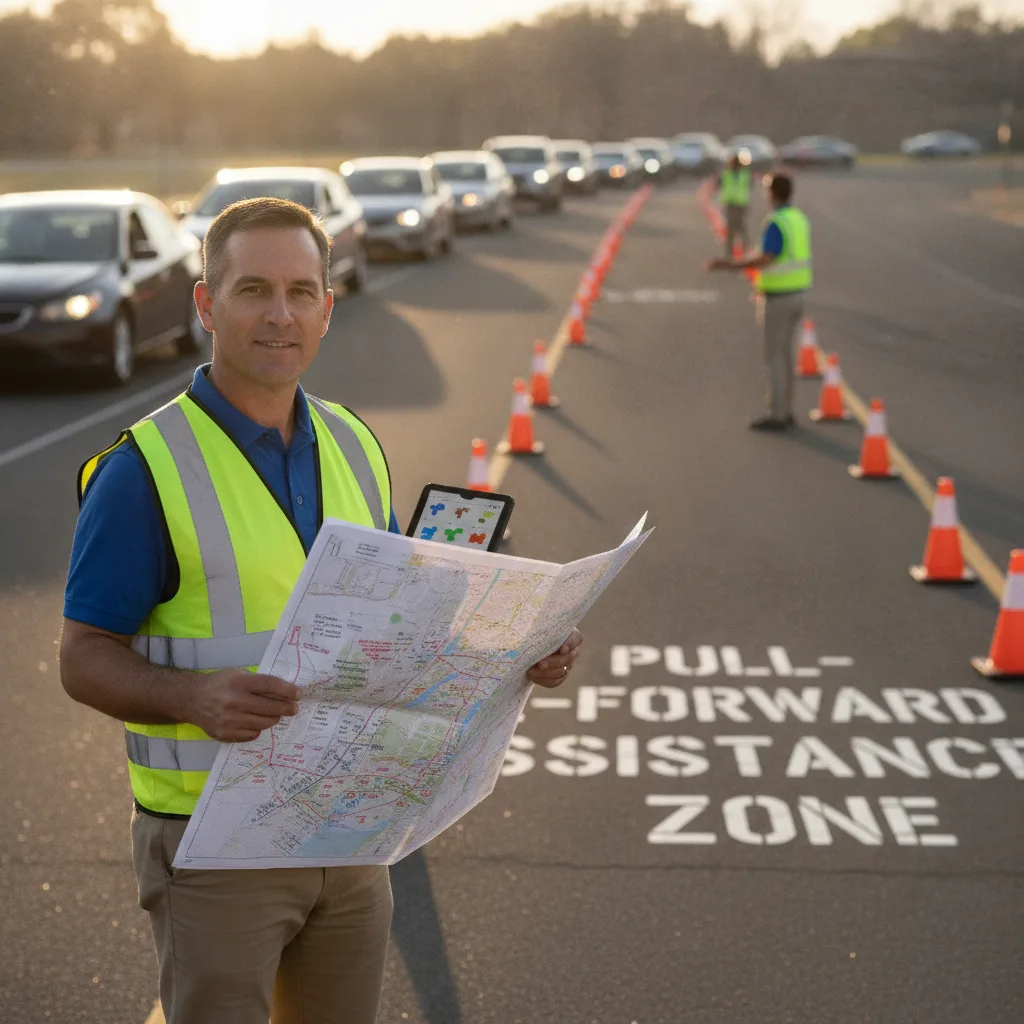
For pre-K and kindergarten dismissal, a car seat pickup line workflow gives families a safe exception path before the lane starts moving. If a child cannot buckle independently, route that student to walk-up release, a marked pull-forward assistance area, or a delayed pickup window instead of blocking the active lane or moving with an unsecured child.
Key Takeaways
- The problem is not one slow parent. It is an undefined exception that repeats whenever young students, car seats, heat, staff fatigue, and a live loading lane collide.
- Parents should not be pressured to change a child’s restraint setup for lane convenience. Schools should design the lane around safe loading options.
- Current public discussions show the same question from both sides: families want to follow restraint rules, and staff need the line to keep moving.
- The cleanest workflow is to identify buckling-help students in advance, separate the assistance point from the live lane, and give staff one script to use every time.
- Vehicle recognition can help by confirming the approved pickup vehicle earlier, so the exception route is ready before the car reaches the loading zone.
What This Workflow Involves
This process is a dismissal exception design for younger students who cannot quickly get into a vehicle and secure their own restraint. It starts before the first week of school, when families tell the office whether a child needs help buckling, unbuckling, loading from a five-point harness, or walking from a separate pickup gate.
The school then assigns one of three release paths. Some families use the normal carline because the child can load and buckle without adult help. Some use a park-and-walk or walker gate because the guardian needs time outside the vehicle. Others use a marked pull-forward area where the child is released to the approved vehicle first, then the driver moves out of the active loading stack before assisting.
The important part is consistency. Teachers, office staff, security, and families should not negotiate this in the middle of the lane. If the student profile says buckling assistance is needed, staff know the release path before the car arrives.
Why This Problem Is Showing Up Now
Back-to-school pickup has restarted across the country, and parent forums are again full of questions about carline rules, pre-K pickup, kindergarten independence, and whether a school can ask a family to move before a child is fully restrained. In a public Reddit discussion observed on August 21, 2026, a parent described being told to move from the pickup lane before securing a younger child in a car seat. Teachers in the thread pushed back from the operations side: a 45-second stop can multiply quickly when hundreds of cars are waiting.
A second public kindergarten discussion from August 2026 used the same language: parents were unsure whether to use the car line, walk-up release, or a pull-forward point when a child could not manage a five-point harness alone. Those sources are not factual authority, but they are useful signals because they show the exact uncertainty schools need to remove.
The safety context is current, too. KUNC reported on August 20, 2026 that Colorado transportation officials were using the new school year to remind families about child passenger safety and free car-seat inspections. The practical school question is what to do during dismissal when safe restraint use and lane flow both matter.
The Core Operational Problem
The core conflict is that the live pickup lane is built for repeated short stops, while car-seat assistance often requires a longer controlled stop. If the parent gets out in the loading zone, the lane stalls and staff may have adults walking around moving vehicles. If the parent is told to move first, the family may feel pushed toward a restraint decision they are not comfortable making. If every staff member gives a different instruction, trust erodes fast.
That is why this is an operations policy issue, not just etiquette. Schools need to define where a child who needs help will be released, who confirms the guardian, who watches the child while the vehicle pulls forward, whether the parent may park and walk up, and how the plan changes when rain, heat, construction, or a substitute dismissal team is involved.
The safest answer is usually separation. Keep the live lane for students who can load quickly. Move assistance to a place where a driver can stop without blocking the stack. Keep pedestrians out of traffic lanes. Give parents the rule in writing before the first dismissal week.
Car Seat Pickup Line Workflow
| Step | School action | Record to keep |
|---|---|---|
| 1. Identify | Ask families during registration or first-week updates whether the student needs help with a harness, booster, door, or seat belt. | Dismissal profile note |
| 2. Assign route | Choose normal carline, walk-up release, pull-forward assistance, or late-window pickup based on the lot design and student need. | Assigned release path |
| 3. Verify vehicle | Match the arriving car, plate, car tag, or pickup credential to the approved pickup record before the student is sent to the loading point. | Approved vehicle or guardian check |
| 4. Load safely | Have staff release the student only when the vehicle is stopped in the correct zone and the child can enter from the safe side. | Staff role and zone map |
| 5. Assist outside the stack | If help is needed, direct the driver to the marked assistance area or use walk-up release rather than holding the main lane. | Exception timestamp or note |
| 6. Review | Track repeated delays, confusing handoffs, heat exposure, and unsafe pedestrian crossings during the first two weeks. | Safety-log item and fix owner |
Design The Assistance Zone Before You Need It
A good assistance zone is not just a spare curb. It needs to let the driver leave the active loading stack, stop legally, get out on the safe side if necessary, and rejoin traffic without reversing through students. Cones, signs, and staff scripts matter because parents should not have to guess whether they are allowed to stop there.
BuckleUpNC’s school travel guidance says children should remain properly restrained until the vehicle is stopped and staff indicate it is safe to exit, and that schools may need accommodations such as a separate pickup location or designated pull-over area for children who need help. That is the policy concept schools can adapt to their own campus layout.
Public school procedures show the same idea in practice. Greenhill’s 2026-2027 carpool instructions tell families to remain in the car while students load and to pull forward beyond a building corner before helping with a seatbelt or car seat. St. Joseph’s pickup procedure routes children in car seats to the far side of the car line near cones so assistance does not block every car behind them.
Parent Notice Template
Use plain language and send it before the first full dismissal week:
If your child needs help buckling a car seat, harness, or seat belt, please tell the office so we can assign the correct pickup route. Students who need buckling help should use the walk-up release area or the marked pull-forward assistance zone. Staff will not ask families to stop in the active loading lane for extended buckling help, and families should not move onto public roads until children are properly restrained.
Then add campus-specific details: map, grade levels, times, accessible parking, rain plan, late pickup window, and who to contact if a child’s needs change.
How Vehicle Recognition Helps Without Replacing Staff Judgment
A school pickup system should not decide whether a child is safely buckled. That remains a family and staff safety matter. Where vehicle recognition helps is earlier in the sequence: identifying that an approved pickup vehicle has arrived and showing staff the student’s assigned release path before the vehicle reaches the loading zone.
For example, if a recognized vehicle is tied to a kindergarten student marked “needs buckling assistance,” the dismissal screen can route that student to the pull-forward zone instead of the main loading stack. If the arriving vehicle is not approved, staff can hold the release and follow the school’s normal exception process. That is why the school pickup line license plate recognition guide and the automated school student dismissal workflow should be evaluated around staff-controlled release, not speed alone.
Risks, Limits, And Exceptions
This article is not legal advice, and child-restraint rules vary by state. Schools should review the final policy with district leadership, counsel, transportation staff, and local traffic partners when needed. The goal is to avoid improvisation, not to create a universal rule for every campus.
Some schools have no extra lot space. Some cannot allow walk-up release because of surrounding roads. Some have students with disabilities, guardians with mobility limits, or family vehicles that require extra loading time. Those cases should be handled as planned accommodations, not as exceptions negotiated at the curb while cars are moving.
Do not solve the problem by telling parents to graduate a child to a simpler restraint before the child is ready. The safer operational fix is to change the release route, arrival order, or assistance zone.
Worked Example: First Week Of Kindergarten
A 600-student elementary school has 90 kindergarten car riders. During the first two dismissal days, staff notice that ten families need more than the normal loading time because children are still learning their harnesses. The line backs into the neighborhood, teachers begin giving different instructions, and parents start asking whether they should park, pull forward, or stay in line.
The principal pauses the improvisation. The office sends a same-day form asking which students need buckling help. The dismissal coordinator creates a temporary pull-forward zone in a staff-supervised curb area and a walk-up option for families who prefer to buckle in a parked vehicle. Staff mark those students in the dismissal roster. On day three, those cars are identified before they reach the loading zone and routed consistently.
The line still takes patience, but the conflict is removed. Families know where to go, staff no longer argue at the curb, and the school has a record of which exception path each student used. The first-week school pickup safety log becomes the place to record whether the zone needs a permanent map change.
Frequently Asked Questions
Should parents be allowed to get out in the live pickup lane?
Usually no. Getting out in the active loading lane can delay the stack and put adults near moving vehicles. A safer policy is to provide a marked assistance area, park-and-walk route, or delayed pickup option for children who need help.
Can schools ask families to pull forward before buckling?
Schools can design a pull-forward assistance point, but the instruction should be written, mapped, and reviewed against local rules. Families should not be left to decide on the fly whether a child can move while unsecured.
What if the school has no parking or pull-forward space?
Use timing and routing instead: separate pre-K pickup from older grades, release younger students through a supervised walk-up gate, create a late-window pickup after the main stack clears, or coordinate with local traffic staff for a temporary first-week pattern.
How should the office collect this information?
Add one dismissal-profile question: Does this student need adult help with a car seat, harness, booster, seat belt, door, or mobility support? Then assign a release path and review it during the first two weeks.
Does LPR make the pickup lane safe by itself?
No. LPR can help staff know which approved vehicle has arrived and which route the student should use. It does not replace staff supervision, campus traffic design, family restraint decisions, or legal review.
Related PLACA Resources
- Start with the school pickup line license plate recognition guide when evaluating how vehicle arrival data supports dismissal decisions.
- Use the automated school student dismissal workflow when mapping staff-controlled release, approved pickup records, and exception handling.
- Use the first-week school pickup safety log to track whether car-seat assistance, walk-up release, or pull-forward zones need adjustment.
Next Step
Before the next dismissal cycle, list every student who needs loading or buckling help, assign each one a release path, and give staff one written script. If the current lane cannot handle those students safely, change the route before the first full week makes the conflict routine.