

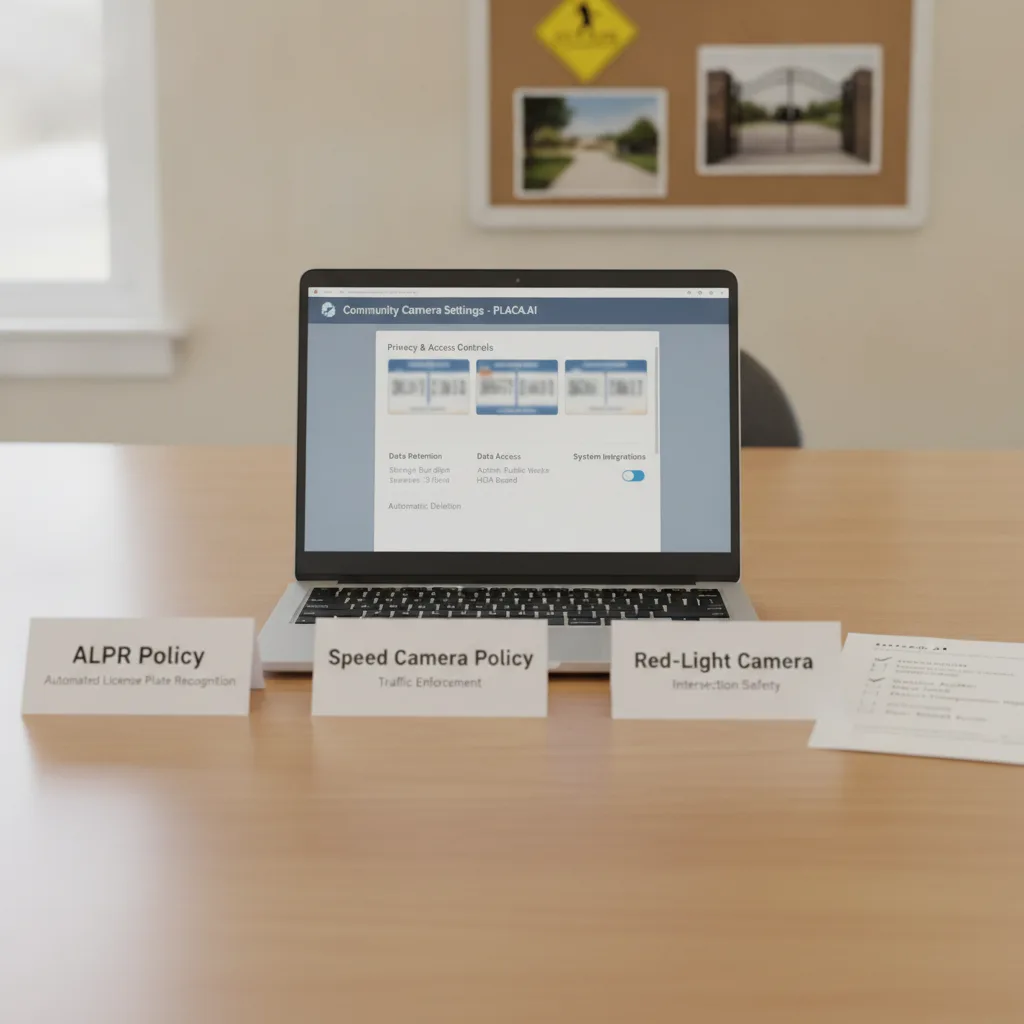
When residents ask whether roadside or parking cameras are recording every vehicle, an ALPR vs speed cameras checklist keeps the answer precise. Separate what triggers capture, whether a searchable record is created, who can access it, how long data is retained, and whether the device can issue a traffic or parking citation.
Key Takeaways
- License plate readers and automated speed or red-light cameras can look similar from the road, but they usually serve different jobs.
- ALPR systems generally create searchable vehicle records for access control, parking, security, or investigations; traffic enforcement cameras are usually violation-triggered.
- Fresh Connecticut reporting on August 23, 2026 and an August 20 Greenwich clarification show why operators need plain resident-facing language before cameras go live.
- The safest answer is not “this is harmless” or “this is surveillance.” It is a documented table covering capture, purpose, signage, retention, access, audit logs, and appeals.
- Private-property teams should avoid borrowing public traffic-enforcement language unless their own workflow, contract, and retention settings actually match it.
What This Workflow Involves
This workflow is a camera-type explanation packet for people who have to answer resident, parent, driver, or board questions in public. It is useful when a device on a pole, trailer, gate, school entrance, parking lot, or private road raises a basic concern: is this reading every plate, only recording violations, issuing tickets, feeding a police network, or doing something narrower for a private property?
The packet should be short enough for a board meeting and specific enough for counsel, procurement, and operations. It starts with the camera’s purpose, then moves through trigger logic, records created, access roles, sharing, retention, signage, exceptions, and appeal paths. The goal is to prevent a vague answer from becoming a trust problem.
For PLACA audiences, the issue is practical. A school dismissal camera, HOA entrance camera, valet arrival tool, parking payment enforcement camera, municipal speed device, and police ALPR network can all involve a license plate image. That does not make them the same product, risk, or policy obligation.
Why This Problem Is Showing Up Now
Connecticut has become a useful current example because municipalities are rolling out state-approved speed and red-light systems while communities debate automated license plate readers. CT Insider reported on August 23, 2026 that license plate readers and speed or red-light cameras function differently, serve different purposes, and are subject to different legal frameworks.
The same week, Greenwich Time reported on August 20, 2026 that Greenwich officials publicly clarified that town school-zone speed cameras were not Flock cameras, while also noting that police use separate Rekor-operated license plate readers. That kind of clarification is exactly what private-property operators should prepare before rumors fill the gap.
The official traffic-enforcement side is also public. The Connecticut Department of Transportation describes ATESD cameras as devices for capturing images of drivers committing traffic violations such as speeding or running red lights. CTDOT’s program overview says municipalities must prepare a plan, adopt an ordinance, hold a public hearing, and receive CTDOT approval before use.
Public discussion is moving quickly outside official pages, too. A public Broward Reddit discussion observed on August 24, 2026 used ALPR protest language and asked, in effect, why communities would accept broad camera networks. Axios Fort Lauderdale also reported on August 24, 2026 that a local subreddit photo of a transit fixture sparked debate about whether the object was a camera. Those posts are useful as language signals only; they are not proof of what any particular device does.
The Core Operational Problem
The core problem is category confusion. People often use “camera” as one word for several different workflows. A violation-triggered speed camera may document a vehicle only after a speed threshold is met. A red-light camera may document an alleged intersection violation. A private-property LPR camera may match a plate to a resident, visitor, permit, parent pickup account, valet ticket, or enforcement queue. A police ALPR network may create searchable investigative records.
If the operator does not explain the category, residents will fill in the blanks from headlines, social posts, or past experiences with unrelated systems. A parent may hear “license plate camera” and think of police surveillance. A resident may hear “speed camera” and assume fines. A parking customer may hear “plate recognition” and worry about being billed after paying. A board member may hear “not a red-light camera” and overstate the privacy difference.
The fix is not a softer slogan. The fix is a record of operational facts that can survive questions: when the camera activates, what record is created, what action can follow, who has access, how searches are logged, how long records remain, what notice is posted, and how a person disputes an error.
ALPR vs Speed Cameras Checklist
| Question to answer | ALPR or LPR workflow | Speed or red-light workflow | Record to keep |
|---|---|---|---|
| What triggers capture? | Often every vehicle passing a defined camera view, or every vehicle entering a private workflow. | Usually an alleged violation, such as speeding above a threshold or entering on red. | Vendor trigger description and configuration screenshot. |
| What is the purpose? | Access control, school dismissal, resident matching, permit enforcement, security, towing evidence, or investigation support. | Traffic safety enforcement and violation documentation. | Board or municipal purpose statement. |
| Can it issue a citation? | Not by itself. It may feed a review queue, gate action, permit check, tow workflow, or police lead. | Yes, if the jurisdiction authorizes the program and a violation review process supports it. | Policy, ordinance, contract, or enforcement SOP. |
| Who can search records? | Depends on customer roles, vendor support, police sharing, manager access, or private-property rules. | Usually limited to the violation-review and fine-enforcement process. | User roster, sharing list, audit-log export. |
| How long is data retained? | Varies by system, contract, account setting, and law. Connecticut’s 2026 ALPR law is one current public-sector example with a 21-day default. | Often tied to fine collection, hearing resolution, and statutory retention rules. | Retention table and deletion proof. |
| What public notice is needed? | At minimum, notice should say the camera reads plates, why, who controls data, and how to ask questions. | Traffic-enforcement programs often require signs, public awareness, plans, hearings, and approvals. | Signage photo, resident FAQ, meeting minutes. |
How To Explain The Difference Without Overpromising
Start with the trigger. Say whether the system records every vehicle in a defined lane, records only vehicles tied to a configured rule, or records only an alleged traffic violation. That first sentence prevents most confusion. It also keeps the operator from making a privacy claim that the settings do not support.
Then separate purpose from possibility. An HOA may buy a camera for entrance security, but if the vendor account allows broader police sharing, the resident FAQ should not imply that the data is only used inside the community. A school may use LPR for dismissal matching, but the policy should say whether the data is connected to student records, how exceptions are handled, and who can inspect the log. A parking operator may use plate data for payment matching, but it should explain grace periods and appeals before issuing notices.
Finally, use precise negative statements. “This camera is not a red-light camera” is helpful but incomplete. Better: “This entrance camera does not issue traffic tickets; it creates a vehicle event for resident access and security review; records are retained for the period listed in the policy; searches are limited to named roles.” The words are less dramatic, but they are easier to verify.
Policy Language For Each PLACA Audience
Schools should connect camera language to the school pickup line license plate recognition workflow. The public question is usually not whether the school is issuing traffic tickets. It is whether the plate match is used only to queue an authorized pickup, how unregistered vehicles are handled, and whether dismissal records are retained in a way the district can explain.
HOAs and apartments should connect the explanation to the HOA license plate recognition camera planning guide. Residents need to know whether the system is for access control, parking rules, package-theft investigation, public-road monitoring, police sharing, or some combination. If the board is considering a networked vendor, the Flock Safety alternatives for HOA communities guide is the more relevant buyer route.
Parking operators should avoid calling payment enforcement a speed or red-light workflow. A pay-by-plate system should explain payment records, plate entry errors, zone matching, grace periods, manual review, and notice timing. A private-lot citation process is not automatically the same legal process as a municipal traffic-enforcement ticket.
Buyers comparing vendors can use the license plate recognition comparison hub to separate camera hardware, OCR software, dashboards, integrations, retention, and sharing models. The category label matters less than the workflow facts that can be verified before launch.
Risks, Limits, And Exceptions
This article is not legal advice. Traffic enforcement, ALPR, towing, parking, school privacy, and HOA authority rules vary by state, city, contract, property type, and use case. Connecticut is a current example because it has fresh public debate and official traffic-camera materials, not because its rules apply everywhere.
Do not imply that violation-triggered cameras are always low risk. A red-light or speed program still needs authority, notice, data handling, due process, vendor controls, and an appeals process. Do not imply that every LPR system is a police surveillance network either. A private-property LPR workflow can be narrow if the operator limits purpose, access, retention, and sharing in writing.
Also watch for mixed systems. A trailer, pole, gate, or dashboard may support more than one function. The operator should explain the active configuration, not the broadest feature list on a vendor website. If a camera can do more than the current policy allows, the policy should say what is disabled and who can turn it on.
Worked Example: School-Zone Camera Rumor At An HOA Gate
A master-planned community installs a pole-mounted camera near the entrance after a series of gate strikes and unauthorized overnight parking complaints. A resident sees a separate city announcement about school-zone speed cameras and asks whether the HOA camera will ticket every car or feed a police database.
The manager does not answer with a generic “no.” Instead, the board posts a one-page camera explanation. It says the HOA device reads plates only at the entrance lane, does not measure speed, does not issue red-light or speed citations, does not decide towing without human review, is used for resident and incident lookup, and is retained under the community’s written policy. The page also names who can search the system and how residents can ask for correction or deletion where allowed.
That answer does not make every resident comfortable. It does something more useful: it gives residents a falsifiable operating record. If the board later changes sharing, retention, citation review, or vendor features, the change must be documented instead of quietly assumed.
Frequently Asked Questions
Are license plate readers the same as speed cameras?
No. A speed camera is usually tied to detecting and documenting an alleged speed violation. A license plate reader usually reads plate data for matching, access, parking, security, or investigation workflows. Some products can combine features, so always verify the exact configuration.
Does an ALPR camera issue red-light or speeding tickets?
Not by itself. An ALPR record may support an investigation, parking review, access decision, or enforcement queue. Traffic citations require a separate legal and operational process that depends on the jurisdiction and program.
What should a resident notice say first?
It should say what the camera does in plain language: whether it reads plates, whether capture is event-triggered or all-vehicle, why data is collected, who controls it, who can access it, how long it is retained, and how questions or errors are handled.
Can a camera look like one thing and do another?
Yes. Roadside equipment can be confusing from the driver’s seat, and some products support multiple functions. Operators should disclose the active function and keep proof of disabled features, active settings, signage, and data flows.
Should private-property operators copy city speed-camera policy language?
Only if the workflow actually matches. A school, HOA, valet, parking, or towing system may involve plate data without being a municipal traffic-enforcement program. Use language that matches the operator’s authority, purpose, access, retention, and appeal process.
What is the first buyer question before choosing a vendor?
Ask for a written data-flow and trigger diagram: what starts capture, what record is created, where it is stored, who can search it, what is shared, when it is deleted, and what happens when a record is wrong.
Related PLACA Resources
- Use the license plate recognition comparison hub to compare capture methods, software workflows, privacy controls, and deployment models.
- Review the plain-English guide to how license plate recognition works when explaining OCR, matching, and post-capture actions.
- Use the Flock Safety alternatives for HOA communities guide when the question is network participation, vendor replacement, data sharing, or renewal risk.
- Start with the school pickup line license plate recognition workflow when the camera’s job is parent-vehicle matching rather than traffic enforcement.
- Use the HOA license plate recognition camera planning guide when a board needs resident-facing purpose, signage, retention, and access language.
Next Step
Before installing or defending any camera, write the first resident-facing sentence in a testable way: “This device is used for [purpose], it captures [trigger], it creates [record], it can be accessed by [roles], it is retained for [period], and it cannot [unsupported claim].” If the team cannot fill every bracket, the camera policy is not ready.